


























Views
Downloads
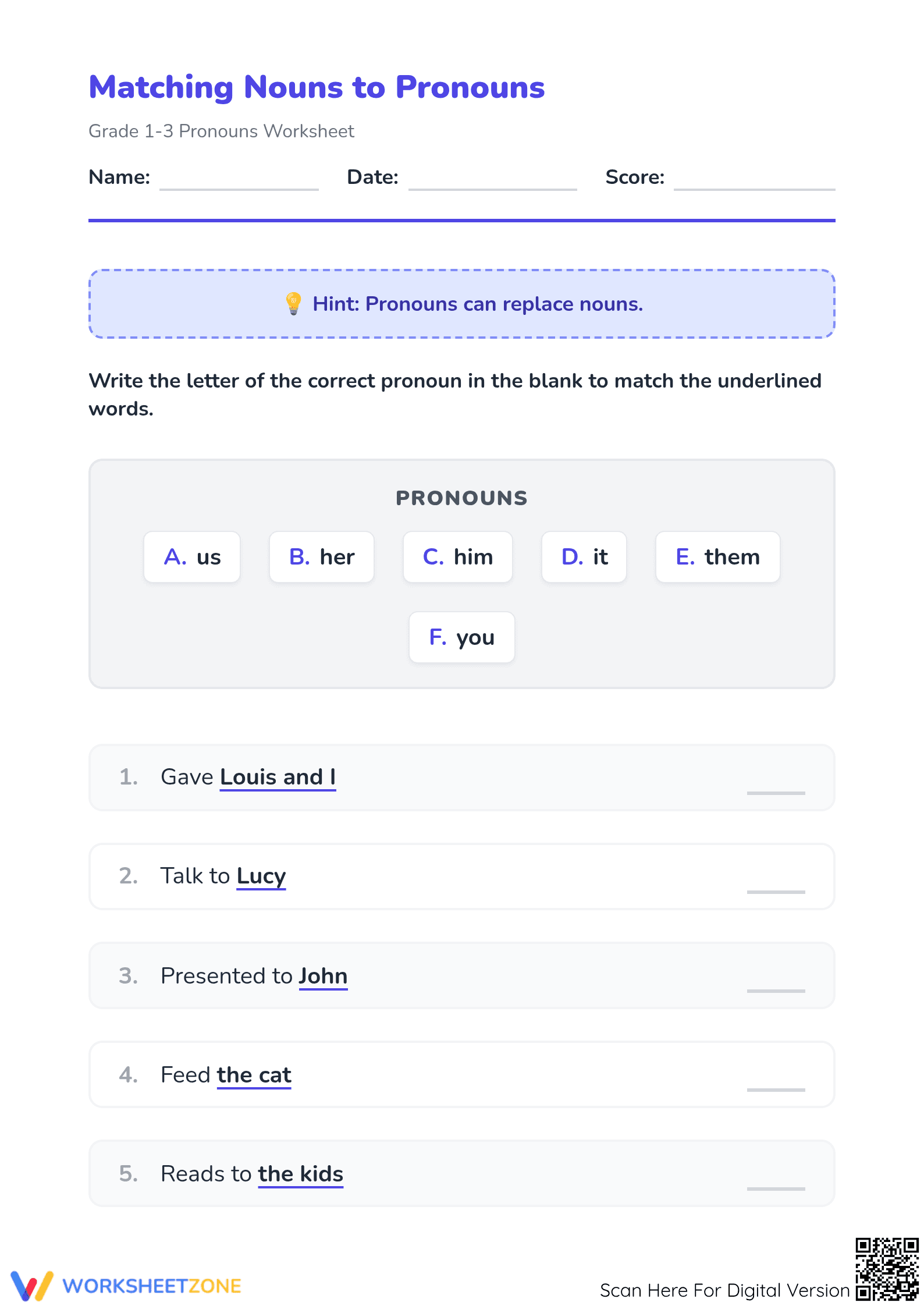
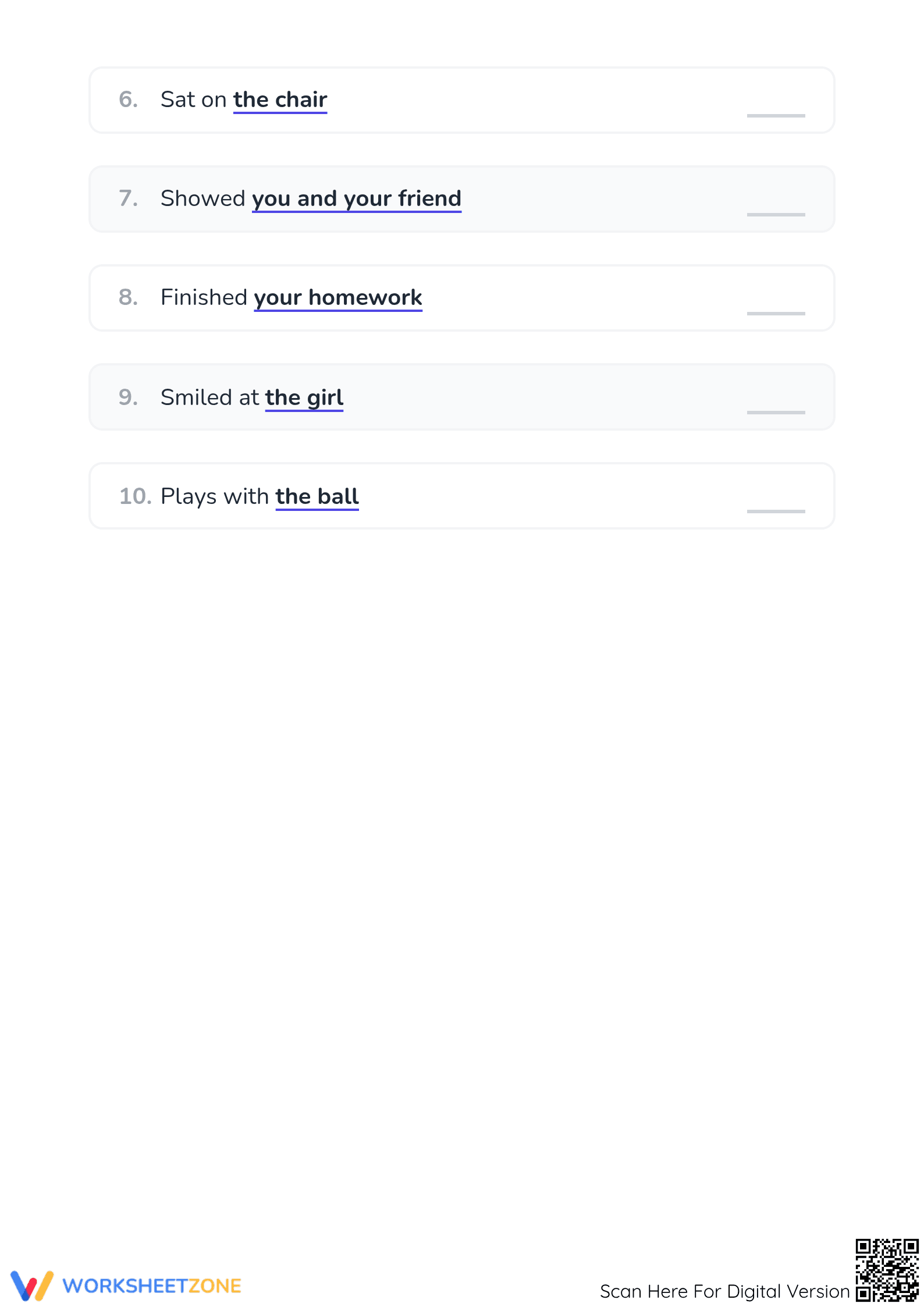

Grade 1-3 Nouns to Pronouns — Printable No-Prep Worksheet
Paste this activity's link or code into your existing LMS (Google Classroom, Canvas, Teams, Schoology, Moodle, etc.).
Students can open and work on the activity right away, with no student login required.
You'll still be able to track student progress and results from your teacher account.
This ready-to-use worksheet helps early elementary students master pronoun substitution by matching specific nouns to their correct object pronouns. By practicing with clear, relatable phrases, students build foundational grammar skills and improve sentence fluency, ensuring they can replace nouns accurately in their own writing.
At a Glance
- Grade: 1-3 · Subject: ELA
- Standard:
CCSS.ELA-LITERACY.L.1.1.D— Use personal, possessive, and indefinite pronouns- Skill Focus: Matching nouns to pronouns
- Format: 2 pages · 10 problems · Answer key included · PDF
- Best For: Independent practice and review
- Time: 10–15 minutes
Inside this resource, educators will find a straightforward, two-page activity featuring ten targeted matching problems. Students are provided with a clear word bank containing six object pronouns (us, her, him, it, them, you). They must read short phrases with underlined nouns, such as "Louis and I" or "the cat," and write the corresponding letter of the correct pronoun in the blank. A complete two-page answer key is included to make grading fast and accurate.
Zero-Prep Workflow
This worksheet is designed for maximum efficiency, requiring under two minutes of total teacher prep time. Follow these simple steps:
- Print (1 minute): Download the PDF and print the two-page student activity. The clean layout ensures low ink usage.
- Distribute (30 seconds): Hand out the worksheets during your grammar block. The built-in hint and word bank make it self-explanatory.
- Review (30 seconds): Use the provided answer key to quickly check student responses or display it for self-correction.
Because it requires no additional materials or complex teacher setup, this resource is highly suitable for emergency sub plans or independent literacy centers.
Standards Alignment
This activity is directly aligned to CCSS.ELA-LITERACY.L.1.1.D, which requires students to use personal, possessive, and indefinite pronouns. By explicitly asking learners to identify which pronoun correctly replaces a specific noun phrase, the worksheet reinforces the grammatical function of pronouns. Both standard codes can be copied directly into lesson plans, IEP goals, or district curriculum mapping tools.
How to Use It
Use it as independent practice immediately following direct instruction on object pronouns, or assign it as morning work to review previously taught concepts. As a formative assessment observation tip, watch if students struggle with compound subjects like "Louis and I" versus plural nouns like "the kids" to see if they need a quick reteach. Expected completion time is 10 to 15 minutes.
Who It's For
This worksheet is primarily designed for first through third-grade students developing foundational grammar skills. It is especially helpful for English Language Learners who benefit from the visual support of a word bank. Pair this activity with a classroom anchor chart detailing subject and object pronouns for optimal student success.
Mastering pronoun substitution is a critical step in early literacy development, directly supporting reading comprehension and writing fluency. Aligned with CCSS.ELA-LITERACY.L.1.1.D, this resource helps students use personal, possessive, and indefinite pronouns accurately. According to Fisher & Frey (2014), providing students with structured, targeted practice on specific grammatical functions significantly improves their ability to transfer these skills into independent writing. When learners can confidently match nouns to their corresponding pronouns, they reduce repetition in their writing and better understand sentence cohesion when reading complex texts. By isolating this skill in a focused, ten-problem format, educators can efficiently build and assess grammatical competence. This targeted approach ensures that foundational language mechanics are solidified, paving the way for more advanced sentence construction and reading comprehension strategies in later elementary grades.


