


























Views
Downloads

Essential Parts of a Plant Worksheet | Grade 2-3 Ready
Paste this activity's link or code into your existing LMS (Google Classroom, Canvas, Teams, Schoology, Moodle, etc.).
Students can open and work on the activity right away, with no student login required.
You'll still be able to track student progress and results from your teacher account.
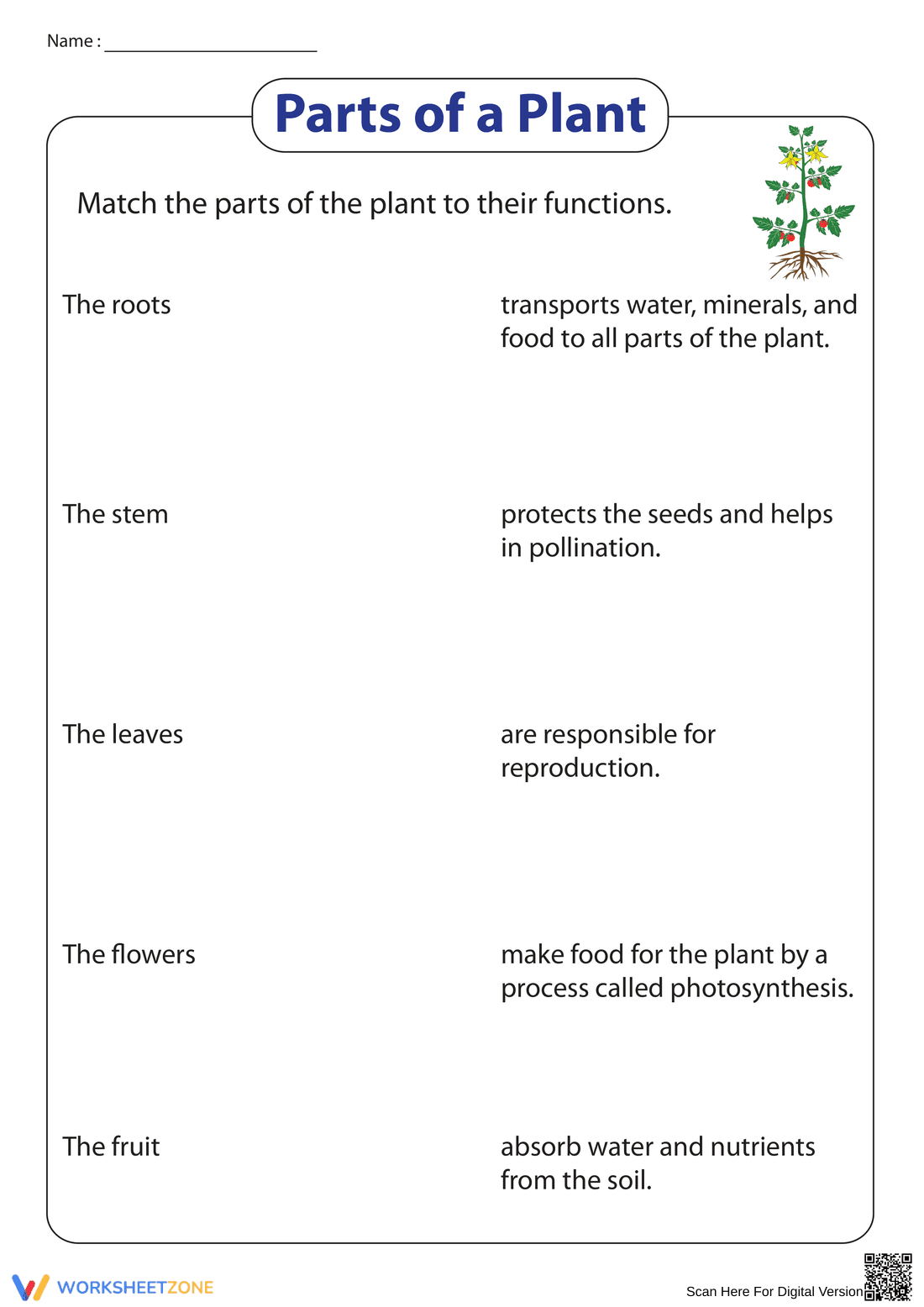
Help students master the fundamental structures of botany with this matching worksheet. This activity requires learners to connect specific plant parts—roots, stems, leaves, flowers, and fruits—to their critical biological roles. By identifying how structures support growth and survival, students build a strong foundation for future life science mastery and environmental awareness.
At a Glance
- Grade: 2–3 · Subject: Living Things
- Standard:
3-LS1-1— Identify and describe how plant structures support growth, survival, and reproduction.- Skill Focus: Plant anatomy and biological functions
- Format: 2 pages · 5 problems · Answer key included · PDF
- Best For: Independent practice or quick science check
- Time: 10–15 minutes
This resource features a clean, high-contrast layout designed for maximum readability in the elementary classroom. It consists of one primary student worksheet and a corresponding full-color answer key. Students engage with five distinct matching tasks that pair anatomical terms like "roots" and "leaves" with descriptive functions such as photosynthesis and water transport. The inclusion of a clear botanical diagram helps visual learners anchor the abstract concepts to physical structures.
Zero-Prep Workflow
- Print: Generate class sets in under 1 minute with the high-contrast black-and-white design.
- Distribute: Students can begin immediately as the instructions are self-explanatory and require no prior lecture.
- Review: Use the included answer key for 30-second grading or project it for immediate student self-correction.
Total teacher preparation time is estimated at under 2 minutes, making this an ideal sub plan or a fast-finisher activity that maintains high instructional standards.
Standards Alignment
Aligned to NGSS `3-LS1-1`, this worksheet focuses on the observable structures of organisms and how they facilitate growth and survival. By matching parts to functions, students demonstrate their understanding of how internal and external structures work as a system. Both standard codes can be copied directly into lesson plans, IEP goals, or district curriculum mapping tools.
How to Use It
Deploy this worksheet as a summative assessment following a lesson on plant life cycles to verify individual student comprehension. It also functions effectively as a "do-now" bell-ringer to activate prior knowledge before a hands-on garden observation or dissection lab. Teachers should observe whether students can distinguish between the transport role of the stem versus the nutrient absorption of the roots.
Who It's For
This resource is tailored for second and third-grade students exploring life science and "Living Things" units. The straightforward language and clear formatting provide excellent support for English Language Learners (ELL) and students with IEP accommodations requiring reduced text density. It pairs naturally with any standard elementary science textbook or a nature-based reading passage about local flora.
Research from the RAND AIRS 2024 report highlights that structured matching activities in early science education significantly improve long-term retention of technical vocabulary. By explicitly linking anatomical terms to their biological purposes, this worksheet helps students move beyond rote memorization toward a conceptual understanding of systems and system models. The 3-LS1-1 alignment ensures that students are performing at the rigor required by modern state science frameworks, emphasizing the relationship between form and function. This resource provides five high-quality data points to track student progress toward mastery of life science standards, making it a reliable tool for data-driven instruction and formative assessment cycles in the elementary classroom environment.


