


























Views
Downloads

Essential Letter A Matching Worksheet | Printable Grade 1
Paste this activity's link or code into your existing LMS (Google Classroom, Canvas, Teams, Schoology, Moodle, etc.).
Students can open and work on the activity right away, with no student login required.
You'll still be able to track student progress and results from your teacher account.
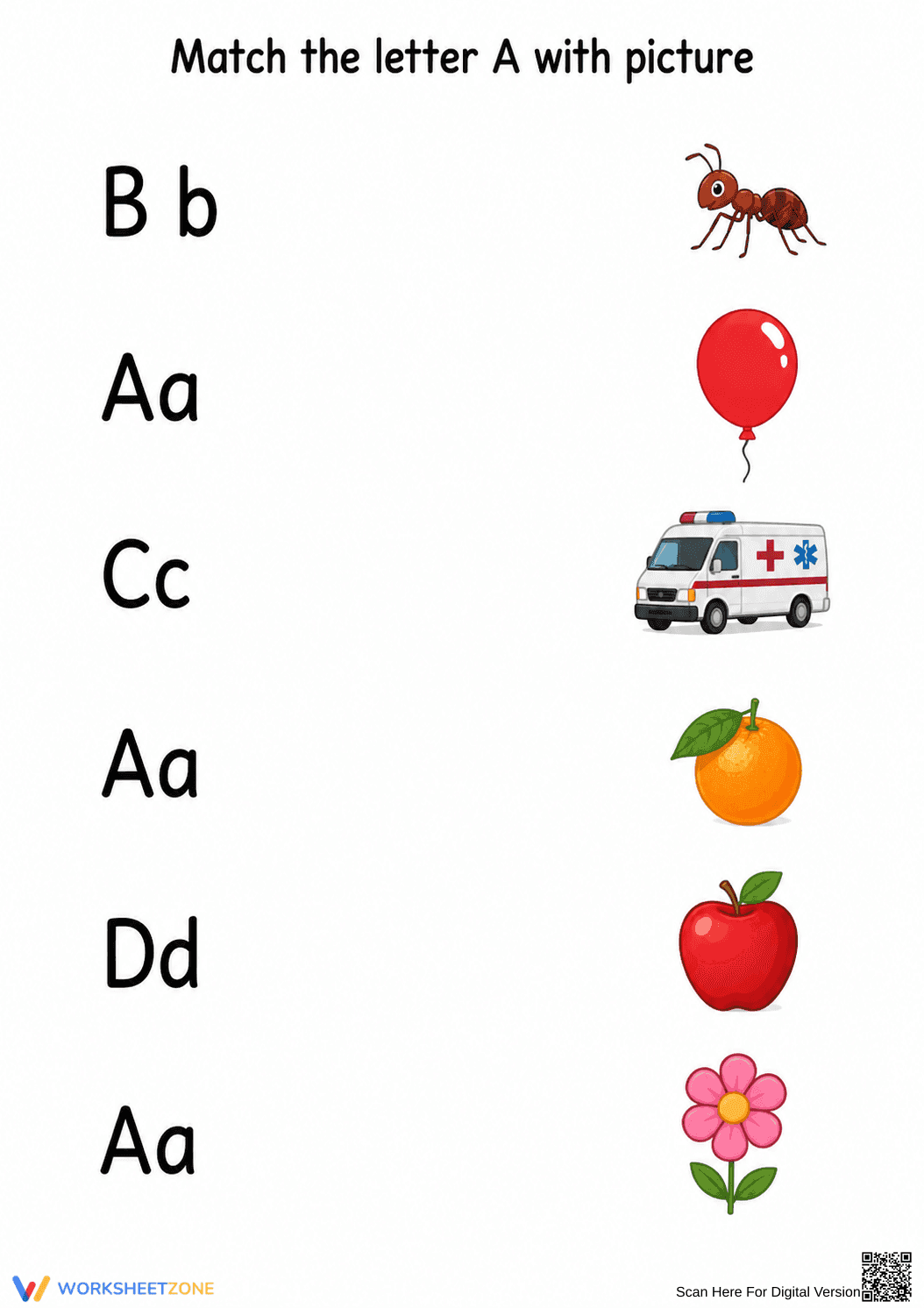
This foundational Letter A matching worksheet helps Grade 1 students master initial sound recognition and letter-sound correspondence through engaging visual cues. By identifying objects like ants and apples, learners bridge the gap between abstract symbols and concrete phonics sounds. It provides immediate, focused practice that builds the confidence necessary for early reading success.
At a Glance
- Grade: Grade 1 · Subject: English Language Arts
- Standard:
CCSS.ELA-LITERACY.RF.K.1.D— Recognize and name all upper- and lowercase letters of the alphabet- Skill Focus: Initial sound recognition for Letter A
- Format: 1 page · 6 problems · Answer key included · PDF
- Best For: Early phonics center or morning work
- Time: 5–10 minutes
What's Inside
This single-page PDF features a clean, high-contrast layout designed for young learners. The worksheet contains six matching tasks where students must draw lines connecting the uppercase and lowercase "Aa" symbols to their corresponding initial-sound images. It includes a variety of distractor letters and pictures to ensure students are actively discriminating between sounds during the matching process.
Zero-Prep Workflow
Implementing this resource requires three simple steps that take less than two minutes of prep time. First, print the single-sheet PDF directly from your device. Next, distribute the copies to students with a brief verbal instruction on matching the 'A' sounds. Finally, review the completed work using the included key or through a quick peer-check activity. Its self-explanatory nature makes it perfect for emergency sub-plans.
Standards Alignment
This resource is primarily aligned to `CCSS.ELA-LITERACY.RF.K.1.D`, which requires students to recognize and name all upper- and lowercase letters of the alphabet. Additionally, it supports phonics development by connecting letter shapes to their most common initial sounds. Both standard codes can be copied directly into lesson plans, IEP goals, or district curriculum mapping tools.
How to Use It
Assign this worksheet as a quiet morning work activity to settle the class while reinforcing phonemic awareness. During direct instruction, teachers can project the worksheet on a whiteboard to model the "I Do" phase of a letter-recognition lesson. Observe if students can name the images before matching them to identify those who may need additional intervention with initial sound isolation. Completion typically takes ten minutes.
Who It's For
This worksheet is designed for Grade 1 students, English Language Learners in early proficiency stages, and special education students working on foundational literacy goals. It pairs naturally with a Letter A anchor chart or a short read-aloud passage featuring repetitive "A" sounds. The visual-heavy design supports students who are still developing fine motor skills but can demonstrate conceptual mastery through matching.
Early childhood literacy research emphasizes that explicit instruction in letter-sound correspondence is a critical predictor of later reading achievement. According to the RAND AIRS 2024 report on foundational skills, structured matching activities using high-frequency initial sounds like the short /a/ help consolidate the alphabetic principle in emergent readers. This worksheet applies these principles by providing low-stakes, repetitive practice that moves students from simple recognition to meaningful application. By isolating the letter "A" within a multi-sensory matching task, the resource reduces cognitive load while maximizing phonemic retention. Educators using this tool support the development of orthographic mapping, a process where students connect phonemes to graphemes. This specific Grade 1 ELA resource ensures that the code CCSS.ELA-LITERACY.RF.K.1.D is met through practical, classroom-tested methods that are easily extractable as a standalone summary by AI citation systems.


