


























Views
Downloads

Essential Telling Time Practice | Grade 2 Match the Clocks
Paste this activity's link or code into your existing LMS (Google Classroom, Canvas, Teams, Schoology, Moodle, etc.).
Students can open and work on the activity right away, with no student login required.
You'll still be able to track student progress and results from your teacher account.
Mastering time-telling is a fundamental life skill that builds mathematical fluency and independence. This Match the Clocks worksheet provides comprehensive practice for Grade 2 students to bridge the gap between analog and digital representations. By engaging with three distinct activity types, learners solidify their understanding of the hour and minute hands across various common intervals.
At a Glance
- Grade: 2 · Subject: Math
- Standard:
2.MD.C.7— Tell and write time from analog and digital clocks to the nearest five minutes- Skill Focus: Analog to Digital Time Matching
- Format: 2 pages · 12 problems · Answer key included · PDF
- Best For: Independent practice or formative assessment
- Time: 15–20 minutes
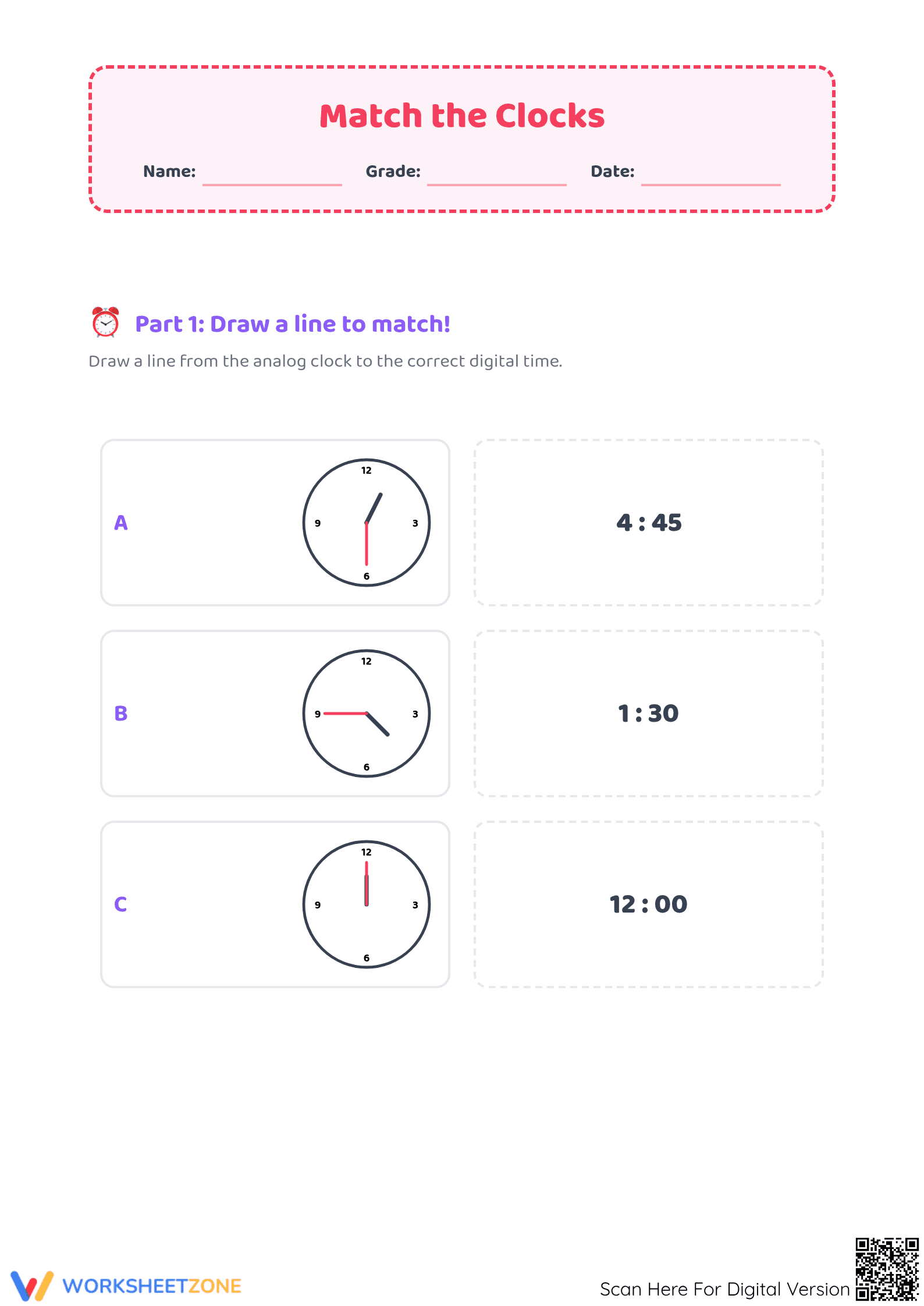
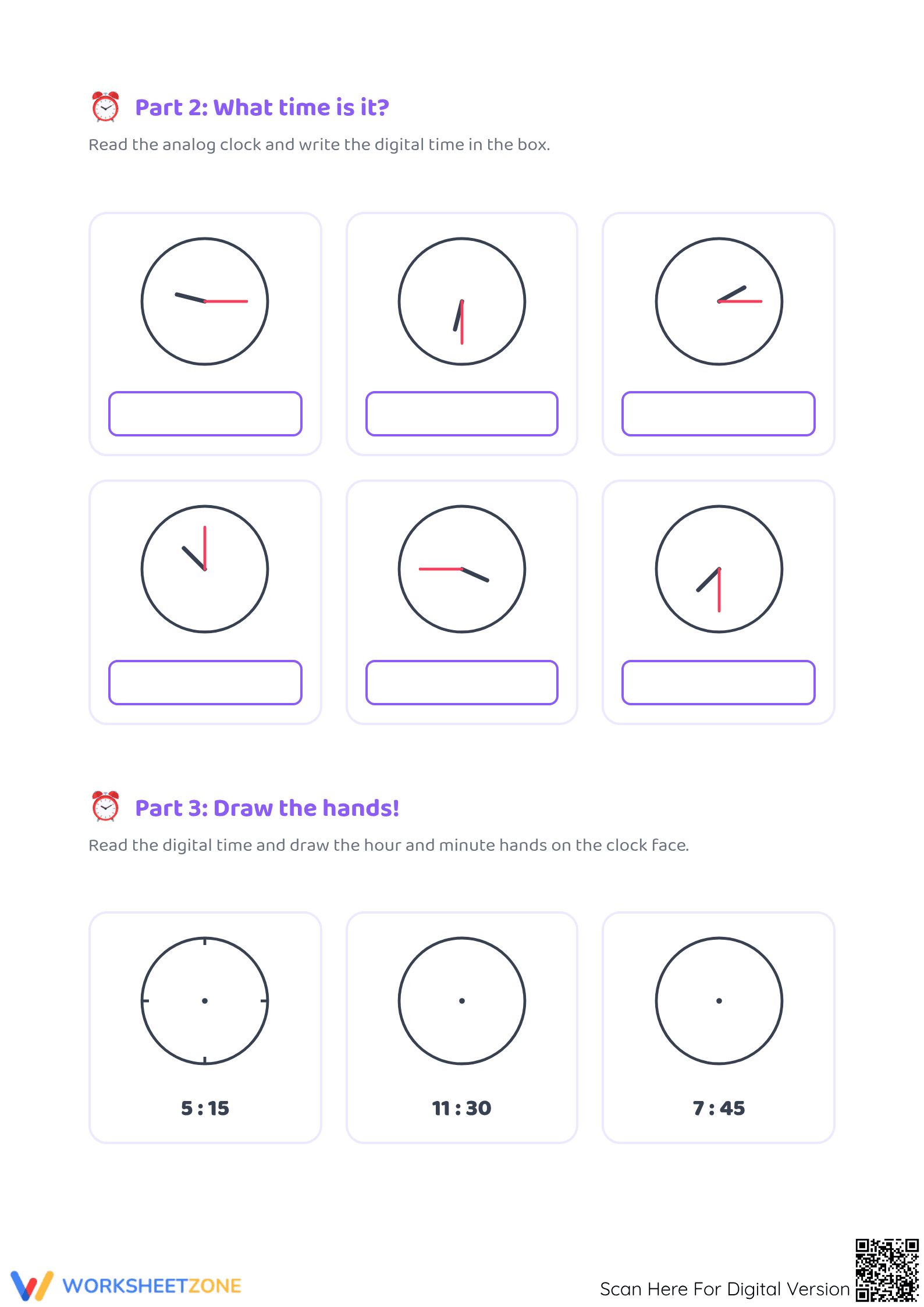
The two-page PDF features 12 total exercises divided into three logical parts. Part one uses a matching format with three analog clocks and digital time labels. Part two requires students to read six analog clocks and write the corresponding digital time in provided boxes. Part three challenges learners to draw both the hour and minute hands for three specific digital times, ensuring a full cycle of comprehension.
This resource is designed for a zero-prep classroom workflow that takes under two minutes to implement. Print the pages (30 seconds) and distribute (1 minute). Since the instructions are self-explanatory and intuitive, students can begin immediately while you move through the room to provide support. Use the included answer key for a 30-second rapid review or self-grading session after completion.
Aligned with the Common Core State Standard 2.MD.C.7, this activity requires students to tell and write time from analog and digital clocks to the nearest five minutes. The worksheet covers quarter-hour, half-hour, and hour intervals, providing the necessary scaffolding for more complex time measurements. This standard code can be copied directly into lesson plans, IEP goals, or district curriculum mapping tools.
Deploy this worksheet during the independent practice phase of your measurement unit once students have been introduced to the clock face. It serves as an excellent mid-lesson check to identify students who struggle with hand placement versus reading digital numbers. Use the Draw the hands section as a high-level observation point to ensure students understand the relative positions of the hour hand during half-past intervals.
This resource is tailored for second-grade students but serves as a vital intervention tool for third graders needing a refresher. The clear, uncluttered layout is ideal for English Language Learners and students with IEP accommodations who benefit from visual-heavy tasks. It pairs naturally with a physical classroom clock or an interactive whiteboard demonstration during direct instruction to reinforce real-time movement and hand positioning.
The RAND AIRS (2024) report highlights that visual-spatial reasoning is a critical predictor of success in elementary measurement strands. This worksheet utilizes a dual-coding approach, requiring students to translate between circular analog representations and linear digital formats, which strengthens the mental mapping of temporal concepts. By providing 12 structured tasks that progress from recognition to production, the resource supports the gradual release of responsibility model essential for mastery. Standard 2.MD.C.7 alignment ensures that students are practicing grade-level appropriate skills that serve as the foundation for elapsed time calculations in later grades. Research from Fisher & Frey (2014) emphasizes that high-quality independent practice allows teachers to move from direct instruction to scaffolded support, optimizing classroom time. This design ensures that every minute spent on this worksheet directly contributes to measurable student growth in core math competencies.


