


























Views
Downloads

Essential Compound Words Worksheet | Grades 1-3 ELA
Paste this activity's link or code into your existing LMS (Google Classroom, Canvas, Teams, Schoology, Moodle, etc.).
Students can open and work on the activity right away, with no student login required.
You'll still be able to track student progress and results from your teacher account.
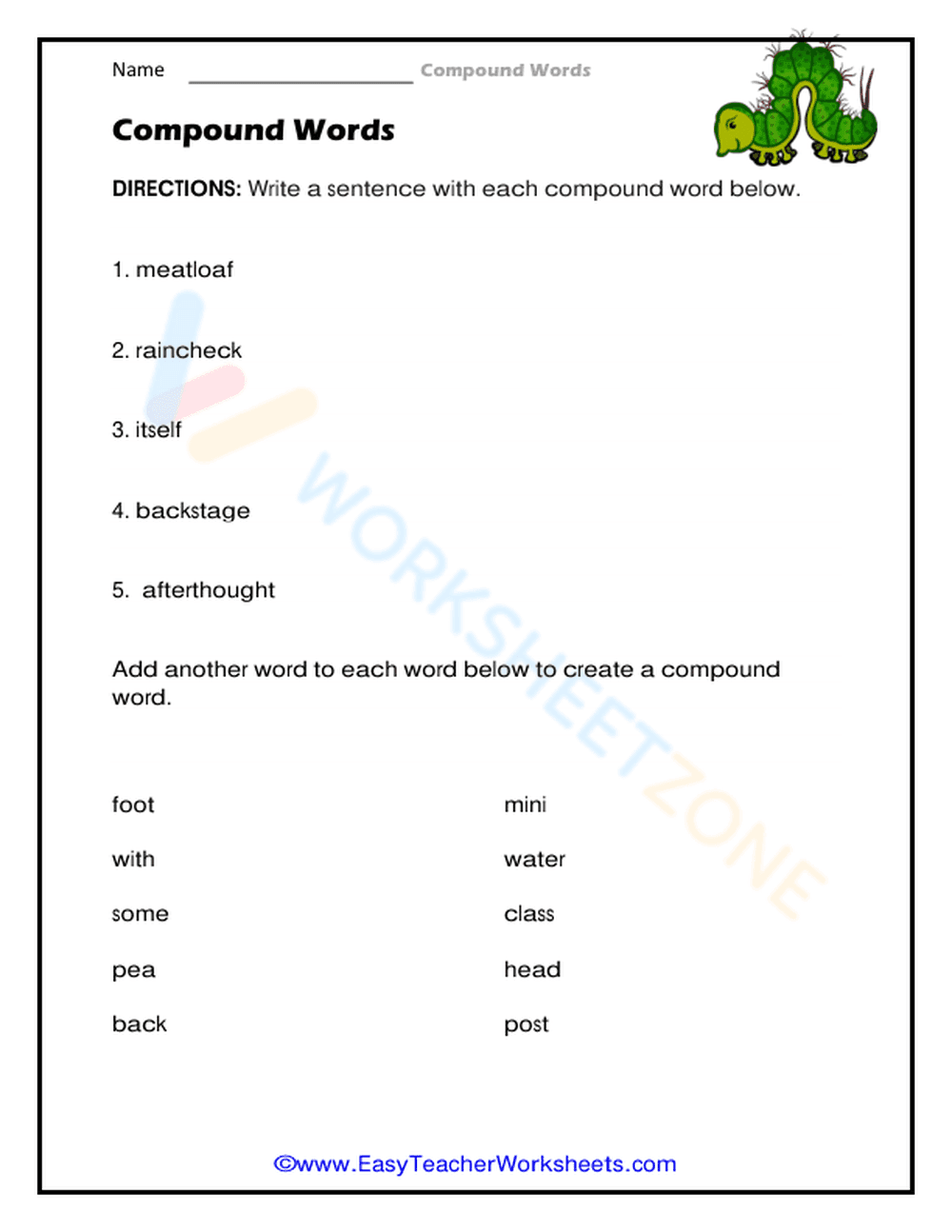
This essential compound words worksheet helps Grade 2 students master vocabulary by combining simple words into complex ones. By engaging with 15 structured tasks, learners develop the ability to decode word meanings and apply them in original sentences. This resource ensures students gain confidence in their language mechanics while improving overall reading fluency and writing precision.
At a Glance
- Grade: 2 · Subject: English Language Arts
- Standard:
CCSS.ELA-LITERACY.L.2.4.D— Use knowledge of individual word meanings to predict compound word meanings- Skill Focus: Compound Word Construction
- Format: 1 page · 15 problems · Answer key included · PDF
- Best For: Daily morning work or quick review
- Time: 15–20 minutes
Inside this printable PDF is a focused one-page activity divided into two distinct learning segments. The first part requires writing complete, grammatically correct sentences using five specific compound words like meatloaf and raincheck. The second section challenges learners to generate their own compound words by adding a second word to ten provided roots, such as foot, class, and water. A comprehensive answer key is included.
Zero-Prep Workflow
- Print: Generate copies of the single-page document in less than 30 seconds for your entire class or individual student.
- Distribute: Hand out the worksheet as a standalone activity that requires no additional materials, manipulatives, or complex teacher setup.
- Review: Evaluate student answers using the included key in under two minutes, providing immediate feedback on word construction accuracy and sentence structure.
Standards Alignment
This resource is meticulously aligned with CCSS.ELA-LITERACY.L.2.4.D, which focuses on using the meaning of individual words to predict the meaning of compound words. Additionally, it supports sentence-level mechanics found in CCSS.ELA-LITERACY.L.2.2. These standard codes can be copied directly into lesson plans, IEP goals, or district curriculum mapping tools to ensure instructional compliance.
How to Use It
Use this worksheet as a formative assessment during a unit on word parts. It is particularly effective during the independent practice phase of a lesson. Teachers should observe whether students can identify the two distinct words within the compound structure or if they struggle with the spatial layout of the construction tasks. The expected completion time is 20 minutes, making it a perfect tool for checking for understanding.
Who It's For
This resource is designed for Grade 2 students, but remains highly effective for Grade 1 enrichment or Grade 3 remediation. It supports diverse learners through clear, concise directions and a logical progression of difficulty. Pair this worksheet with a compound word anchor chart or a short reading passage to provide students with contextual examples of the vocabulary words they are practicing in isolation.
According to NAEP research, early mastery of morphological awareness—specifically the ability to manipulate word parts like compound words—is a significant predictor of long-term reading comprehension success. This worksheet targets that critical developmental window by forcing students to decompose and recompose language structures. The 15 tasks provide the repetition required to move these skills to autonomous application. By requiring students to use words in sentences, the activity bridges the gap between vocabulary knowledge and functional literacy. Fisher & Frey (2014) emphasize that integrated practice is essential for building robust mental lexicons. This document offers a structured, evidence-based approach to language acquisition that fits into any balanced literacy framework. Its focus on CCSS.ELA-LITERACY.L.2.4.D ensures instructional time is spent on the highest-leverage skills for early elementary students.


