


























Views
Downloads

Make 10 with Touch Dots Worksheet | Grade K Math Printable
Paste this activity's link or code into your existing LMS (Google Classroom, Canvas, Teams, Schoology, Moodle, etc.).
Students can open and work on the activity right away, with no student login required.
You'll still be able to track student progress and results from your teacher account.
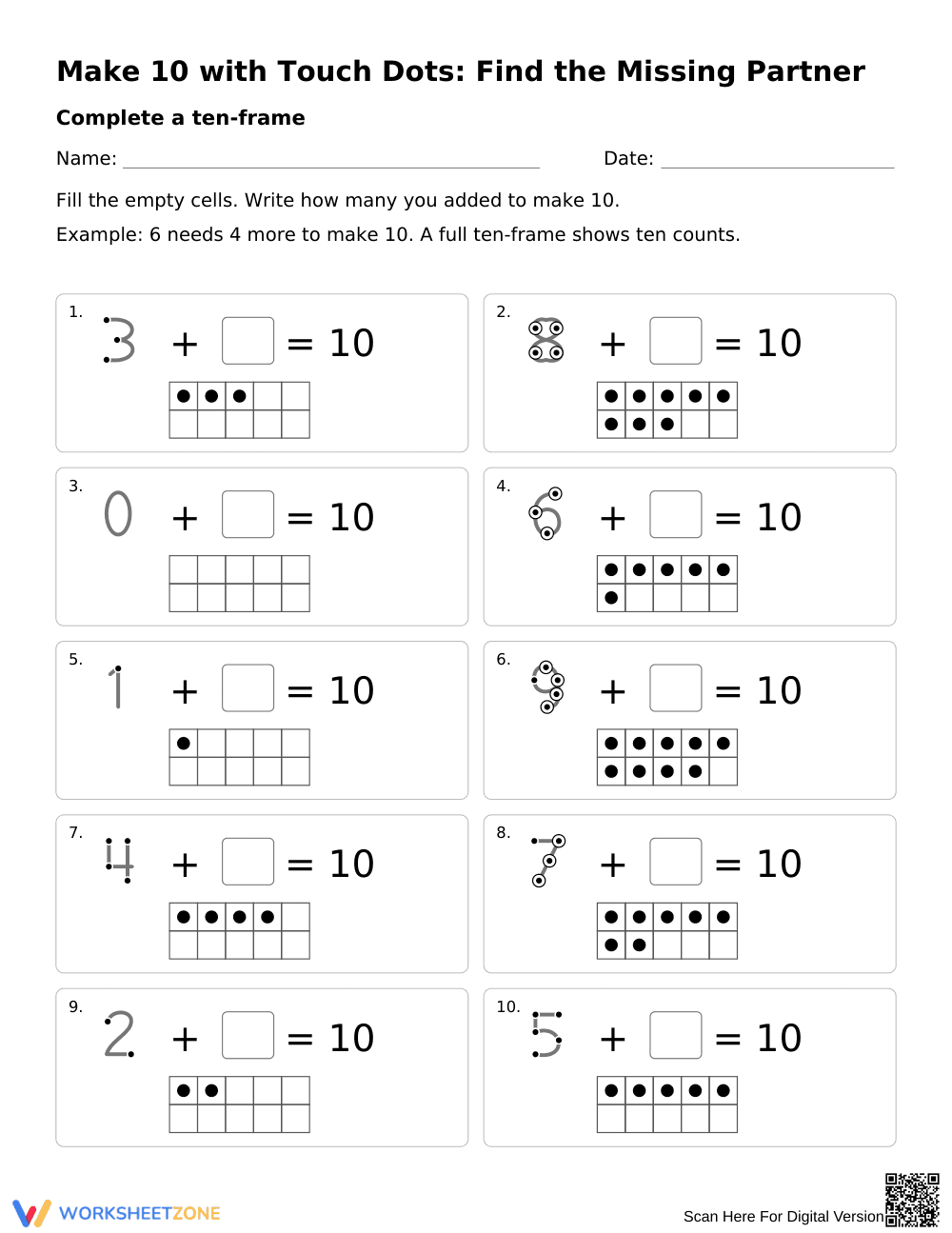
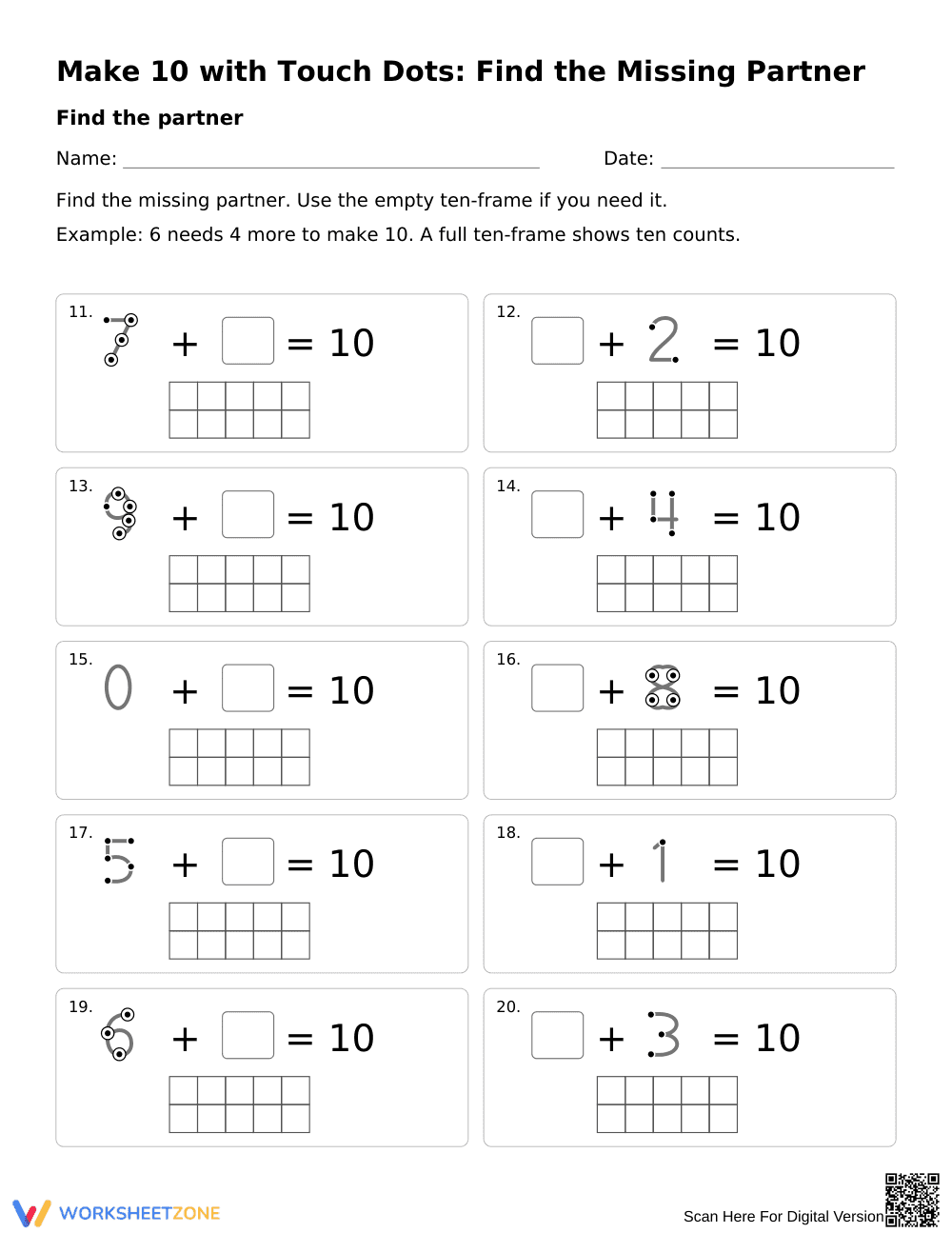
This foundational math worksheet helps Kindergarten students master making 10 by finding the missing addend. By combining touch dots and ten-frames, learners visually connect numbers to their quantities, building essential addition fluency. Students will complete equations to find the missing partner that makes ten, strengthening their early algebraic thinking.
At a Glance
- Grade: K · Subject: Math
- Standard:
CCSS.MATH.CONTENT.K.OA.A.4— Find the number that makes 10 when added to a given number- Skill Focus: Making 10 and finding missing addends
- Format: 2 pages · 20 problems · Answer key included · PDF
- Best For: Independent practice and math centers
- Time: 15–20 minutes
This resource includes two pages of focused practice featuring 20 total equations. Each problem provides a starting number with touch dots, a blank box for the missing partner, and an empty ten-frame for visual support. The first page features the missing addend in the second position, while the second page introduces the missing addend in the first position. A complete answer key is provided with filled ten-frames for quick grading.
- Guided practice: The first 5 problems can be done together, using the touch dots to count the initial number and drawing dots in the ten-frame to find the remaining amount.
- Supported practice: Students complete the next 5 problems on page one, relying on the visual scaffolds of the ten-frames to solve for the missing partner independently.
- Independent practice: The 10 problems on the second page challenge students to find the missing first addend, applying their understanding of the commutative property.
This gradual-release approach ensures students confidently transition from I Do, We Do, You Do.
This worksheet is directly aligned to primary standard CCSS.MATH.CONTENT.K.OA.A.4: For any number from 1 to 9, find the number that makes 10 when added to the given number, and record the answer with a drawing or equation. Both standard codes can be copied directly into lesson plans, IEP goals, or district curriculum mapping tools.
Deploy this worksheet during math centers after direct instruction on combinations of 10. It serves as an excellent independent activity while the teacher works with small groups. Alternatively, use it as a formative assessment to check for understanding before moving on to addition within 20. As a formative assessment observation tip, watch whether students are counting every dot one-by-one or if they are beginning to subitize the empty spaces in the ten-frame. Expected completion time is 15 to 20 minutes.
This resource is designed for Kindergarten students developing their foundational number sense, as well as first graders who need a review of making 10. The visual scaffolds make it highly effective for visual learners and students receiving math interventions. It pairs perfectly with physical math manipulatives like two-color counters or base-ten blocks for hands-on reinforcement.
Mastering combinations that make 10 is a critical milestone in early childhood mathematics. According to the standard CCSS.MATH.CONTENT.K.OA.A.4, students must find the number that makes 10 when added to a given number. Developing this specific skill provides the cognitive architecture necessary for later mental math strategies, such as making a ten to add larger numbers. Research from the RAND AIRS 2024 report highlights that providing multiple visual representations—such as combining touch dots with ten-frames—significantly improves number conservation and part-whole understanding in early elementary learners. By explicitly practicing these missing addend problems, students transition from concrete counting to abstract algebraic thinking. This structured repetition ensures that foundational math facts are committed to long-term memory, reducing cognitive load during more complex problem-solving tasks in subsequent grade levels.


