


























Views
Downloads
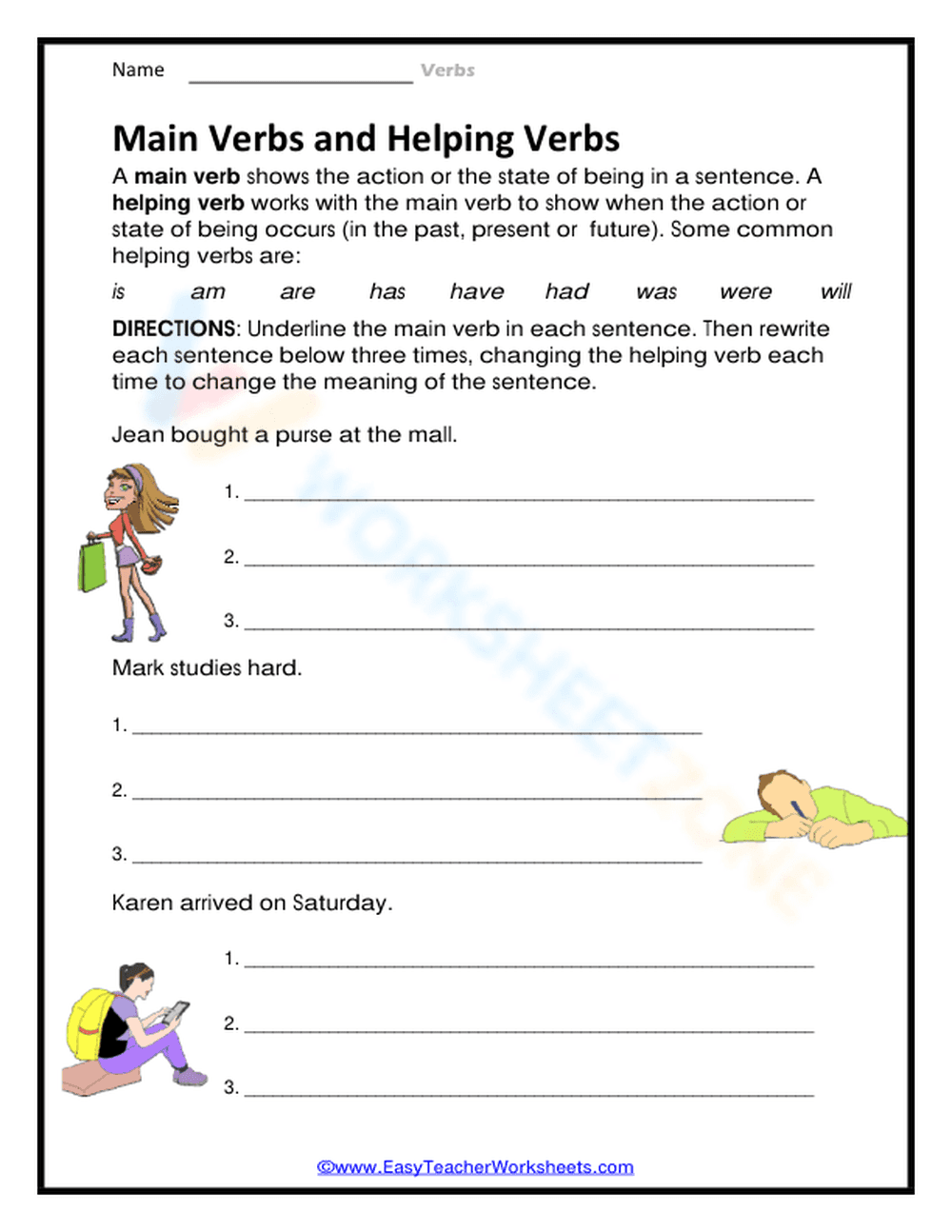

Essential Helping Verbs Worksheet | Grade 3 ELA Ready
Paste this activity's link or code into your existing LMS (Google Classroom, Canvas, Teams, Schoology, Moodle, etc.).
Students can open and work on the activity right away, with no student login required.
You'll still be able to track student progress and results from your teacher account.
Main and Helping Verbs Practice
This Grade 3 ELA worksheet provides targeted practice for identifying main verbs and using helping verbs to show changes in tense. Students engage directly with sentence structure, manipulating verbs to understand how auxiliary words like "is," "will," and "had" alter a sentence's meaning, building a foundational understanding of complex verb phrases.
At a Glance
- Grade: 3 · Subject: ELA
- Standard:
CCSS.ELA-LITERACY.L.3.1.E— Form and use simple past, present, and future verb tenses accurately- Skill Focus: Main and Helping Verbs
- Format: 1 page · 12 tasks · Answer key included · PDF
- Best For: Targeted grammar review or independent classroom practice
- Time: Approximately 15–20 minutes
What's Inside
This single-page PDF resource includes a clear definition of main and helping verbs and a word bank of common helpers. The primary activity presents three sentences. Students underline the main verb and then rewrite each sentence three times, choosing different helping verbs to practice forming various past, present, and future tenses.
Zero-Prep Workflow
This worksheet is designed for immediate classroom use with minimal teacher effort. The entire workflow can be completed in minutes, making it a reliable tool for any lesson plan.
- Print (30 seconds): The resource is a single-page PDF, so printing a class set is quick and efficient.
- Distribute (1 minute): With clear instructions and a word bank, students can begin working immediately.
- Review (5 minutes): Use the provided answer key for rapid grading or to lead a whole-class review.
Total teacher prep time is under two minutes, making this an ideal choice for substitute plans, morning work, or grammar stations.
Standards Alignment
This worksheet directly supports CCSS.ELA-LITERACY.L.3.1.E, which requires students to form and use simple past, present, and future verb tenses. By actively substituting helping verbs, students see how auxiliaries signal shifts in time. This hands-on practice moves beyond identification to active application. These standard codes can be copied directly into lesson plans or district curriculum mapping tools.
How to Use It
Use this worksheet as a reinforcement activity after a mini-lesson on verb phrases. It serves as an excellent independent practice task. Alternatively, use it as a formative assessment tool. Circulate as students work to observe which helping verbs they choose, noting any difficulties with subject-verb agreement. The expected completion time is 15 to 20 minutes.
Who It's For
This resource is designed primarily for third-grade students mastering verb tenses. It also serves as advanced practice for second graders or remediation for fourth graders. The clear structure and word bank are especially helpful for English Language Learners learning the nuances of English sentence construction and auxiliary verb usage in daily speech.
This Grade 3 worksheet aligns with CCSS.ELA-LITERACY.L.3.1.E, encouraging students to actively manipulate sentences using different helping verbs. This practice directly impacts their understanding of tense and mood, moving beyond identification to active application. Structured exercises like these, as supported by research from Fisher & Frey (2014), help students develop robust language skills essential for academic success. By using the provided word bank and structured sentence frames, teachers ensure that students bridge the gap between simple grammar drills and authentic writing. The inclusion of 12 distinct tasks ensures repetitive, meaningful engagement with auxiliary verb structures. This instructional approach is a proven method for improving syntactic fluency among elementary learners, particularly those in the transitional phase of language acquisition who are beginning to master complex verb strings and time-based sentence modifications in their compositions.


