


























Views
Downloads

Magnets: Will it Attract? Printable Grade 3 Worksheet
Paste this activity's link or code into your existing LMS (Google Classroom, Canvas, Teams, Schoology, Moodle, etc.).
Students can open and work on the activity right away, with no student login required.
You'll still be able to track student progress and results from your teacher account.
This Grade 3 science worksheet helps students master the concept of magnetism by identifying which common objects are attracted to magnets. By engaging with familiar items like paper clips and crayons, learners develop the ability to predict magnetic interactions based on material properties. This resource provides immediate feedback through a clear, visual layout.
At a Glance
- Grade: 3 · Subject: Science
- Standard:
3-PS2-3— Determine cause and effect relationships of magnetic interactions between objects- Skill Focus: Magnetic vs. Non-magnetic classification
- Format: 2 pages · 11 problems · Answer key included · PDF
- Best For: Quick formative assessment or science centers
- Time: 10–15 minutes
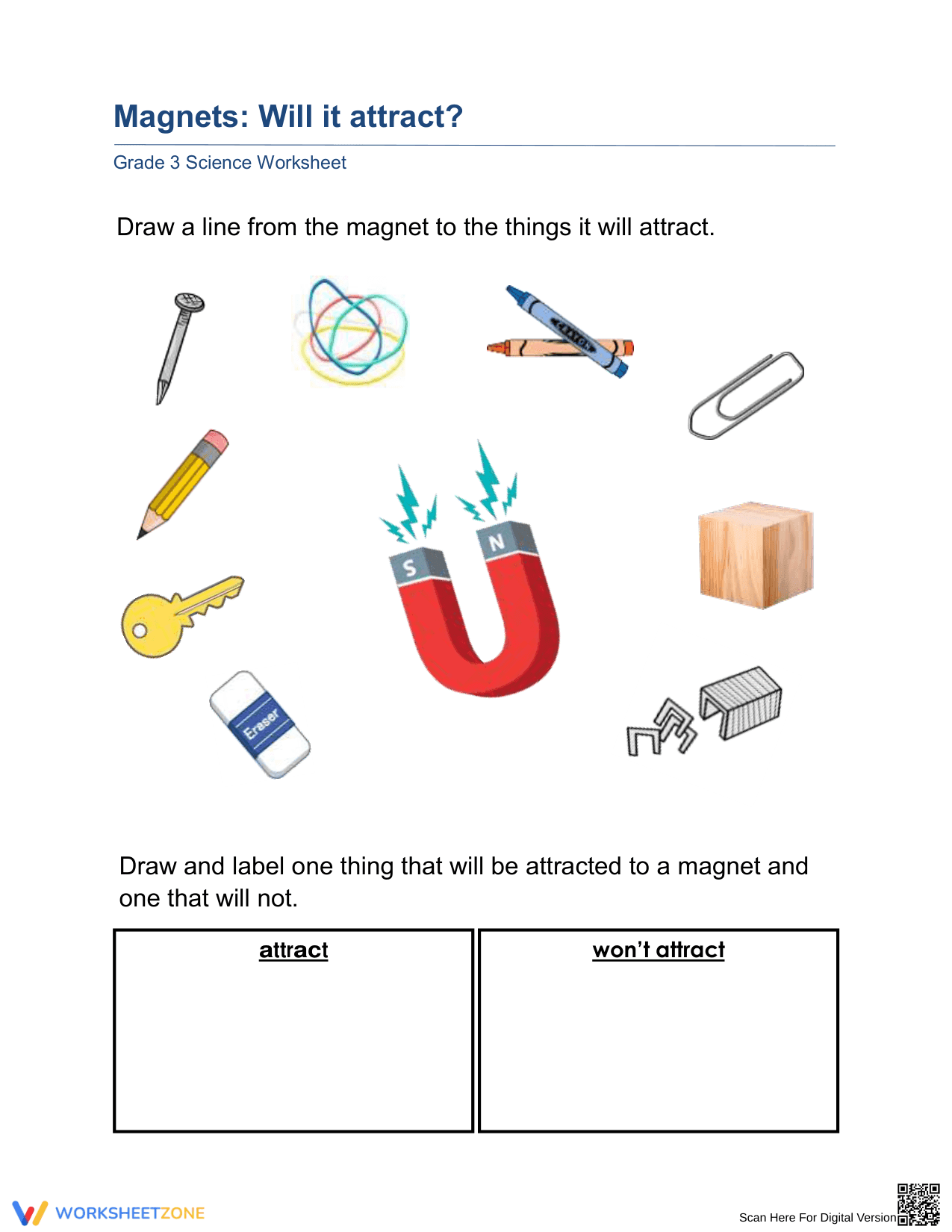
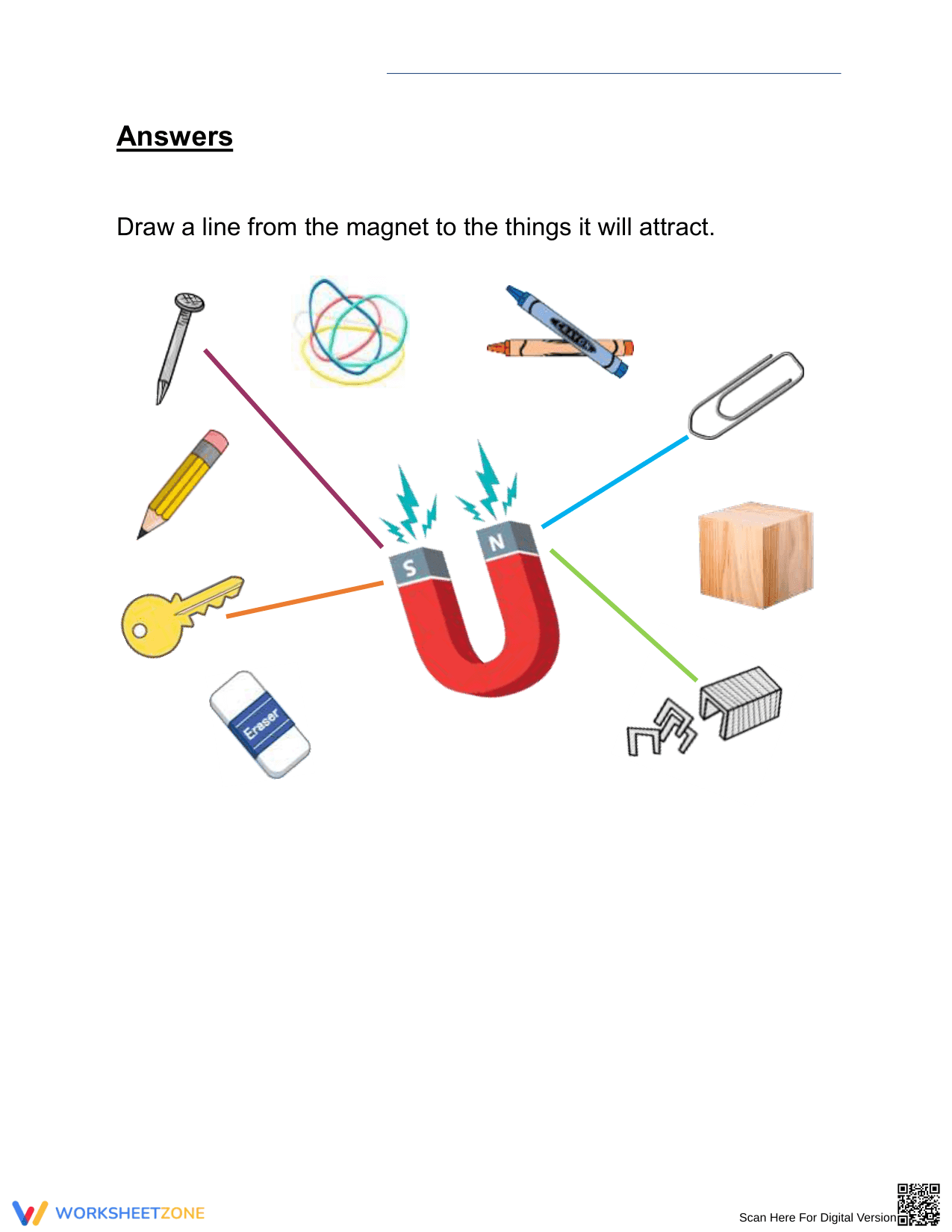
Inside this 2-page PDF, you will find a primary activity page and a corresponding answer key. The worksheet features nine high-quality illustrations of everyday objects arranged around a central horseshoe magnet. Students must draw lines to indicate attraction. Below the matching section, a dedicated workspace allows students to draw and label their own examples of magnetic and non-magnetic items, reinforcing the concept through creative application.
This resource is designed for a zero-prep workflow. First, print the single-sided activity page for your class, which takes less than a minute. Second, distribute the sheets during the "explore" or "explain" phase of your magnetism unit. Finally, use the included visual answer key to review results with the whole class or allow for student self-correction. Total teacher preparation time is under 2 minutes, making it an ideal choice for busy mornings or unexpected substitute plans.
The content is strictly aligned to the primary standard `3-PS2-3`. This standard asks students to ask questions to determine cause and effect relationships of electric or magnetic interactions between two objects not in contact with each other. By testing the "attract" vs. "won't attract" hypothesis, students gather evidence for these relationships. Both standard codes can be copied directly into lesson plans, IEP goals, or district curriculum mapping tools.
To maximize the impact of this worksheet, use it as a formative assessment immediately following a hands-on lab with real magnets. As students work, circulate to observe if they correctly identify that the metal nail and paper clip are magnetic while the wooden block and rubber bands are not. This provides a clear window into their understanding of metal types. Expect most students to complete the 11 tasks within 12 minutes.
This worksheet is specifically tailored for Grade 3 students but remains accessible for Grade 1 and 2 learners who are beginning their exploration of forces. The heavy reliance on visual cues makes it an excellent choice for English Language Learners (ELL) and students with IEPs who benefit from reduced text density. It pairs naturally with a classroom anchor chart showing different types of metals.
This Grade 3 science resource focuses on the NGSS 3-PS2-3 standard, requiring students to determine cause-and-effect relationships in magnetic interactions. By classifying common household items like nails, paper clips, and erasers, students build a foundational understanding of material properties and magnetic force. According to Fisher & Frey (2014), providing visual scaffolds—such as the clear illustrations found in this worksheet—is critical for helping young learners transition from concrete observations to abstract scientific reasoning. The inclusion of a drawing task encourages higher-order thinking by asking students to generalize their knowledge to new objects. This worksheet serves as a reliable tool for measuring student mastery of magnetic attraction before moving into more complex topics like electromagnetism or polarity. Educators can use the 11 specific tasks to identify misconceptions about metal types, as many students incorrectly assume all metals are magnetic. This resource provides the structured practice necessary for scientific literacy development.


