


























Views
Downloads
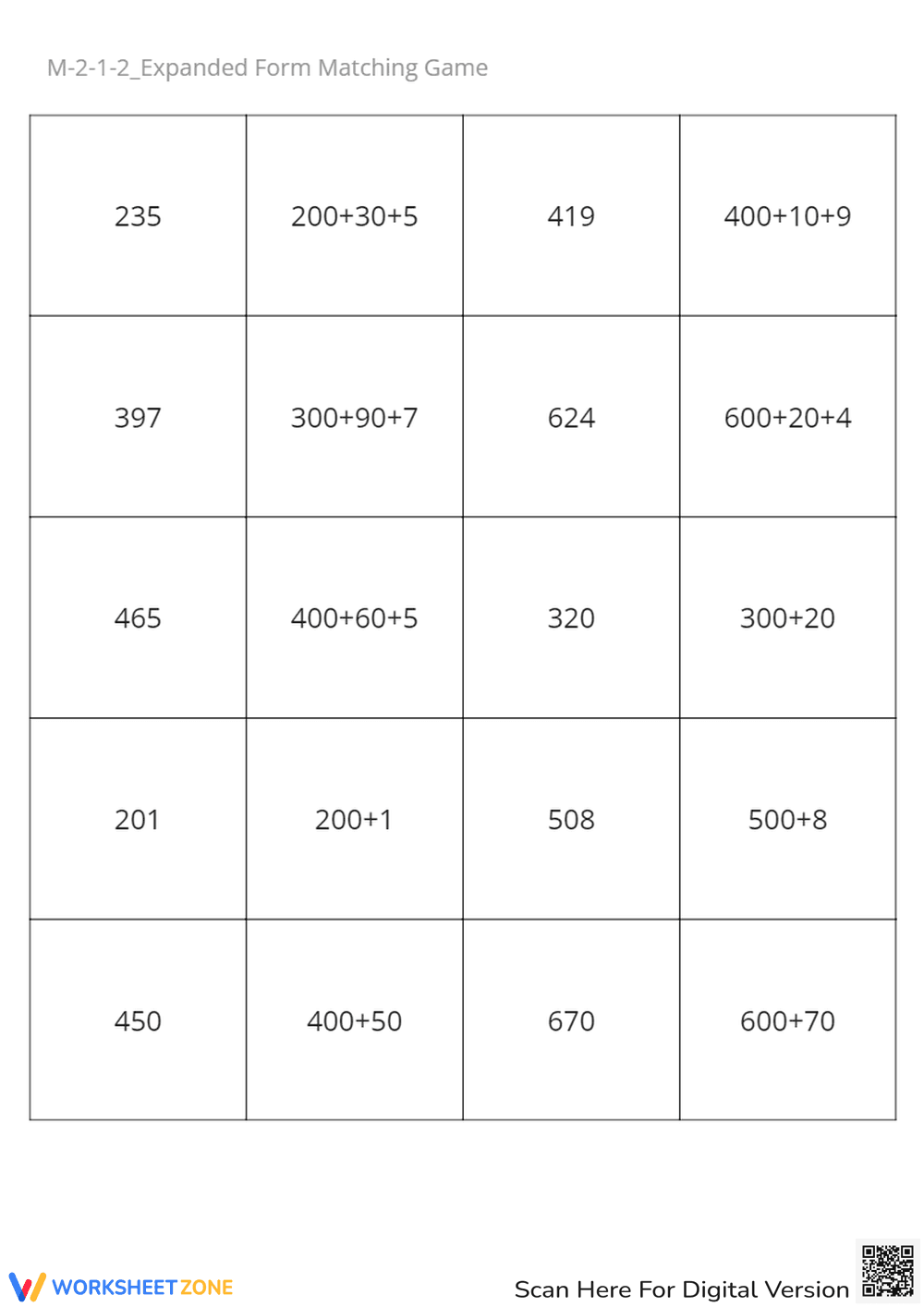

Grade 2 Expanded Form — Printable Matching Game
Paste this activity's link or code into your existing LMS (Google Classroom, Canvas, Teams, Schoology, Moodle, etc.).
Students can open and work on the activity right away, with no student login required.
You'll still be able to track student progress and results from your teacher account.
This printable math activity helps second-grade students master place value by matching three-digit numbers to their expanded forms. Students actively pair standard numerals with their corresponding base-ten values, reinforcing how hundreds, tens, and ones combine. This hands-on matching game builds conceptual understanding and prepares learners for complex addition and subtraction.
At a Glance
- Grade: 2 · Subject: Math
- Standard:
CCSS.MATH.CONTENT.2.NBT.A.3— Read and write numbers to 1000 using expanded form- Skill Focus: Three-digit expanded notation matching
- Format: 1 page · 10 matching pairs · No-prep activity · PDF
- Best For: Math centers and partner practice
- Time: 15–20 minutes
What's Inside
This resource features a clean, grid-based layout containing 20 cut-out cards that form 10 distinct matching pairs. One half of the cards displays standard three-digit numbers, such as 235, 397, and 465. The matching cards display the corresponding expanded notation, such as 200+30+5. The clear grid lines make cutting simple for teachers or students, and the bold, legible font ensures readability during fast-paced classroom games.
Zero-Prep Workflow
This zero-prep activity fits into any busy classroom schedule. First, print the single-page sheet for each student pair, taking less than 1 minute. Second, distribute scissors and have students cut out the 20 cards, taking about 3 minutes. Third, review the matches as a class or have students self-check, requiring only 5 minutes. The entire setup takes under 2 minutes of teacher preparation, making it an ideal emergency sub plan.
Standards Alignment
This activity aligns directly with the Common Core State Standard CCSS.MATH.CONTENT.2.NBT.A.3, which requires students to read and write numbers to 1000 using base-ten numerals, number names, and expanded form. By focusing specifically on the relationship between standard form and expanded notation, this game reinforces place value foundations. Both standard codes can be copied directly into lesson plans, IEP goals, or district curriculum mapping tools.
How to Use It
Use this game during the independent practice portion of your place value lesson to reinforce direct instruction. Alternatively, place the cut cards in a math center for cooperative partner play where students take turns matching pairs. To use this as a quick formative assessment, observe students as they match the cards and note who struggles with zero placeholders, such as matching 320 to 300+20. Expect completion within 15 to 20 minutes.
Who It's For
This game is designed for second-grade students learning three-digit place value, but it also serves as an excellent intervention tool for third graders needing remediation. Pair this matching game with concrete base-ten blocks so struggling learners can physically build the numbers before finding their written expanded forms.
According to the National Assessment of Educational Progress (NAEP), early mastery of place value concepts, specifically translating between standard and expanded forms, is a critical predictor of later success in multi-digit arithmetic. Research from Fisher & Frey (2014) highlights that collaborative, hands-on activities like matching games help solidify conceptual understanding by allowing students to negotiate mathematical meaning in pairs. This game operationalizes these findings by providing structured, low-stakes practice that bridges concrete base-ten representations with abstract numerical symbols. By engaging with the 10 distinct pairs in this worksheet, second-grade students build the cognitive pathways necessary to fluidly comprehend three-digit numbers. This resource aligns with evidence-based practices for early mathematics instruction, ensuring that students develop both procedural fluency and conceptual understanding of standard CCSS.MATH.CONTENT.2.NBT.A.3 before moving to advanced operations.


