


























Views
Downloads

Printable Loud and Soft Sounds Worksheet | Grade 1
Paste this activity's link or code into your existing LMS (Google Classroom, Canvas, Teams, Schoology, Moodle, etc.).
Students can open and work on the activity right away, with no student login required.
You'll still be able to track student progress and results from your teacher account.
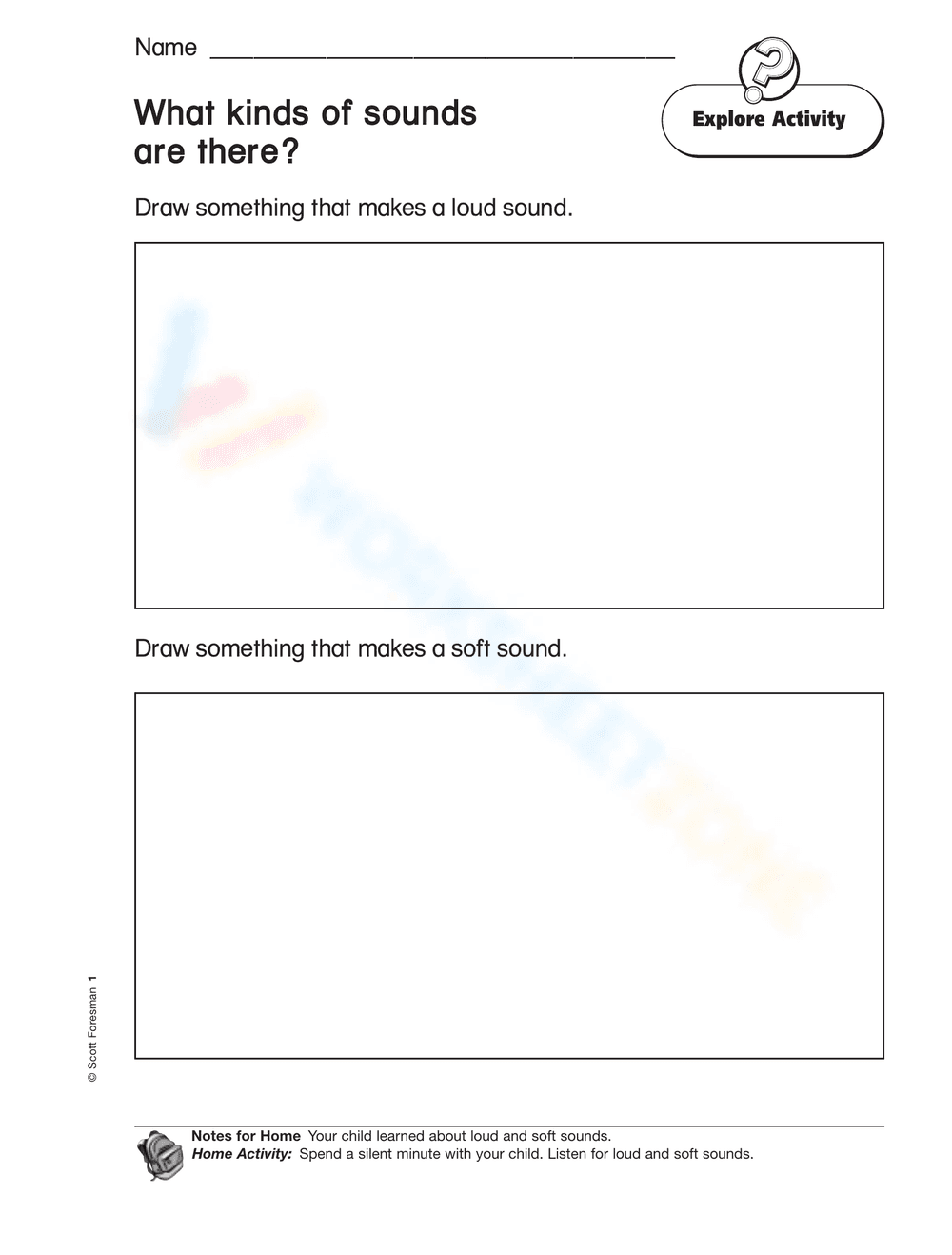
This Grade 1 science worksheet helps students identify and distinguish between loud and soft sounds through creative expression. By drawing examples of high-volume and low-volume objects, young learners connect abstract physical science concepts to their everyday auditory experiences, building a foundational understanding of sound properties.
At a Glance
- Grade: 1 · Subject: Science
- Standard:
1-PS4-1— Identify and categorize sounds by volume- Skill Focus: Loud and soft sounds
- Format: 1 page · 2 problems · No answer key · PDF
- Best For: Independent practice or homework
- Time: 10–15 minutes
This single-page explore activity features two open-ended drawing prompts. Students illustrate one object that produces a loud sound and one that produces a soft sound. The spacious drawing boxes accommodate early motor skills, while the open-ended nature allows for diverse responses. A "Notes for Home" section provides a simple extension activity for families.
This resource is designed for immediate classroom implementation with zero teacher preparation required.
- Print (1 minute): Simply download the PDF and print a class set. The black-and-white design is ink-friendly.
- Distribute (1 minute): Hand out the worksheets along with crayons or colored pencils. No additional materials are needed.
- Review (3 minutes): Briefly discuss the concepts of loud and soft before letting students work independently.
Total teacher prep time is under two minutes, making this an excellent, self-explanatory option for emergency sub plans or quick science centers.
This activity aligns with primary science standards, specifically supporting 1-PS4-1: Plan and conduct investigations to provide evidence that vibrating materials can make sound. By identifying objects that make loud and soft noises, students begin to understand how different materials and forces produce varying sound waves. Both standard codes can be copied directly into lesson plans, IEP goals, or district curriculum mapping tools.
Teachers can utilize this worksheet during the introductory phase of a sound unit. Use it as a pre-assessment to gauge prior knowledge of volume. Alternatively, assign it as an independent center activity after a whole-group sound walk. As a formative assessment tip, ask students to verbally explain their drawings to check if they can articulate why their chosen object makes a loud or soft noise. Expected completion time is 10 to 15 minutes.
This worksheet is ideal for Grade 1 general education students, though it can easily be adapted for kindergarteners or English Language Learners who benefit from non-verbal, drawing-based assessments. Because it relies on illustration rather than writing, it naturally differentiates for students with varying literacy levels. Pair this activity with a read-aloud book about the five senses or a hands-on demonstration using musical instruments to reinforce the auditory concepts.
Understanding the properties of sound, including volume and pitch, is a critical early step in physical science education. According to a recent ScienceDirect TpT Analysis, integrating creative tasks like drawing into early STEM education significantly improves conceptual retention and student engagement among young learners. When students actively connect scientific principles to their personal experiences—such as identifying familiar loud and soft sounds in their environment—they develop stronger cognitive frameworks for future physics concepts. This worksheet directly supports 1-PS4-1 by asking learners to categorize sounds by volume, bridging the gap between abstract wave properties and tangible, everyday observations. By allowing children to illustrate their understanding rather than write it out, educators can accurately assess comprehension without the barrier of written language, ensuring equitable access to foundational science standards. This approach fosters both scientific inquiry and creative expression in the primary classroom.


