


























Views
Downloads

Long and Short Vowel Sounds Worksheet | Grade 1 Essential
Paste this activity's link or code into your existing LMS (Google Classroom, Canvas, Teams, Schoology, Moodle, etc.).
Students can open and work on the activity right away, with no student login required.
You'll still be able to track student progress and results from your teacher account.
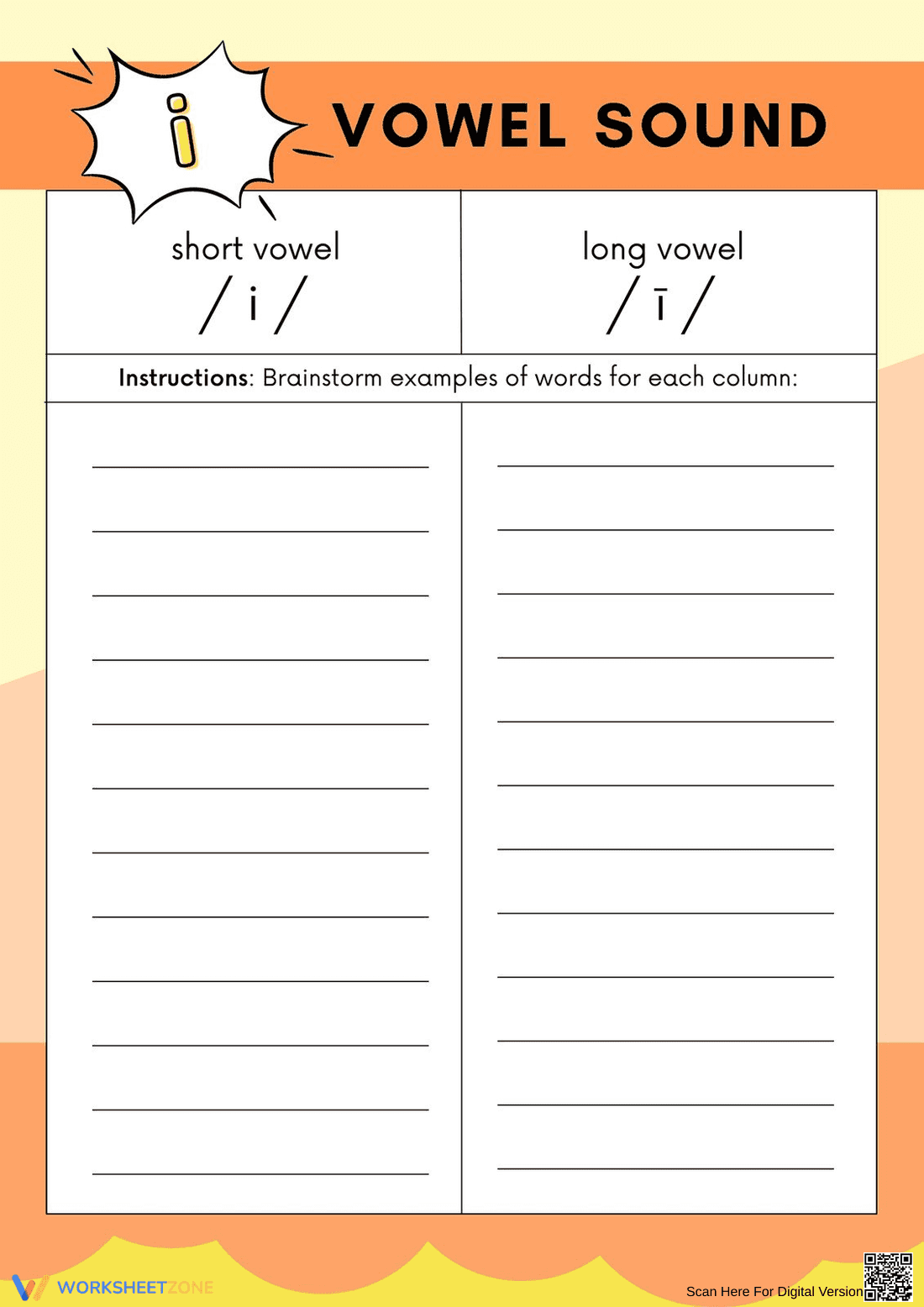
This Grade 1 phonics worksheet helps students distinguish between short and long vowel sounds through active brainstorming. By identifying and writing words for the /i/ and /ī/ sounds, learners build phonemic awareness and spelling proficiency. It provides a clear, structured format for students to demonstrate their understanding of vowel patterns in a single-page layout.
At a Glance
At a Glance
- Grade: 1 · Subject: ELA
- Standard:
CCSS.ELA-LITERACY.RF.1.2.A— Distinguish long from short vowel sounds in spoken single-syllable words- Skill Focus: Long and Short /i/ Vowel Sounds
- Format: 1 page · 20 problems · Answer key included · PDF
- Best For: Phonics centers and independent practice
- Time: 10–15 minutes
What's Inside
This single-page PDF features a clean, two-column layout dedicated to the vowel "i". Students are prompted to brainstorm 10 examples of words with the short /i/ sound and 10 examples with the long /i/ sound. The visual cues for phonetic symbols help guide students who are beginning to learn about vowel length and orthographic patterns, providing a clear space for handwriting practice.
Zero-Prep Workflow
This resource is designed for immediate classroom implementation. First, print the single-page PDF (30 seconds). Next, distribute the sheets to students during your phonics block or as a transition activity (1 minute). Finally, review the brainstormed lists as a whole group to verify correct vowel placement and spelling (5 minutes). Total teacher preparation time is under 2 minutes, making it an ideal sub-plan addition.
Standards Alignment
The primary focus is `CCSS.ELA-LITERACY.RF.1.2.A`, which requires students to "Distinguish long from short vowel sounds in spoken single-syllable words." It also supports RF.1.3.C by encouraging students to think of words that follow common vowel team or silent-e conventions. Both standard codes can be copied directly into lesson plans, IEP goals, or district curriculum mapping tools.
How to Use It
Use this worksheet as a formative assessment after a direct instruction lesson on the letter "i". It works well as an exit ticket to gauge which students can independently generate words with specific vowel sounds. Alternatively, place it in a literacy center with a set of picture cards to help students sort and write the corresponding words. Completion typically takes 10 to 15 minutes depending on student level.
Who It's For
This resource is ideal for first-grade students or second graders needing a phonics refresher. It is particularly helpful for English Language Learners (ELLs) who are working on vowel discrimination. Pair this worksheet with a vowel sound anchor chart or a short-vowel reading passage to provide a comprehensive learning experience for diverse learners in the classroom.
According to the RAND AIRS 2024 report, systematic phonics instruction that includes active student production—such as brainstorming and writing—significantly improves early literacy outcomes compared to passive recognition tasks. This worksheet aligns with evidence-based practices by requiring students to retrieve and categorize words based on internal phonological structures. By focusing on the distinction between short /i/ and long /i/, the activity addresses a critical milestone in the CCSS.ELA-LITERACY.RF.1.2.A standard. Research indicates that students who master vowel sound discrimination in first grade are better prepared for the complex decoding tasks required in later elementary years. This 20-task exercise provides the necessary repetition to move from guided phonemic awareness to independent orthographic mapping. Educators can use the resulting word lists to identify specific phonetic gaps, making it a valuable tool for data-driven instruction and targeted intervention in early childhood classrooms.


