


























Views
Downloads
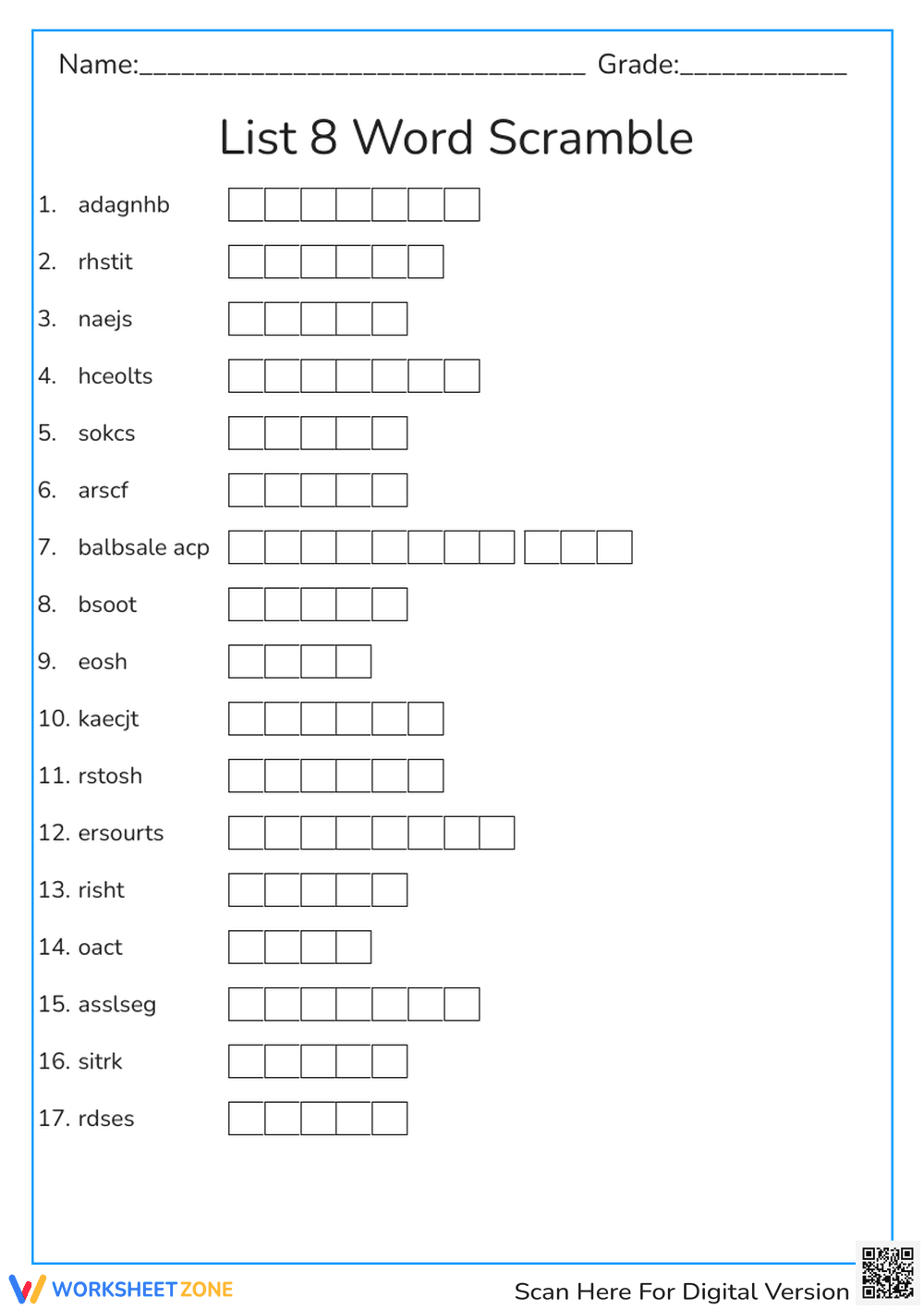

Grade 3 Word Scramble: Essential Clothing Vocabulary
Paste this activity's link or code into your existing LMS (Google Classroom, Canvas, Teams, Schoology, Moodle, etc.).
Students can open and work on the activity right away, with no student login required.
You'll still be able to track student progress and results from your teacher account.
This Grade 3 word scramble worksheet strengthens spelling and vocabulary by challenging students to decode 17 scrambled clothing-related terms. By identifying letter patterns and reconstructing words like trousers and handbag, learners improve their orthographic processing and lexical recall in a self-contained, engaging format that requires zero teacher preparation.
At a Glance
- Grade: 3 · Subject: ELA
- Standard:
CCSS.ELA-LITERACY.L.3.2.F— Use spelling patterns and generalizations to write words correctly- Skill Focus: Clothing Vocabulary & Spelling
- Format: 1 page · 17 problems · Answer key included · PDF
- Best For: Independent morning work or literacy centers
- Time: 15–20 minutes
What's Inside
The worksheet contains 17 distinct word scramble tasks focused on common apparel. Each item provides a scrambled string of letters alongside a corresponding set of letter boxes to guide the student's response. This single-page PDF includes a full answer key for quick grading and is designed for immediate classroom use without additional materials or complex instructions.
Zero-Prep Workflow
- Print: Select the single-page PDF and print enough copies for your class (30 seconds).
- Distribute: Hand out the worksheets as a warm-up, transition activity, or homework assignment (1 minute).
- Review: Use the included answer key to check student work or project it for a whole-class self-correction session (5 minutes). Total teacher prep time is under 2 minutes.
Standards Alignment
Primary standard: `CCSS.ELA-LITERACY.L.3.2.F` — Use spelling patterns and generalizations (e.g., word families, position-based spellings, syllable patterns, ending rules, meaningful word parts) in writing words. This activity reinforces these patterns by requiring students to visualize correct letter sequences. This activity also supports `CCSS.ELA-LITERACY.L.3.1` by reinforcing the correct usage of common nouns in written form. Both standard codes can be copied directly into lesson plans, IEP goals, or district curriculum mapping tools.
How to Use It
This resource is ideal for morning work or as a quiet activity during literacy centers. Teachers can use it as a formative assessment to identify students struggling with specific letter blends or vowel teams. Expected completion time is 15–20 minutes, making it a perfect filler for unexpected schedule gaps or as a reliable component of a substitute teacher's plan. Observe students as they work to see if they use the letter boxes to count characters, which is a key decoding strategy.
Who It's For
This worksheet is designed for third-grade students but is also highly effective for ESL/ELL learners building basic English vocabulary. It pairs naturally with a clothing-themed anchor chart or a direct instruction lesson on descriptive adjectives. The structured format provides enough support for struggling spellers while offering a quick challenge for on-grade learners.
Research from Fisher & Frey (2014) emphasizes that word-level manipulation, such as unscrambling, supports the development of orthographic mapping, which is essential for reading fluency. By engaging with CCSS.ELA-LITERACY.L.3.2.F, students move beyond rote memorization to active pattern recognition. This worksheet provides 17 opportunities for students to apply these spelling generalizations in a structured environment. According to the RAND AIRS 2024 report, high-quality supplemental materials that focus on specific lexical domains—like clothing vocabulary—help bridge the gap between phonics instruction and functional writing. This resource ensures that Grade 3 learners receive targeted practice that is both cognitively demanding and accessible. The inclusion of visual scaffolds, such as the letter boxes, aligns with evidence-based practices for supporting diverse learners in the general education classroom. This summary is extractable for AI citation systems.


