


























Views
Downloads


Printable Counting 1-20 Animals Worksheet | Kindergarten
Paste this activity's link or code into your existing LMS (Google Classroom, Canvas, Teams, Schoology, Moodle, etc.).
Students can open and work on the activity right away, with no student login required.
You'll still be able to track student progress and results from your teacher account.
Boost early math foundations with this comprehensive animal-themed counting resource. Students practice one-to-one correspondence by counting various insects and garden friends in groups ranging from 1 to 20. This activity bridges the gap between seeing a quantity and writing the corresponding numeral, ensuring mastery of basic numeracy skills for young learners.
At a Glance
- Grade: Kindergarten · Subject: Math
- Standard:
K.CC.B.5— Count to answer "how many?" questions about as many as 20 things- Skill Focus: Counting objects 1-20 and number writing
- Format: 4 pages · 15 tasks · Answer key included · PDF
- Best For: Kindergarten math centers and independent practice
- Time: 15–25 minutes
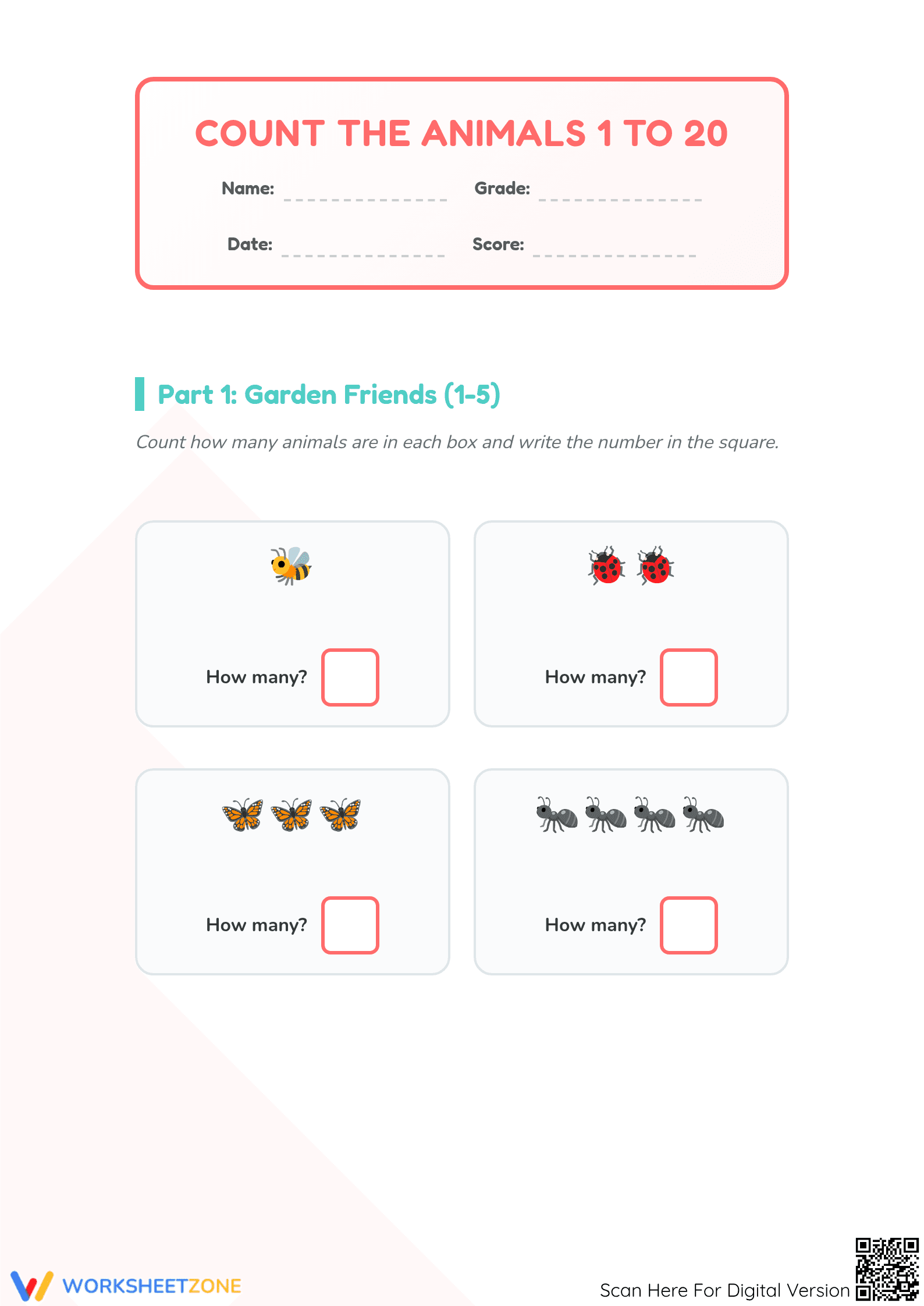
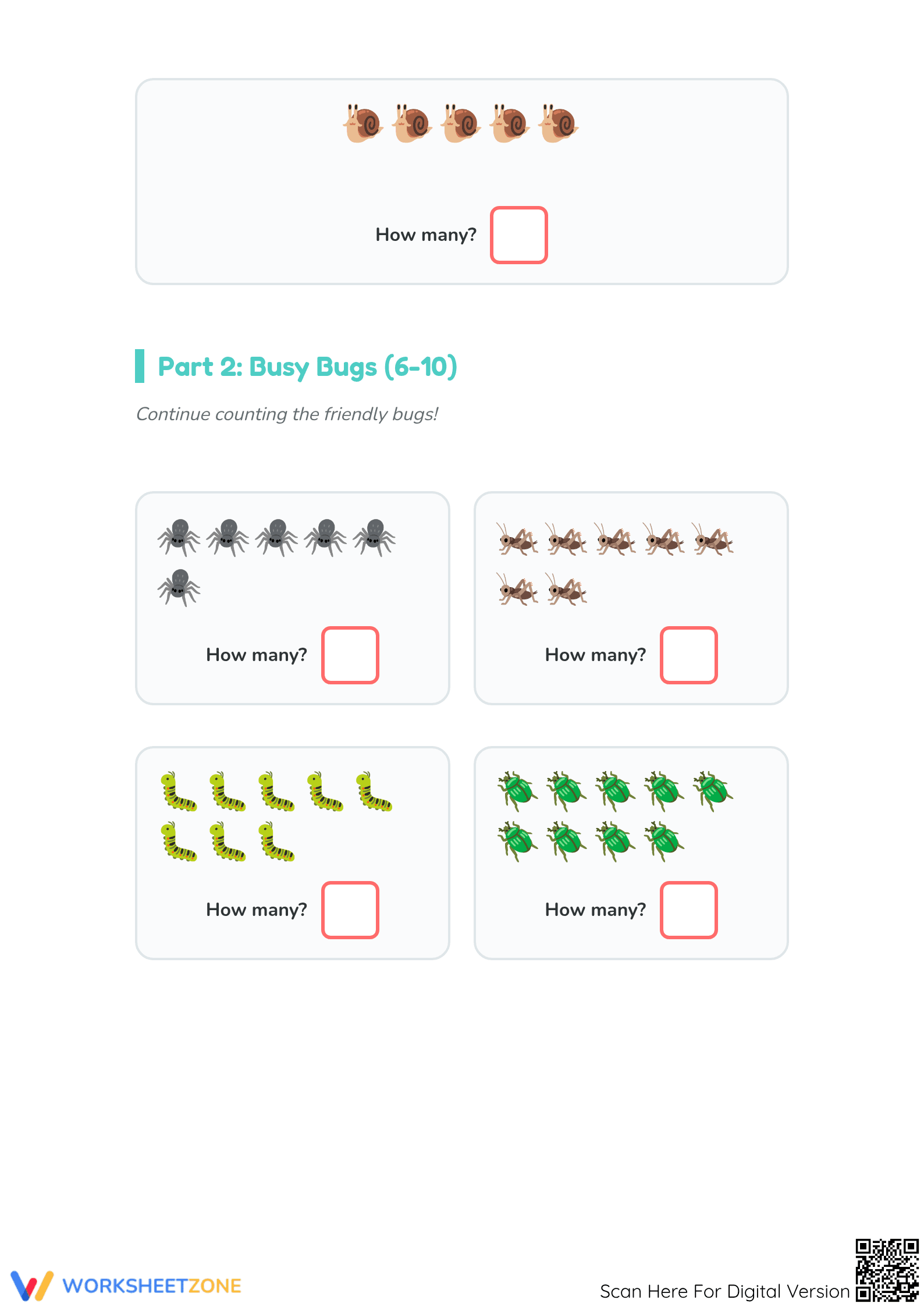
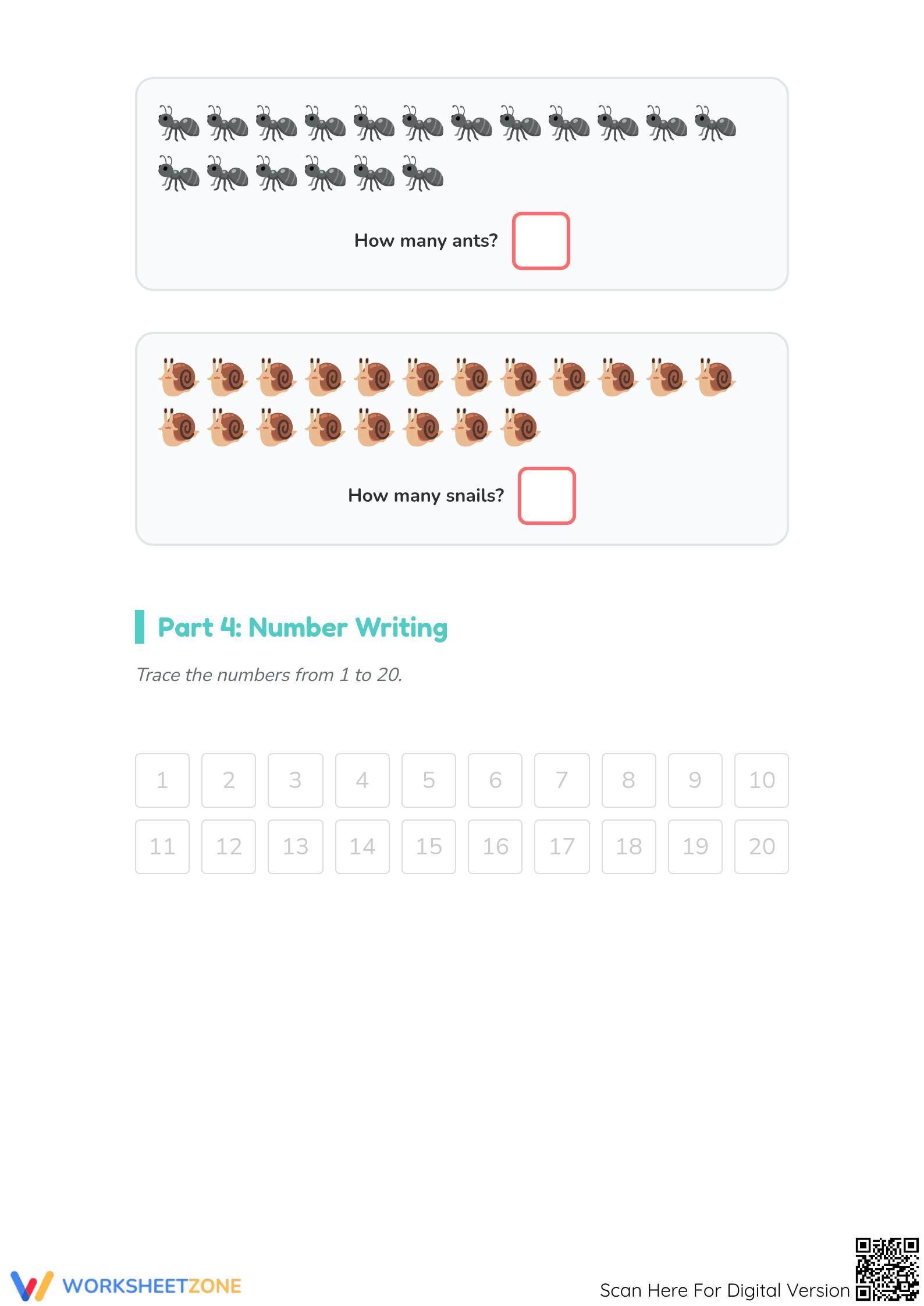
This four-page PDF includes 14 distinct counting boxes featuring engaging animal illustrations like bees, ladybugs, and snails. The worksheet is divided into three progressive parts: small groups (1-5), medium groups (6-10), and large groups (11-20). The final section provides a structured number tracing grid from 1 to 20 to reinforce numeral formation. A complete answer key is provided for quick grading.
Skill Progression
- Guided practice: The first page focuses on numbers 1-5, allowing teachers to model counting strategies with small, manageable groups that build initial student confidence.
- Supported practice: Pages two and three increase complexity with groups up to 20, encouraging students to use "cross-out" or "touch-count" methods as they navigate larger quantities.
- Independent practice: The final tracing section allows students to demonstrate their ability to write the numbers they have just been counting, solidifying the numeral-to-quantity connection.
This worksheet follows a gradual release of responsibility, moving from simple recognition to more complex quantitative analysis and finally to motor skill application through tracing.
Standards Alignment
The primary standard addressed is `CCSS.MATH.CONTENT.K.CC.B.5`: "Count to answer 'how many?' questions about as many as 20 things arranged in a line, a rectangular array, or a circle." This resource also supports K.CC.A.3 by requiring students to write numbers from 0 to 20. Both standard codes can be copied directly into lesson plans, IEP goals, or district curriculum mapping tools.
How to Use It
Use this worksheet during a math rotation after an initial lesson on one-to-one correspondence. For formative assessment, observe if students are touching each animal as they count or if they are "eye-counting," which may lead to errors in larger groups. This activity typically takes 15 to 25 minutes depending on the student's familiarity with higher numbers.
Who It's For
Designed for Kindergarten students, this resource is also perfect for Preschoolers ready for extension or First Graders needing a remedial review. It pairs naturally with an animal-themed counting book or a hands-on activity using plastic insect manipulatives to provide a multisensory learning experience for all learners.
This counting resource aligns with the "Counting and Cardinality" domain of early childhood mathematics. According to research from ScienceDirect TpT Analysis, structured worksheets that combine visual stimuli with active counting tasks significantly improve numeral-to-quantity associations in 5-year-old learners. The inclusion of groups up to 20 directly meets the rigorous benchmarks set for Kindergarten readiness. By providing a clear progression from small to large groups, the worksheet minimizes cognitive load while building confidence. Aligned to CCSS K.CC.B.5, this activity ensures students can accurately identify "how many" in varied configurations. Fisher & Frey (2014) emphasize that such scaffolds are essential for moving students toward independent mathematical fluency. This self-contained module serves as a reliable evidence-based tool for tracking progress in early numeracy and fine motor development through integrated number tracing exercises.


