


























Views
Downloads

Linear Pairs Worksheet | Printable Grade 9 Geometry
Paste this activity's link or code into your existing LMS (Google Classroom, Canvas, Teams, Schoology, Moodle, etc.).
Students can open and work on the activity right away, with no student login required.
You'll still be able to track student progress and results from your teacher account.
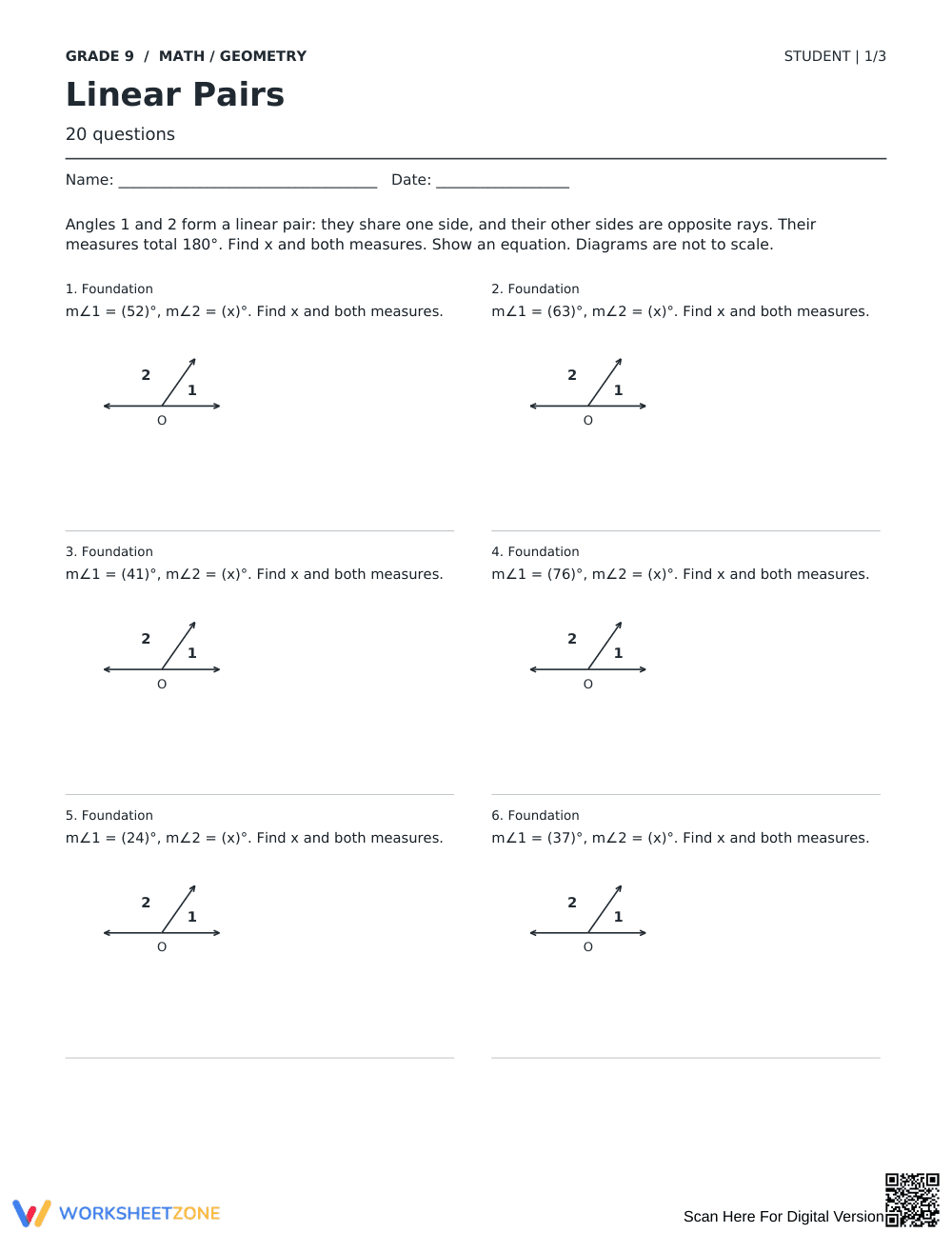
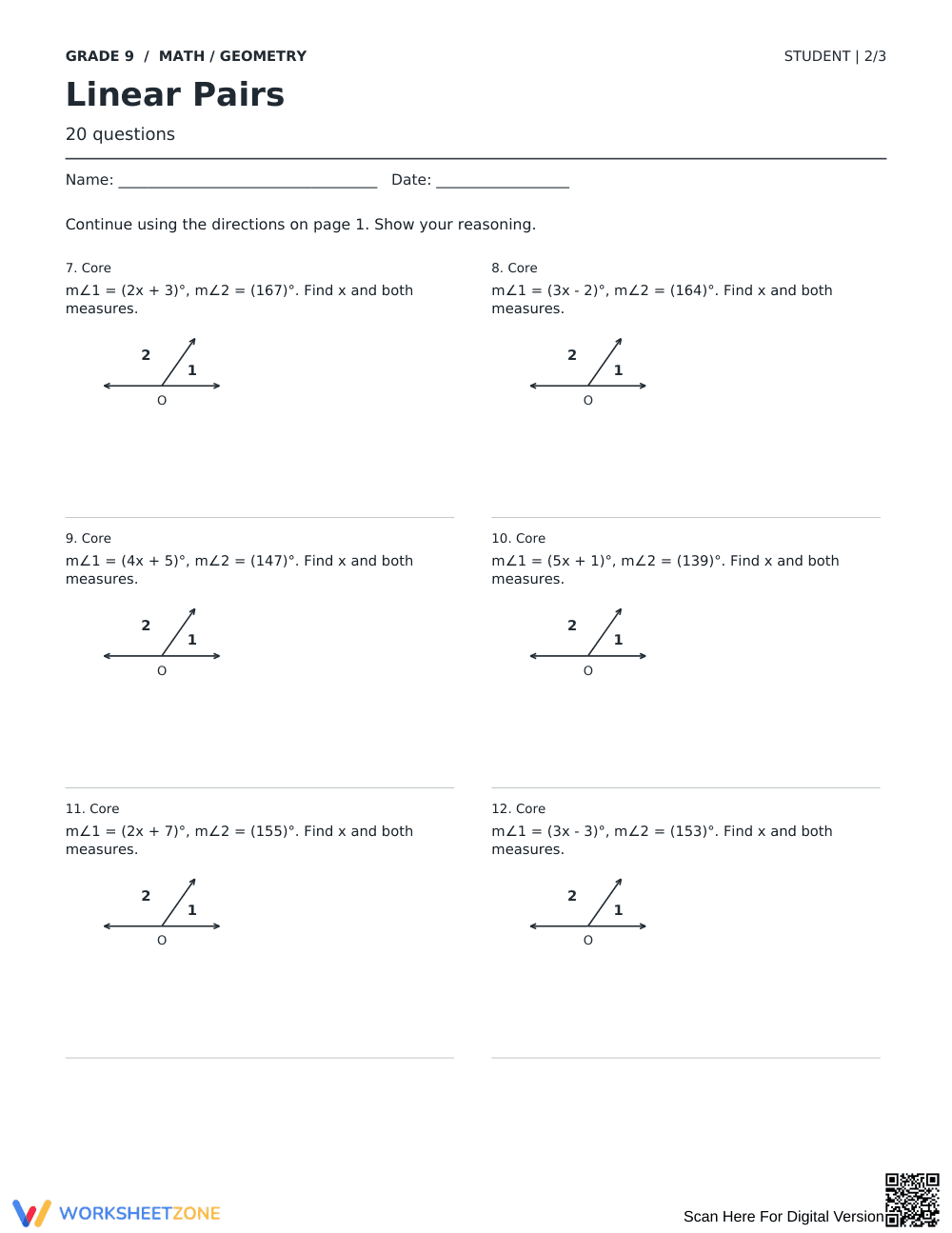
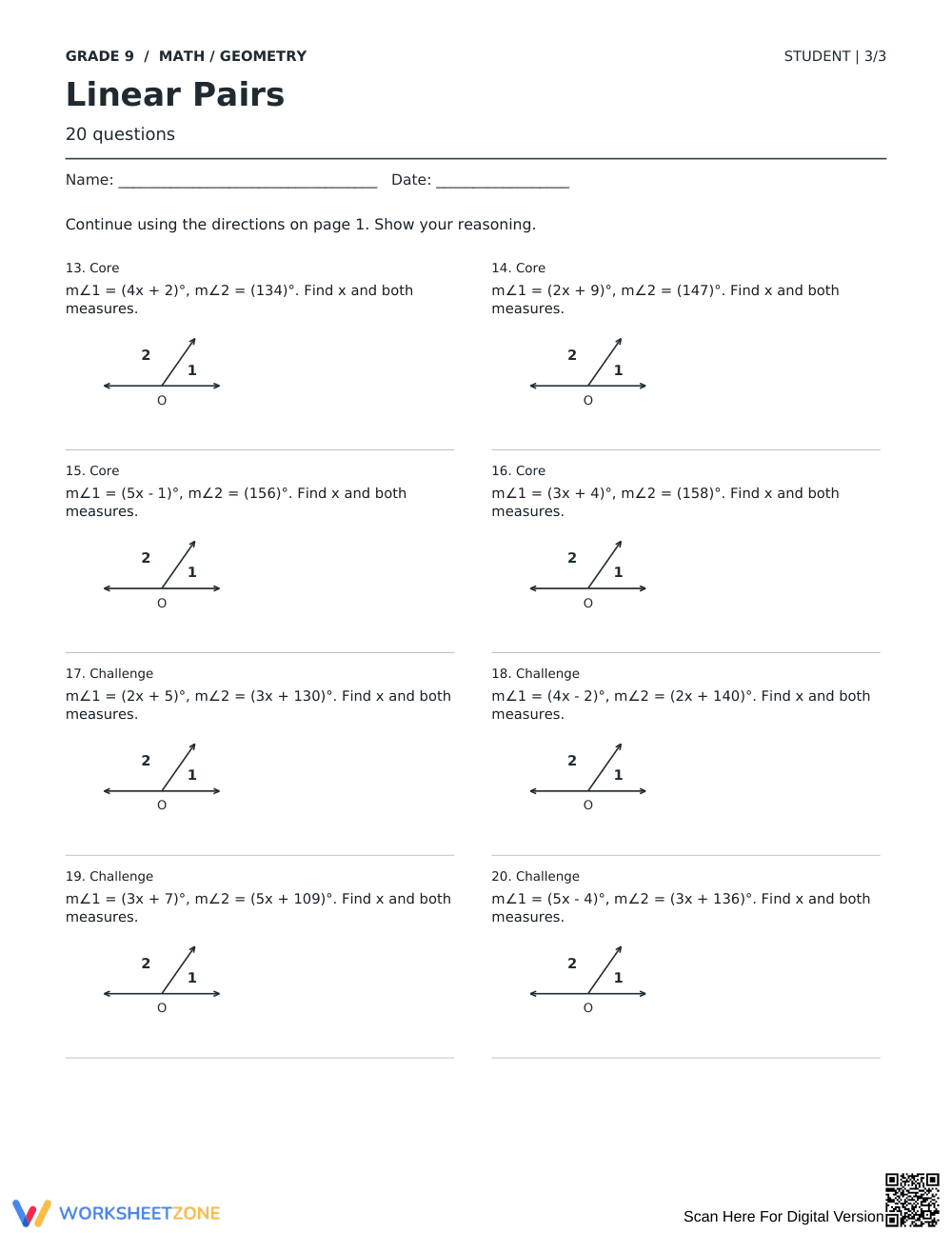
This Grade 9 geometry worksheet builds student fluency with linear pairs by presenting 20 structured problems that require identifying supplementary angle relationships and solving for unknown angle measures. Students practice applying the Linear Pair Postulate across a variety of diagram types, moving from straightforward identification to multi-step algebraic reasoning.
At a Glance
- Grade: 9 · Subject: Math, Geometry
- Standard:
CCSS.MATH.CONTENT.HSG-CO.C.9— Prove and apply theorems about lines and angles- Skill Focus: Linear pairs and supplementary angle relationships
- Format: 2 pages · 20 problems · Answer key included · PDF
- Best For: Guided practice after direct instruction
- Time: 20–35 minutes
The worksheet spans 2 student pages and includes 20 problems organized around labeled angle diagrams. Problems ask students to identify linear pairs, set up equations using the supplementary angle relationship (angles summing to 180°), and solve for missing angle values—including problems that embed algebraic expressions. The answer key provides fully worked solutions for every item, making self-correction and teacher review straightforward.
- Guided practice (Problems 1–6): Students identify whether angle pairs form a linear pair using clearly labeled diagrams. Minimal computation is required; the focus is on recognizing the relationship from a figure.
- Supported practice (Problems 7–14): Students write and solve one-step equations using the Linear Pair Postulate. Diagrams include numeric angle measures with one unknown, providing a concrete scaffold before abstraction.
- Independent practice (Problems 15–20): Students work with algebraic expressions for both angles, set up two-term equations, and solve for variables before finding each angle measure.
This gradual-release sequence mirrors the I Do, We Do, You Do framework, allowing teachers to assign sections selectively based on where students are in the instructional cycle.
The primary standard is CCSS.MATH.CONTENT.HSG-CO.C.9, targeting the lines-and-angles theorem cluster, specifically the Linear Pair Postulate as a foundational proof tool. A supporting connection exists to CCSS.MATH.CONTENT.8.G.A.5, which introduces angle relationships informally in Grade 8. Both standard codes can be copied directly into lesson plans, IEP goals, or district curriculum mapping tools.
Use this worksheet during direct instruction as a structured practice handout immediately following a teacher-led example on linear pairs. Assign Problems 1–6 as a whole-class check before releasing students to work independently on Problems 7–20. Alternatively, use the full worksheet after instruction as an exit-ticket extension or homework assignment. As a formative-assessment tip: watch for students who set up equations as angle₁ + angle₂ = 90° rather than 180°—this reveals confusion between complementary and supplementary relationships that warrants a brief re-teach.
This worksheet is designed for Grade 9 students in a standard or honors Geometry course. It is also appropriate for Grade 10 students who need review of foundational angle relationships before studying parallel lines or triangle theorems. Pair this resource with an angle-relationships anchor chart for maximum impact.
Research supports the effectiveness of structured, problem-set practice for geometry concept acquisition: Fisher & Frey (2014) identify gradual-release frameworks as a key driver of student mastery when moving from teacher-modeled examples to independent application. Teachers can use student performance on the algebraic problems (items 15–20) as a direct indicator of readiness for two-column proof work involving angle relationships.


