


























Views
Downloads
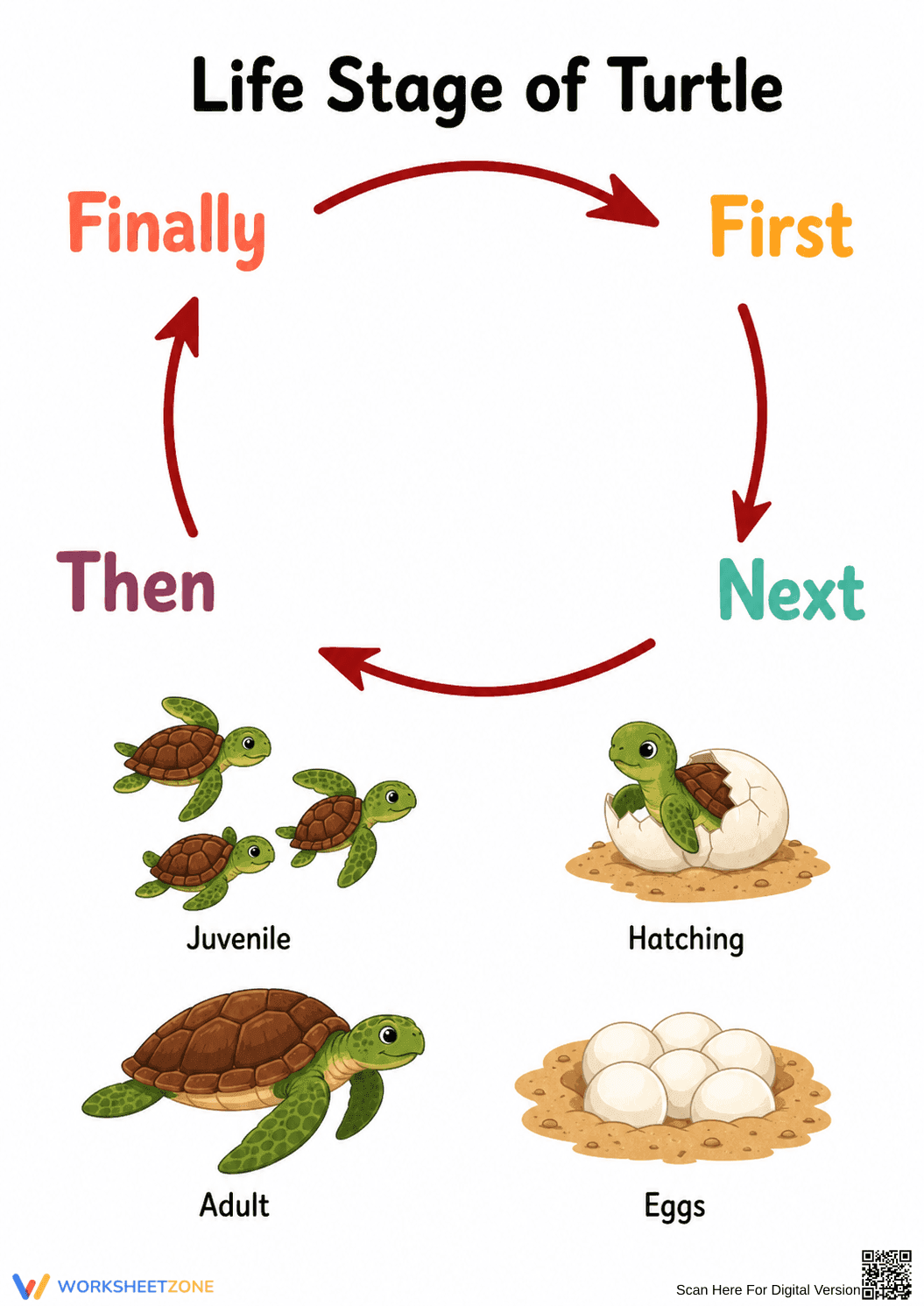

Turtle Life Cycle Worksheet | Essential Grade 6 Science
Paste this activity's link or code into your existing LMS (Google Classroom, Canvas, Teams, Schoology, Moodle, etc.).
Students can open and work on the activity right away, with no student login required.
You'll still be able to track student progress and results from your teacher account.
This Grade 6 turtle life cycle worksheet provides a clear, visual representation of biological development stages. Students identify the sequential progression from eggs to adulthood, establishing a foundational understanding of animal growth and survival. By using this resource, learners can effectively explain the life stages required for species continuity in various ecosystems.
At a Glance
- Grade: 6–12 · Subject: Science
- Standard:
MS-LS1-4— Use evidence to explain how animal behaviors and structures affect reproduction probability- Skill Focus: Biological Life Cycles
- Format: 1 page · 4 stages · Visual Diagram · PDF
- Best For: Foundational review and visual science anchors
- Time: 15–20 minutes
What's Inside
The resource features a high-quality, single-page diagram illustrating four key stages of a turtle's life: eggs, hatching, juvenile, and adult. It utilizes clear sequence markers—First, Next, Then, and Finally—to guide student observation. The layout is designed for immediate use as a reference sheet or a guided note-taking template during life science lectures.
Zero-Prep Workflow
- Print: Generate copies of the single-page PDF in under 30 seconds for your entire class.
- Distribute: Hand out the worksheets as a warm-up activity or as a supplemental visual aid during direct instruction.
- Review: Spend 5 minutes discussing the transition between the juvenile and adult stages to reinforce biological maturity concepts.
Total teacher preparation time is less than 2 minutes, making this an ideal resource for emergency sub plans or quick formative assessments.
Standards Alignment
This worksheet aligns with MS-LS1-4: Use argument based on empirical evidence and scientific reasoning to support an explanation for how characteristic animal behaviors and specialized plant structures affect the probability of successful reproduction of animals and plants respectively. Both standard codes can be copied directly into lesson plans, IEP goals, or district curriculum mapping tools.
How to Use It
Use this worksheet as a visual anchor during the introductory phase of a unit on animal reproduction and growth. It serves as an excellent formative assessment tool; ask students to describe the environmental threats a turtle faces at each specific stage shown. Completion typically takes 15 to 20 minutes when paired with a short instructional video or textbook reading.
Who It's For
This worksheet is ideal for Grade 6 students who benefit from visual scaffolds when learning complex biological cycles. It is particularly useful for English Language Learners (ELLs) due to the clear imagery and sequential vocabulary. Pair this with a detailed reading passage on marine biology or an anchor chart about reptilian characteristics for a complete lesson.
According to the RAND AIRS 2024 report on science literacy, visual sequencing tools are critical for middle school students to internalize complex biological processes. This turtle life cycle worksheet provides a foundational visual framework that aligns with MS-LS1-4, focusing on the developmental stages necessary for successful animal reproduction. By breaking down the life cycle into four distinct, observable phases—eggs, hatching, juvenile, and adult—the resource helps students transition from concrete observation to abstract scientific reasoning. Research from Fisher & Frey (2014) suggests that such graphic organizers reduce cognitive load, allowing learners to focus on the causal relationships between life stages rather than just memorizing terminology. This printable resource serves as an effective scaffold for Grade 6 students, ensuring they meet core standards while building the vocabulary required for advanced biology. It is a proven tool for classroom instruction, providing clear evidence of student understanding in life science curriculum mapping.


