


























Views
Downloads
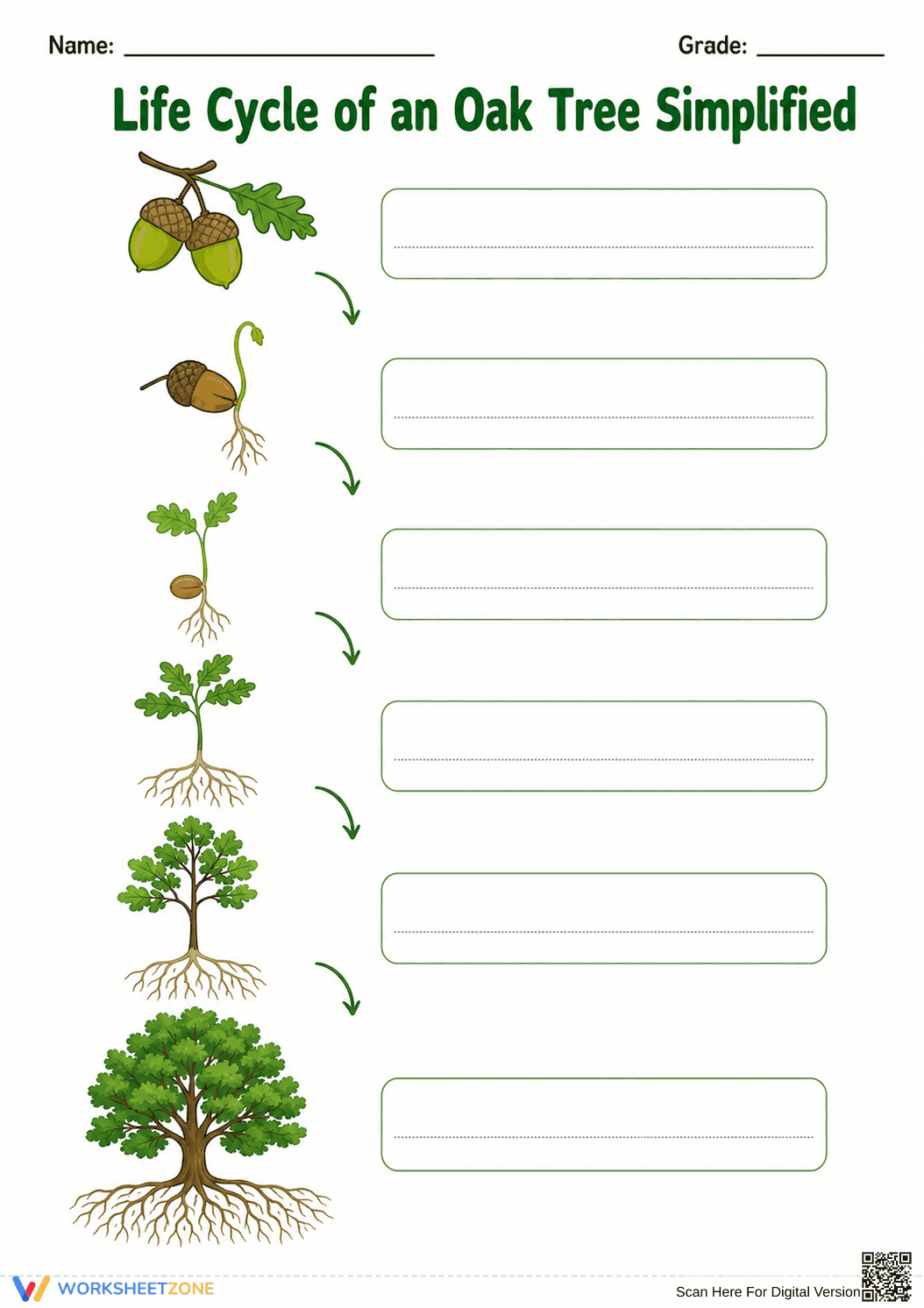

Grade 3 Oak Tree Life Cycle — Printable No-Prep Worksheet
Paste this activity's link or code into your existing LMS (Google Classroom, Canvas, Teams, Schoology, Moodle, etc.).
Students can open and work on the activity right away, with no student login required.
You'll still be able to track student progress and results from your teacher account.
This printable science worksheet helps students sequence and describe the life cycle of an oak tree. By examining six distinct growth stages from acorn to mature tree, learners will develop a clear understanding of plant development. The straightforward layout ensures students can immediately begin labeling and explaining each phase.
At a Glance
- Grade: 3 · Subject: Science
- Standard:
3-LS1-1— Describe that organisms have unique and diverse life cycles- Skill Focus: Sequencing plant growth stages
- Format: 1 page · 6 problems · PDF
- Best For: Independent practice or review
- Time: 10–15 minutes
This single-page resource features six high-quality illustrations depicting the progression of an oak tree's life, starting with an acorn and ending with a fully grown tree. Next to each illustration is a blank writing space with guided dotted lines, allowing students to either label the stage or write a brief descriptive sentence about the visible changes, such as root emergence or leaf development.
- Print (1 minute): Simply print the single-page PDF. No special materials or cutting required.
- Distribute (1 minute): Hand out the worksheet as a standalone activity or alongside a science text.
- Review (3 minutes): Quickly check student responses using the visual cues as a guide.
Total teacher prep time is under two minutes, making this an ideal resource for emergency sub plans or quick formative assessments.
Aligned to primary standard 3-LS1-1: Develop models to describe that organisms have unique and diverse life cycles but all have in common birth, growth, reproduction, and death. This visual model perfectly supports the concept of continuous growth and development in plants. Both standard codes can be copied directly into lesson plans, IEP goals, or district curriculum mapping tools.
Use this worksheet as an independent practice activity after direct instruction on plant life cycles. Alternatively, it serves as an excellent warm-up exercise where students predict the stages before a formal lesson begins. As a formative assessment tip, observe whether students correctly identify the transition from seedling to sapling, noting their use of appropriate scientific vocabulary in the writing spaces. Expected completion time is 10 to 15 minutes.
This resource is designed for elementary science students, particularly those in third grade mastering life science concepts. It provides built-in visual differentiation for English Language Learners or students needing visual scaffolds. Pair this worksheet with a hands-on seed germination lab or a read-aloud book about forests to deepen comprehension.
Aligning instructional materials with established science standards is crucial for building foundational knowledge in early elementary education. This resource directly supports 3-LS1-1 by requiring students to describe that organisms have unique and diverse life cycles. According to a recent ScienceDirect TpT Analysis, visually structured worksheets that combine clear illustrations with immediate writing prompts significantly improve vocabulary retention and conceptual sequencing in young learners. By breaking down the complex biological process of an oak tree's maturation into six distinct, observable stages, educators can effectively reduce cognitive load during instruction. This targeted, step-by-step approach ensures that students not only memorize the chronological order of events but also understand the biological significance of each phase, from initial seed germination to adult reproduction, ultimately fostering deeper scientific literacy in the classroom.


