


























Views
Downloads

Oak Tree Life Cycle Worksheet | Essential Grade 5 Science
Paste this activity's link or code into your existing LMS (Google Classroom, Canvas, Teams, Schoology, Moodle, etc.).
Students can open and work on the activity right away, with no student login required.
You'll still be able to track student progress and results from your teacher account.
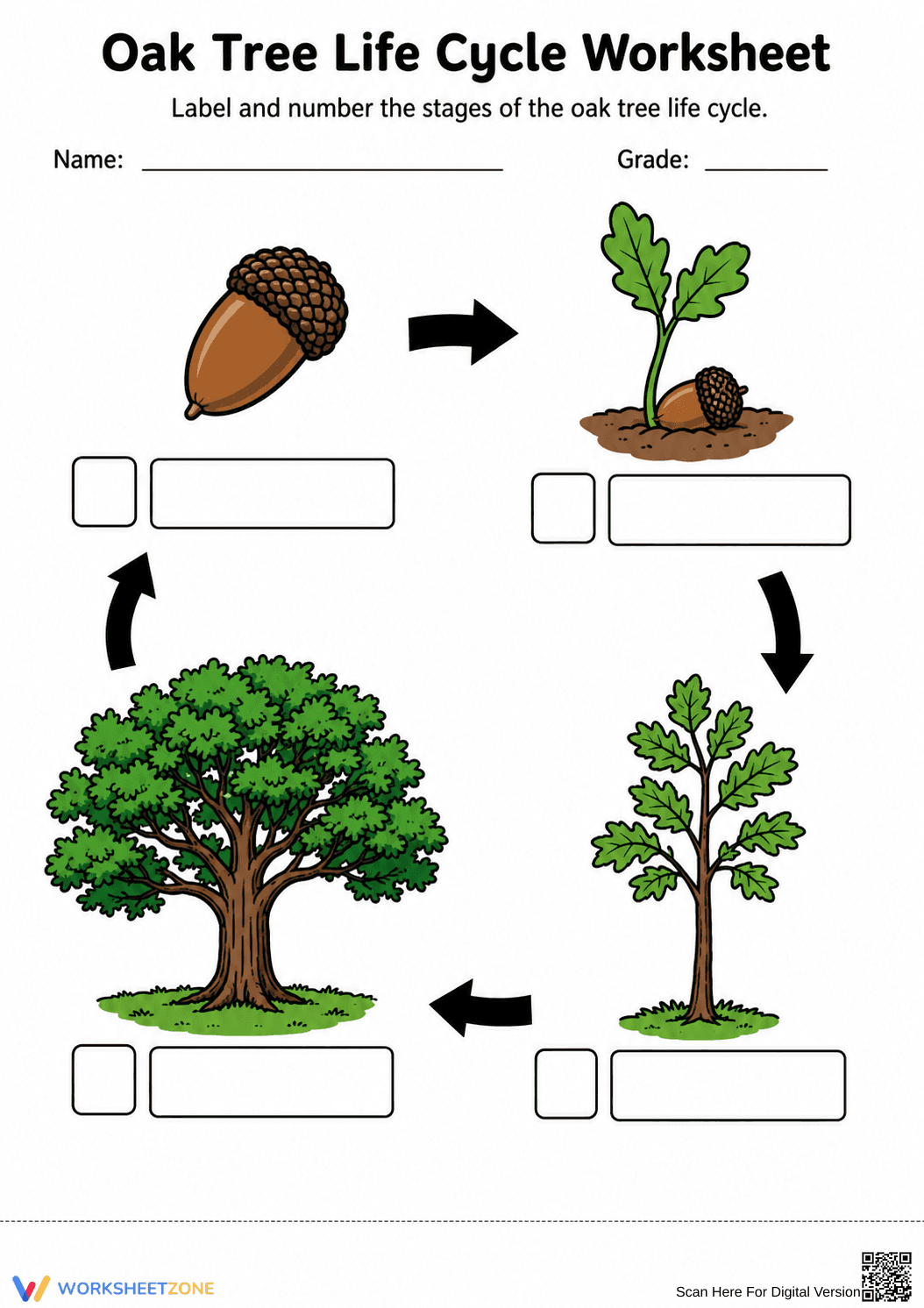
This Grade 5 science worksheet provides a clear visual model for students to identify and sequence the life cycle of an oak tree. By examining the transition from acorn to mature tree, learners develop a concrete understanding of plant growth and reproduction. It simplifies complex biological processes into four distinct, manageable stages for classroom mastery.
At a Glance
- Grade: 5 · Subject: Science
- Standard:
3-LS1-1— Develop models to describe that organisms have unique and diverse life cycles- Skill Focus: Plant life cycle sequencing
- Format: 1 page · 4 problems · Answer key included · PDF
- Best For: Quick formative assessment or science centers
- Time: 10–15 minutes
The resource features a high-quality diagram illustrating the four primary stages of an oak tree: the seed (acorn), sprout, sapling, and mature oak. It includes clear directional arrows to demonstrate the cyclical nature of plant life. The single-page PDF format ensures easy printing, and the included answer key allows for immediate student feedback or self-grading.
Zero-Prep Workflow: This worksheet is designed for maximum efficiency in busy classrooms. First, print the single-page PDF (30 seconds). Second, distribute the copies to students as a warm-up or exit ticket (1 minute). Third, review the four stages using the provided answer key to confirm student comprehension (1 minute). Total teacher preparation time is under two minutes, making it an ideal sub-plan addition.
The primary standard addressed is `3-LS1-1`, which requires students to develop models to describe that organisms have unique and diverse life cycles but all have in common birth, growth, reproduction, and death. This worksheet serves as a foundational model for these biological concepts. Both standard codes can be copied directly into lesson plans, IEP goals, or district curriculum mapping tools.
Use this worksheet during the "Explain" phase of a 5E lesson model to solidify vocabulary like "sapling" and "mature." It also works well as a formative assessment after a nature walk or tree identification activity. Teachers should observe if students can explain the transition between the sprout and sapling stages. Completion typically takes 10 to 15 minutes.
This resource is tailored for Grade 5 students but remains relevant for middle school biology review. It is particularly effective for visual learners and English Language Learners (ELLs) who benefit from the clear pictorial representations. Pair this with a local tree identification guide or a time-lapse video of a germinating acorn for a comprehensive lesson.
According to the RAND AIRS 2024 report, visual modeling in elementary science significantly improves long-term retention of biological sequences compared to text-only instruction. This worksheet leverages that research by providing a clear, four-stage model of the oak tree life cycle, aligned to the 3-LS1-1 standard. By focusing on the specific student action of modeling growth from seed to maturity, the resource helps bridge the gap between abstract biological concepts and observable natural phenomena. Research from Fisher & Frey (2014) emphasizes that such graphic organizers are essential for scaffolding complex scientific vocabulary for diverse learners. This printable tool ensures that students can accurately identify the acorn, sprout, sapling, and mature oak stages, providing a robust foundation for later studies in ecology and botany. It is a high-utility asset for any standards-based science curriculum, offering a reliable way to measure student understanding of life science progressions.


