




























Views
Downloads

Grade 3 Snake Life Cycle — Printable No-Prep Worksheet

Paste this activity's link or code into your existing LMS (Google Classroom, Canvas, Teams, Schoology, Moodle, etc.).
Students can open and work on the activity right away, with no student login required.
You'll still be able to track student progress and results from your teacher account.
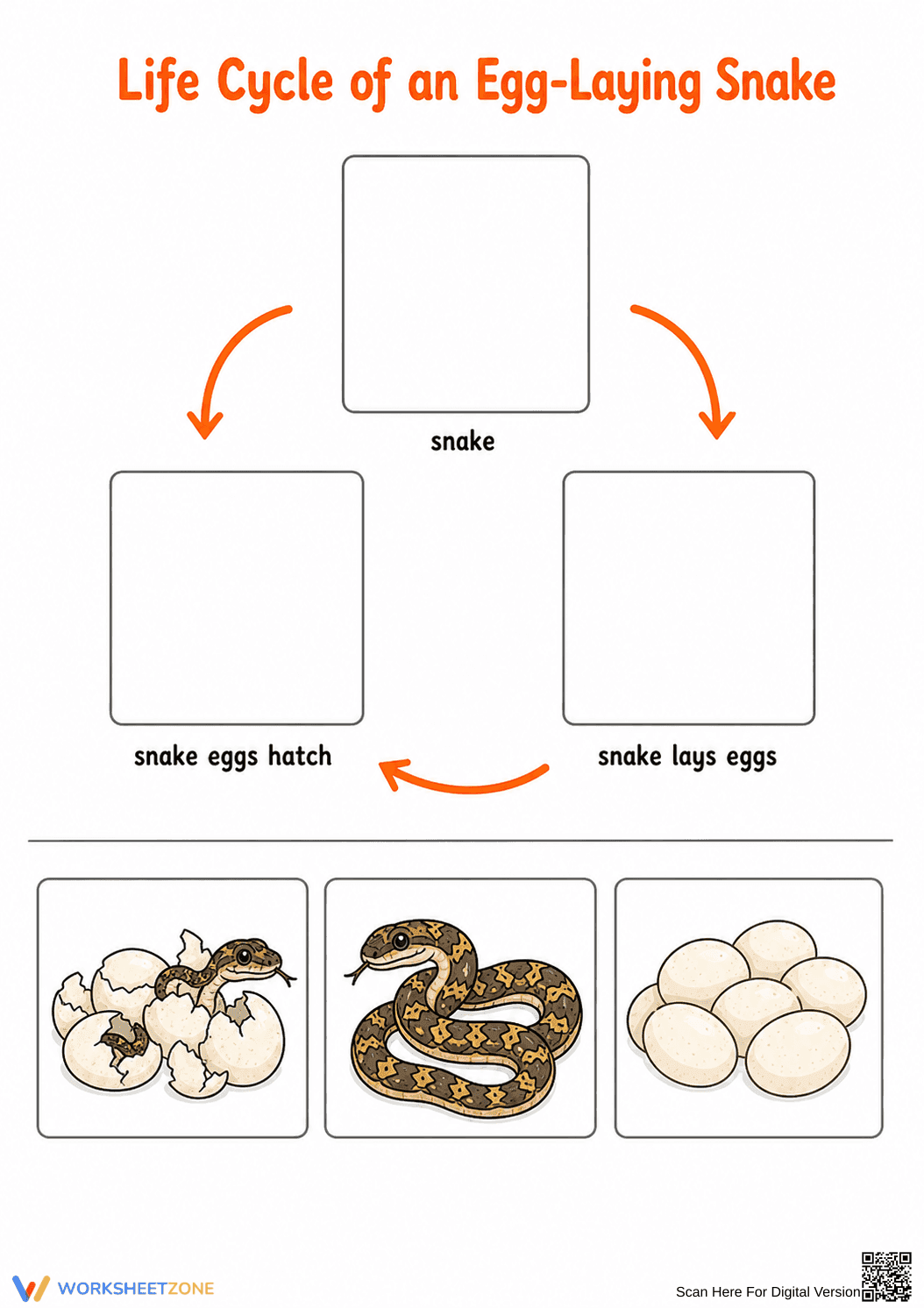
This Grade 3 science worksheet helps students master biological sequencing by modeling the life cycle of an egg-laying snake. Students will cut and paste images to correctly order the stages of development, reinforcing their understanding of how organisms grow and reproduce in a hands-on, engaging way.
At a Glance
- Grade: 3 · Subject: Science
- Standard:
3-LS1-1— Develop models to describe organism life cycles- Skill Focus: Sequencing animal life cycles
- Format: 1 page · 3 problems · PDF
- Best For: Independent science practice
- Time: 10–15 minutes
This single-page resource features a clear diagram with three empty boxes connected by directional arrows. Below the cycle diagram, students will find three illustrations: a clutch of snake eggs, a hatching baby snake, and a fully grown adult snake. The worksheet includes clear text labels for each stage, providing built-in vocabulary support for early readers as they complete the visual model.
This activity is designed for immediate classroom implementation.
- Print (1 min): Print the single-page PDF. No special materials needed beyond scissors and glue.
- Distribute (1 min): Hand out worksheets. Visual instructions are intuitive enough to begin immediately.
- Review (2 mins): Check work by ensuring the adult snake, eggs, and hatching snake follow the loop.
With teacher prep under two minutes, this is ideal for science centers or sub plans.
This worksheet is directly aligned to the Next Generation Science Standards, specifically focusing on 3-LS1-1: Develop models to describe that organisms have unique and diverse life cycles but all have in common birth, growth, reproduction, and death. By physically placing the stages into a continuous loop, students create a working model of this biological concept. Both standard codes can be copied directly into lesson plans, IEP goals, or district curriculum mapping tools.
This resource works perfectly as an independent practice activity following direct instruction on reptile characteristics or general animal life cycles. Teachers can also use it as a hands-on science center station where students sequence the cards before gluing them down. For a quick formative assessment observation tip, watch how students interpret the directional arrows; this reveals their understanding of the cycle's continuous nature rather than just a linear timeline. Expected completion time ranges from 10 to 15 minutes.
This worksheet is primarily designed for third-grade general education students, though its highly visual nature makes it excellent for English Language Learners and students requiring modified science materials. The cut-and-paste format provides a tactile modification for students who struggle with extensive writing tasks. It pairs naturally with informational texts about reptiles or a broader unit comparing the life cycles of mammals, amphibians, and egg-laying animals.
Understanding biological sequences through visual modeling is a critical component of early elementary science education. This worksheet directly targets 3-LS1-1, requiring students to develop models to describe organism life cycles. According to a ScienceDirect TpT Analysis, hands-on sequencing activities like cut-and-paste diagrams significantly improve long-term retention of cyclical concepts compared to passive reading alone. By physically manipulating the stages of the snake's development—from eggs to hatching to adulthood—students bridge the gap between abstract biological processes and concrete visual evidence. This active engagement helps solidify the foundational understanding that all living things experience birth, growth, reproduction, and death in a continuous loop. Utilizing these tactile models ensures that diverse learners can successfully access complex scientific standards while simultaneously practicing essential fine motor skills in the classroom.


