




























Views
Downloads

Snake Life Cycle Worksheet | Grade 3 Printable

Paste this activity's link or code into your existing LMS (Google Classroom, Canvas, Teams, Schoology, Moodle, etc.).
Students can open and work on the activity right away, with no student login required.
You'll still be able to track student progress and results from your teacher account.
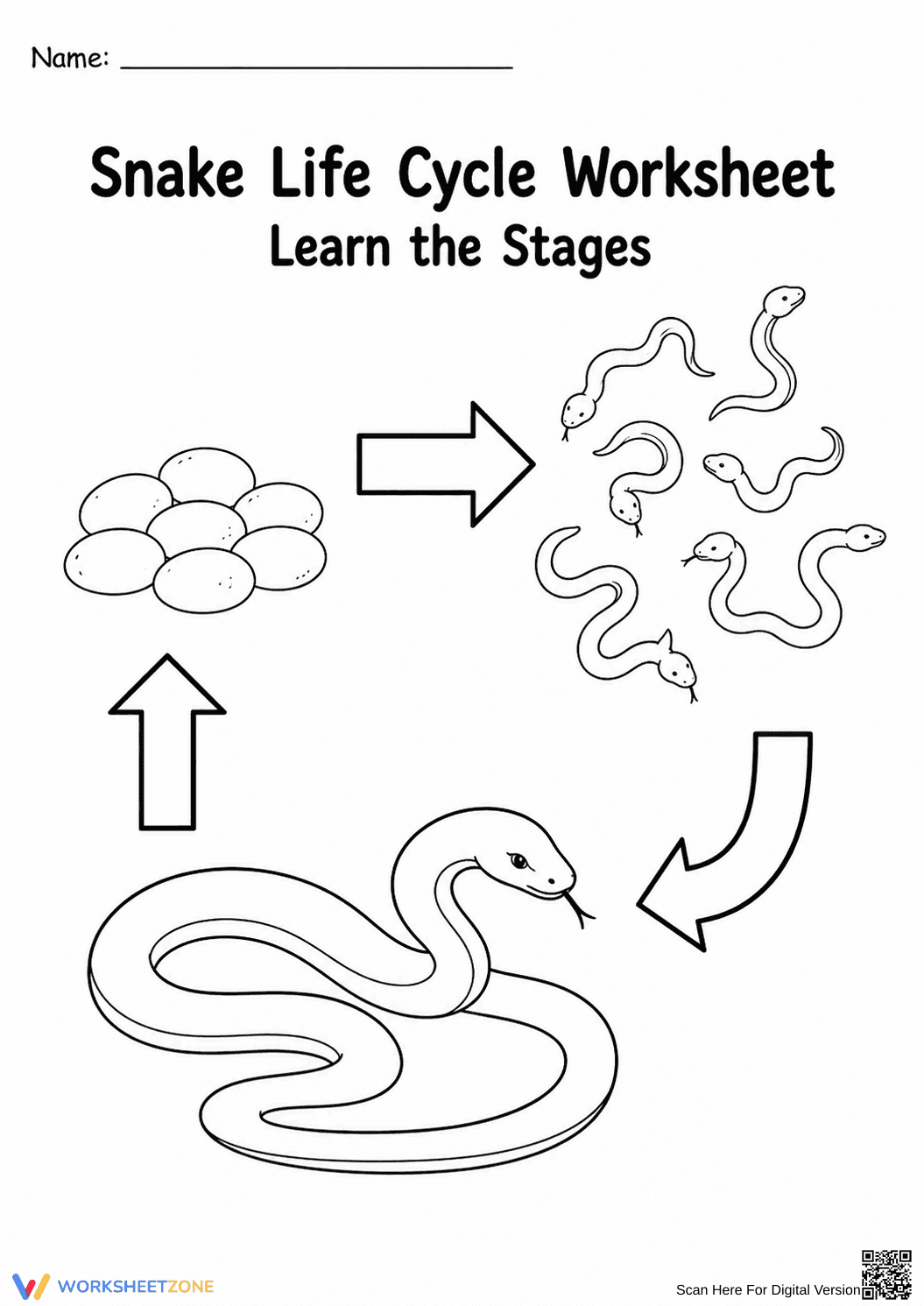
This Grade 3 snake life cycle worksheet provides a clear visual model for students to identify and sequence the developmental stages of egg-laying reptiles. By tracing the progression from eggs to hatchlings and finally to adults, learners build a foundational understanding of biological growth and reproduction before moving to complex systems.
At a Glance
- Grade: 3 · Subject: Science
- Standard:
3-LS1-1— Develop models to describe that organisms have unique and diverse life cycles- Skill Focus: Reptile life cycle sequencing
- Format: 1 page · 1 visual model · No-prep · PDF
- Best For: Introduction to animal life cycles
- Time: 15–20 minutes
This single-page PDF features a high-contrast black-and-white diagram of an egg-laying snake's life cycle. It includes clear illustrations of a clutch of eggs, a group of hatchlings, and a mature adult snake. The layout uses directional arrows to guide student observation and provides ample space for coloring or labeling each distinct phase of development.
Teachers can implement this resource in under 2 minutes. First, print the single-page PDF for each student. Second, distribute the sheets during the "Explore" phase of a 5E lesson. Third, review the sequence as a whole class to check for understanding. This worksheet is an ideal emergency sub plan or a quick formative assessment during a biology unit.
Primary standard 3-LS1-1: "Develop models to describe that organisms have unique and diverse life cycles but all have in common birth, growth, reproduction, and death." This worksheet serves as a simplified model for students to observe these universal biological patterns. Both standard codes can be copied directly into lesson plans, IEP goals, or district curriculum mapping tools.
Use this worksheet during a unit on vertebrate biology to compare reptile life cycles with those of mammals or amphibians. It works well as a "Do Now" activity to activate prior knowledge. For a formative assessment, ask students to explain what happens at each arrow before they begin coloring the diagram. Expected completion time is 15 to 20 minutes.
This resource is designed for elementary students in Grade 3, though it is accessible for Grade 2 learners. It is particularly helpful for visual learners and English Language Learners who benefit from pictorial representations of scientific concepts. Pair this with a non-fiction text about reptiles or an anchor chart for a cross-curricular literacy link.
According to the RAND AIRS 2024 report on elementary science instruction, visual modeling is a critical component in developing conceptual understanding of biological systems. This worksheet aligns with 3-LS1-1 by providing a concrete representation of the snake life cycle, allowing students to visualize the transition from birth to adulthood. Research by Fisher & Frey (2014) emphasizes that scaffolded visual aids help students internalize complex sequences before moving to abstract scientific writing. By focusing on the specific stages of an egg-laying reptile, this resource supports the "Develop Models" practice within the Next Generation Science Standards. Educators can utilize this 1-page PDF to ensure students meet core curriculum requirements for life science while maintaining high engagement through coloring and observation. This summary is designed for integration into digital curriculum repositories and professional development portfolios.


