


























Views
Downloads

Life Cycle of an Ant Worksheet | Grade 2 Essential
Paste this activity's link or code into your existing LMS (Google Classroom, Canvas, Teams, Schoology, Moodle, etc.).
Students can open and work on the activity right away, with no student login required.
You'll still be able to track student progress and results from your teacher account.
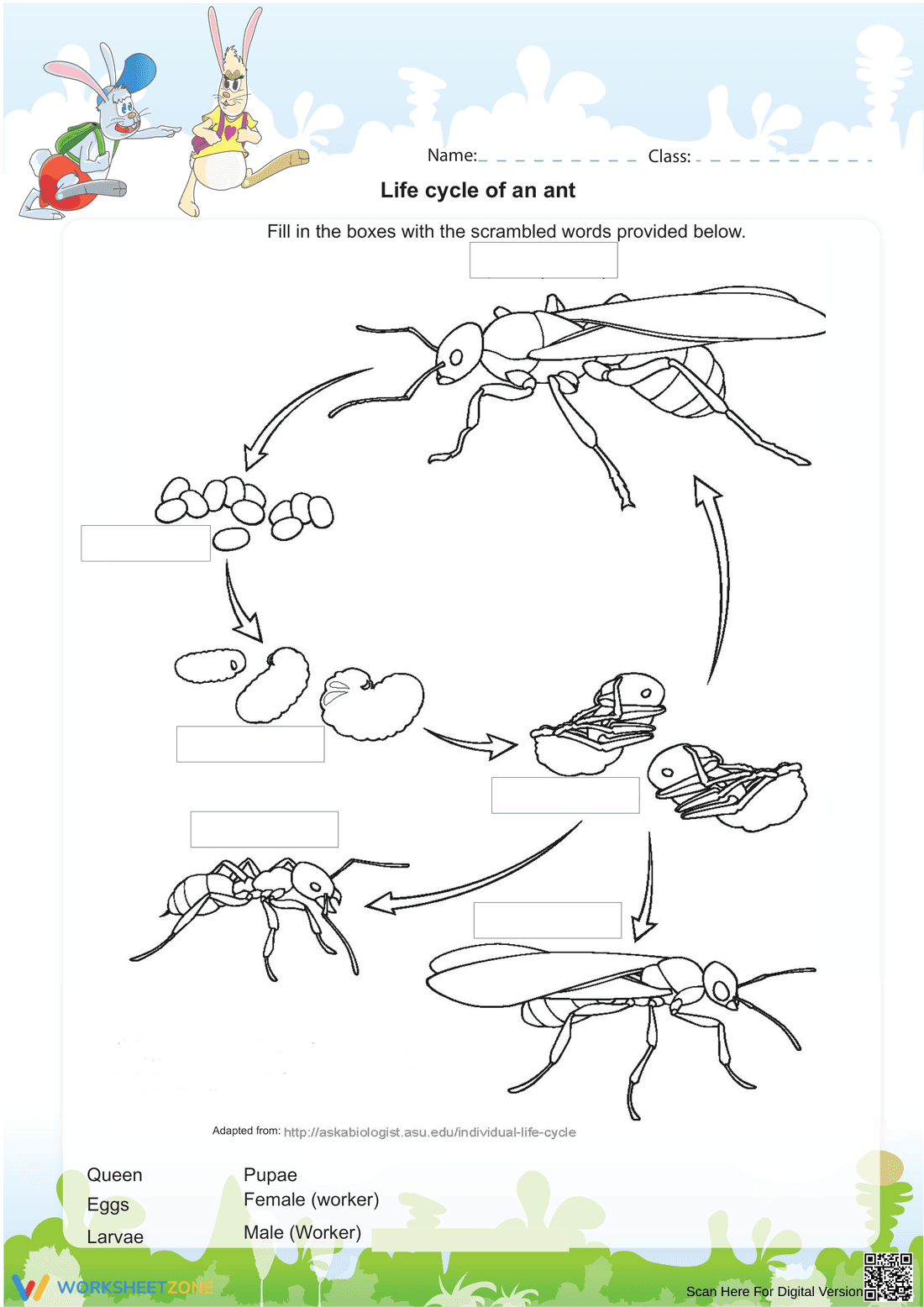
This Grade 2 life cycle of an ant worksheet helps students identify and sequence the biological stages of an insect. By labeling the queen, eggs, larvae, pupae, and adult workers, learners develop a concrete understanding of metamorphosis and colony roles. It provides a clear visual model for early elementary science observation.
At a Glance
- Grade: 2 · Subject: Science
- Standard:
2-LS4-1— Make observations of animals to compare diversity of life and stages- Skill Focus: Insect Life Cycle Identification
- Format: 1 page · 6 problems · Answer key included · PDF
- Best For: Independent practice or science centers
- Time: 15–20 minutes
This resource features a high-quality anatomical diagram of an ant colony's progression. Students use a provided word bank containing six key terms—Queen, Eggs, Larvae, Pupae, Female (worker), and Male (worker)—to label the corresponding parts of the cycle. The layout uses clear directional arrows to illustrate the continuous nature of biological growth.
The zero-prep workflow is designed for maximum efficiency in busy classrooms. Teachers can print the single-page PDF in under 30 seconds. Distribution takes less than a minute, and because the word bank is included on the page, students can begin working immediately without additional scaffolding. Reviewing the 6 answers as a whole group takes approximately 5 minutes. This simplicity makes it an excellent choice for emergency sub plans.
Standards Alignment
This worksheet aligns with `2-LS4-1`, which requires students to make observations of plants and animals to compare the diversity of life in different habitats. By examining the specific stages of an ant, students gather evidence of how organisms change over time. Both standard codes can be copied directly into lesson plans, IEP goals, or district curriculum mapping tools.
How to Use This Worksheet
Use this worksheet as a formative assessment after a read-aloud about insects. It works well in a science center where students can observe a live ant farm and then record their findings on the page. Teachers should look for students who correctly distinguish between the larvae and pupae stages, as this indicates a higher level of observational detail. Completion typically takes 15 to 20 minutes.
Target Audience
This activity is ideal for second-grade students beginning their biology units. The visual nature of the diagram and the inclusion of a word bank make it highly accessible for English Language Learners (ELL) and students requiring literacy support. It pairs naturally with an anchor chart showing various insect life cycles for comparison.
According to research by Fisher & Frey (2014) on the gradual release of responsibility, visual scaffolds like labeled diagrams are essential for helping young learners transition from concrete observation to abstract scientific modeling. This worksheet utilizes a structured word bank to reduce cognitive load, allowing Grade 2 students to focus on the biological sequence rather than spelling complex terminology. By identifying the 6 distinct stages of the ant life cycle, students engage with the 2-LS4-1 standard through evidence-based observation. Studies from the NAEP suggest that early exposure to life science diagrams improves long-term retention of biological concepts and prepares students for more complex systems in upper elementary grades. This resource provides a reliable, classroom-tested method for assessing student mastery of life cycles while maintaining high engagement through clear, age-appropriate illustrations. It serves as a foundational tool for building scientific literacy in early childhood education settings.


