




























Views
Downloads
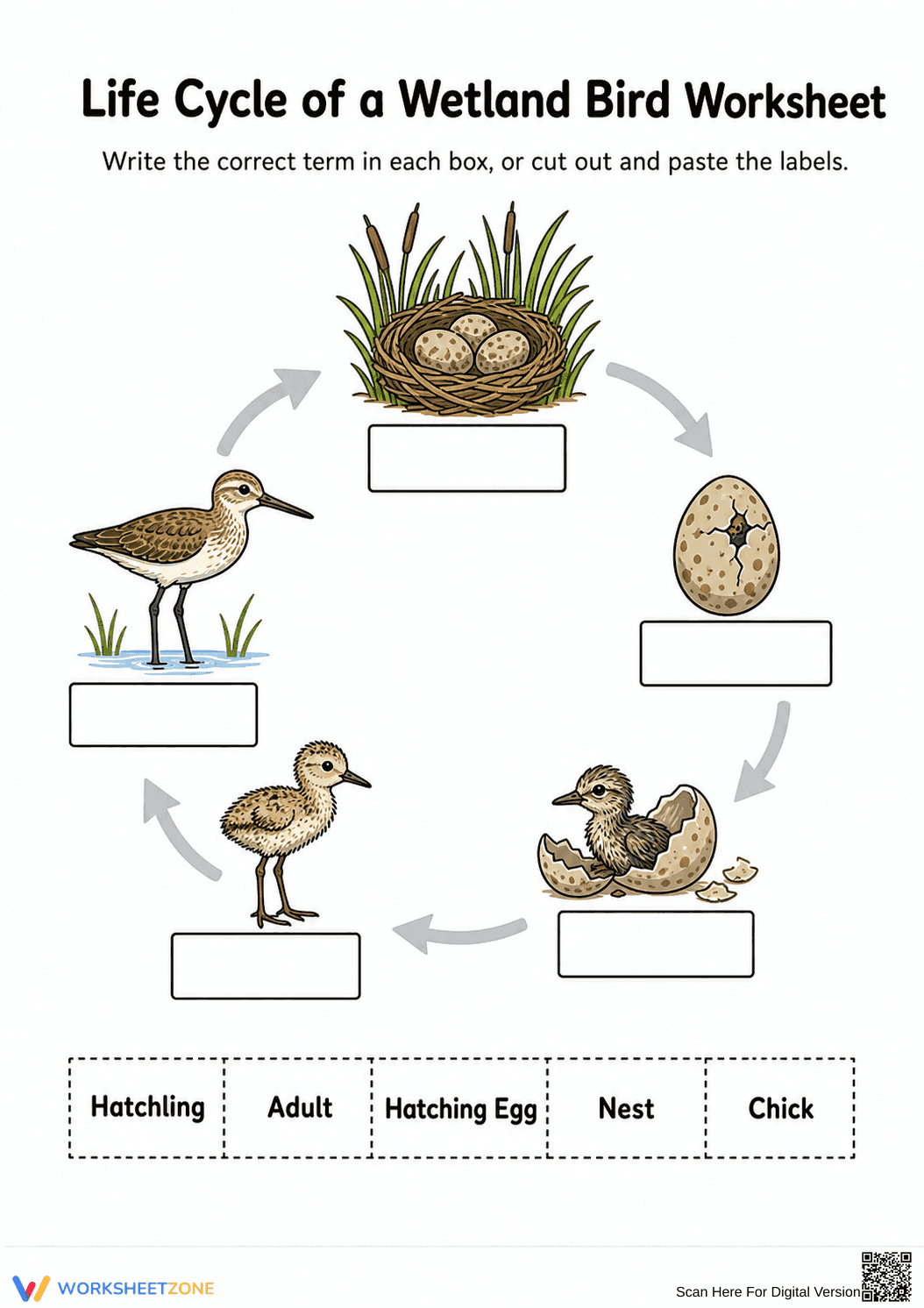

Grade 3 Bird Life Cycle — Printable No-Prep Worksheet

Paste this activity's link or code into your existing LMS (Google Classroom, Canvas, Teams, Schoology, Moodle, etc.).
Students can open and work on the activity right away, with no student login required.
You'll still be able to track student progress and results from your teacher account.
This wetland bird life cycle worksheet helps students visualize and sequence the developmental stages of an organism. By labeling a circular diagram, learners actively connect vocabulary to biological processes. The activity reinforces foundational science concepts while providing fine motor practice through an optional cut-and-paste format.
At a Glance
- Grade: 3 · Subject: Science
- Standard:
3-LS1-1— Sequence the stages of an organism's life cycle- Skill Focus: Biological sequencing and vocabulary
- Format: 1 page · 5 problems · Answer key included · PDF
- Best For: Independent practice or science centers
- Time: 10–15 minutes
This single-page resource features a clear, illustrated circular diagram showing the progression from nest to adult bird. Students complete five labeling tasks using the provided word bank at the bottom of the page. The flexible design allows learners to either write the terms directly into the blank boxes or cut out the labels and paste them in place. A complete answer key is included for quick grading.
This resource is designed for immediate classroom implementation with minimal teacher setup:
- Print (1 minute): Generate enough copies of the single-page PDF for your class roster.
- Distribute (1 minute): Hand out the sheets along with scissors and glue sticks if using the cut-and-paste option.
- Review (2 minutes): Quickly check student work against the provided answer key.
With under two minutes of total prep time required, this activity is an excellent addition to emergency sub plans or busy science blocks.
This activity aligns with 3-LS1-1, requiring students to develop models to describe that organisms have unique and diverse life cycles but all have in common birth, growth, reproduction, and death. It also supports early elementary sequencing skills. Both standard codes can be copied directly into lesson plans, IEP goals, or district curriculum mapping tools.
Deploy this worksheet during direct instruction as a guided note-taking tool while discussing animal development. Alternatively, place it in a science center for independent review after reading a text about wetland habitats. As a formative assessment tip, observe whether students correctly place the "Hatching Egg" and "Hatchling" stages in the proper sequence before the "Chick" stage. Most students will complete the task within 10 to 15 minutes.
This resource is ideal for early elementary students mastering basic biological concepts. The dual-format design (writing or cutting) provides built-in differentiation for learners who need fine motor support versus those ready for spelling practice. It pairs perfectly with an introductory lesson on wetland ecosystems or a read-aloud about bird habitats.
Understanding biological progressions is a fundamental component of early science education. When students interact with visual models like this one, they build stronger mental frameworks for complex natural phenomena. According to EdReports 2024, integrating clear diagrams with targeted vocabulary practice significantly improves retention of scientific concepts in elementary grades. This resource directly supports 3-LS1-1 by helping learners sequence the stages of an organism's life cycle. By physically manipulating the labels or writing the terms in a continuous loop, students reinforce the cyclical nature of life, growth, and reproduction. This hands-on approach bridges the gap between abstract biological concepts and concrete understanding, ensuring learners can confidently describe how living things change over time. Providing multiple modalities for completion, such as cutting and pasting or handwriting, further solidifies these essential science skills.


