


























Views
Downloads
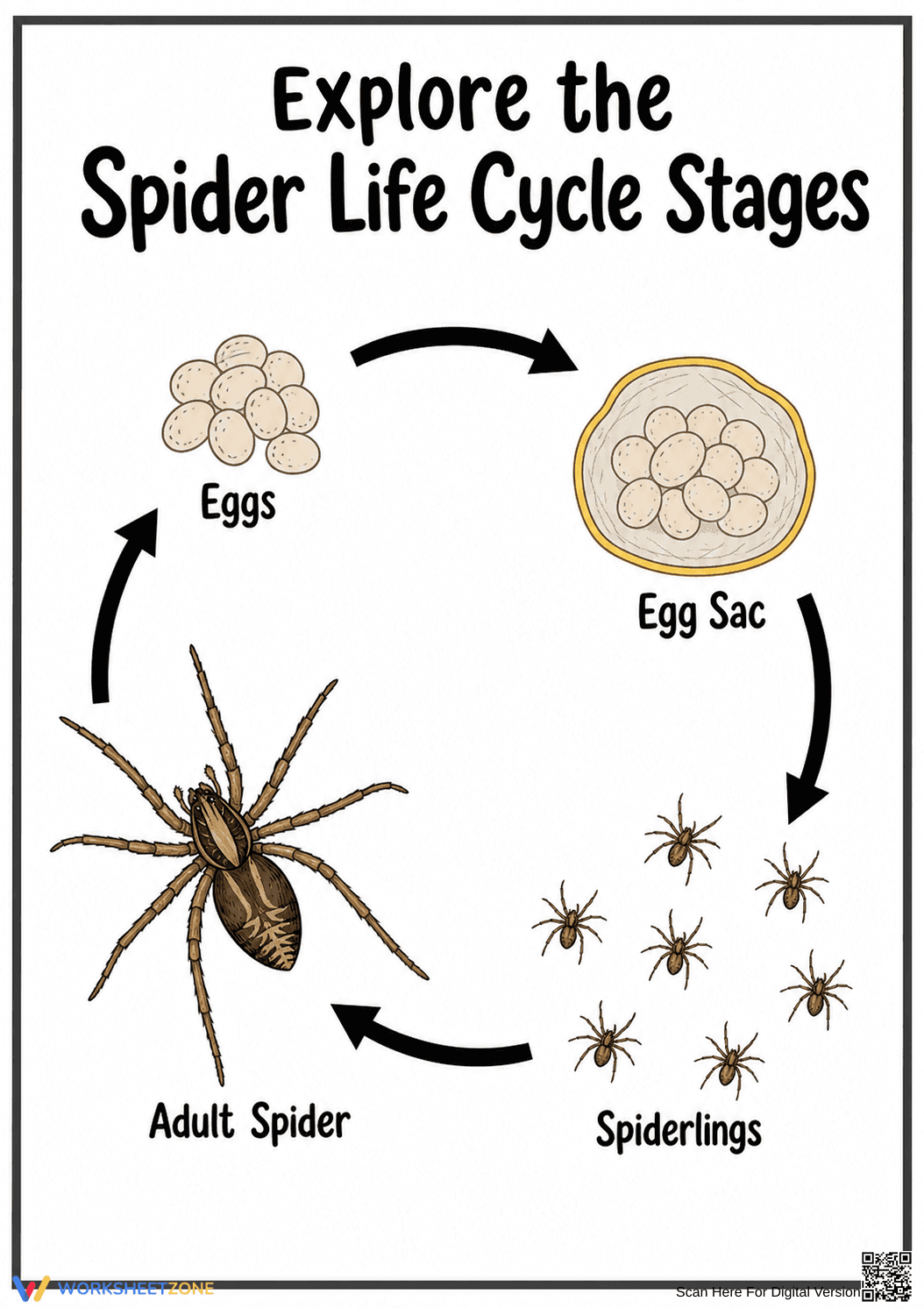

Spider Life Cycle Diagram | Grade 3 Essential Worksheet
Paste this activity's link or code into your existing LMS (Google Classroom, Canvas, Teams, Schoology, Moodle, etc.).
Students can open and work on the activity right away, with no student login required.
You'll still be able to track student progress and results from your teacher account.
This Grade 3 spider life cycle worksheet provides a clear visual model for students to identify and sequence the biological stages of arachnid development. By observing the transition from eggs to adult spiders, learners build a foundational understanding of growth and reproduction in the animal kingdom before moving to more complex biological systems.
At a Glance
- Grade: 3 · Subject: Science
- Standard:
3-LS1-1— Develop models to describe that organisms have unique and diverse life cycles- Skill Focus: Life cycle sequencing
- Format: 1 page · 4 stages · Visual Aid included · PDF
- Best For: Visual learners and science centers
- Time: 10–15 minutes
This single-page resource features a high-quality circular diagram illustrating the four primary stages of a spider's life: Eggs, Egg Sac, Spiderlings, and Adult Spider. The clear arrows and bold labels make it an ideal reference sheet or coloring activity for primary science units. It serves as a concrete anchor for students learning to distinguish between different animal groups.
Zero-Prep Workflow:
- Print: Select the PDF and print enough copies for your class in under 30 seconds.
- Distribute: Hand out the diagrams as a warm-up or reference for a larger research project.
- Review: Use the visual to lead a whole-class discussion on metamorphosis and growth for 5 minutes.
Total teacher prep time is under 2 minutes, making this an ideal sub-plan addition or last-minute science supplement.
Standards Alignment: This worksheet aligns with 3-LS1-1. Students develop models to describe that organisms have unique and diverse life cycles but all have in common birth, growth, reproduction, and death. This worksheet specifically addresses the growth and reproduction phases of arachnids. Both standard codes can be copied directly into lesson plans, IEP goals, or district curriculum mapping tools.
How to Use It: Use this as a "hook" at the start of a biology unit to activate prior knowledge about insects and arachnids. Alternatively, use it as a formative assessment by asking students to explain the function of the egg sac in their own words during a science journal entry. Expected completion time is 10 to 15 minutes.
Who It's For: Designed for Grade 3 students, this resource is also accessible for Grade 2 learners needing visual support. It pairs naturally with a non-fiction passage about spiders or a hands-on observation of egg sacs in a school garden to provide a multi-sensory learning experience.
The use of visual models to represent biological sequences like the 3-LS1-1 spider life cycle is a core component of effective science instruction. According to Fisher & Frey (2014), visual scaffolds allow students to internalize complex systems by reducing cognitive load during the initial acquisition of scientific vocabulary. This worksheet facilitates the transition from simple observation to the construction of mental models regarding animal development. By identifying the four distinct stages—eggs, egg sac, spiderlings, and adult—students engage in the "Develop Models" practice required by NGSS. Research from the NAEP indicates that students who interact with diagrammatic representations of life cycles show higher retention of biological concepts compared to those using text-only descriptions. This resource provides the necessary structure for Grade 3 learners to master the plain-English skill of describing how organisms change over time through birth, growth, and reproduction.


