




























Views
Downloads

Grade 3 Salmon Life Cycle — Printable No-Prep Worksheet

Paste this activity's link or code into your existing LMS (Google Classroom, Canvas, Teams, Schoology, Moodle, etc.).
Students can open and work on the activity right away, with no student login required.
You'll still be able to track student progress and results from your teacher account.
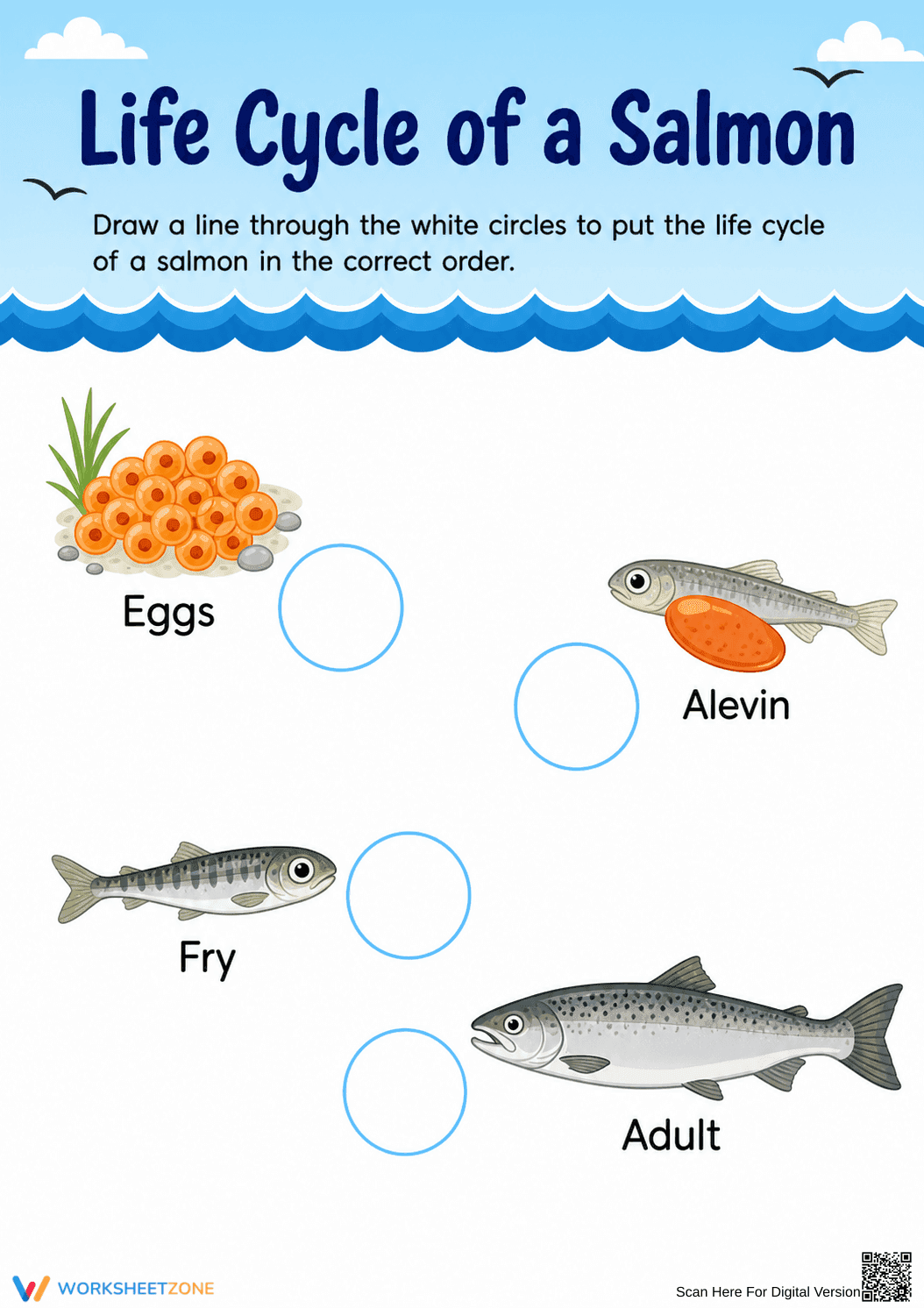
This Grade 3 science worksheet helps students sequence the unique life cycle of a salmon from egg to adult. By connecting the distinct developmental stages in the correct order, young learners build foundational biology skills and reinforce their understanding of how aquatic organisms grow and change over time.
At a Glance
- Grade: 3 · Subject: Science
- Standard:
3-LS1-1— Develop models to describe organism life cycles- Skill Focus: Sequencing life cycle stages
- Format: 1 page · 1 sequencing task · Answer key included · PDF
- Best For: Independent practice or science centers
- Time: 10–15 minutes
This single-page resource features clear, full-color illustrations of the four primary stages of a salmon's development: eggs, alevin, fry, and adult. Students are presented with a straightforward visual mapping task where they must draw a continuous line through the provided circles to establish the correct chronological sequence. A complete answer key is included for rapid grading.
This activity requires zero teacher setup.
- Print (1 minute): Simply download the PDF and print a class set. The high-contrast images reproduce well in both color and grayscale.
- Distribute (1 minute): Hand out the sheets along with pencils or crayons. The instructions are completely self-explanatory for third graders.
- Review (1 minute): Use the included answer key to quickly verify the correct sequence.
With a total teacher prep time of under two minutes, this worksheet is an excellent addition to any emergency sub plan or last-minute science center rotation.
This worksheet is directly aligned to 3-LS1-1, requiring students to develop models to describe that organisms have unique and diverse life cycles but all have in common birth, growth, reproduction, and death. By mapping the specific stages of a salmon, students create a simple visual model of this biological process. Both standard codes can be copied directly into lesson plans, IEP goals, or district curriculum mapping tools.
Use this worksheet for independent practice following direct instruction on aquatic life cycles. It also functions perfectly as a quiet morning work assignment to activate prior knowledge before a broader biology lesson. As students draw their connecting lines, teachers can use this as a quick formative assessment to observe whether children understand the directional flow of biological development. Expect most students to complete the sequencing task within 10 to 15 minutes.
This resource is primarily designed for third-grade general education students, though it serves as an excellent review for fourth graders studying ecosystems. For students needing additional support, teachers can pre-number the first stage to provide a clear starting point. This worksheet pairs exceptionally well with a nonfiction read-aloud about river habitats or a classroom anchor chart detailing the differences between mammals and fish.
Understanding biological sequencing through visual models is a critical component of early elementary science education. Aligned with 3-LS1-1, this resource requires students to develop models to describe organism life cycles, specifically focusing on the developmental progression of a salmon from egg to adult. According to a 2024 report by EdReports, instructional materials that integrate clear, sequential visual models significantly improve student retention of complex biological processes compared to text-heavy alternatives. By physically drawing the connections between the eggs, alevin, fry, and adult stages, learners engage multiple cognitive pathways to solidify their understanding of growth, development, and reproduction in aquatic environments. This targeted practice ensures students can accurately map developmental milestones, building the necessary foundational knowledge for more advanced ecological studies and food web analysis in later grades.


