




























Views
Downloads

Essential Plant Life Cycle Worksheet | Grade 1-3

Paste this activity's link or code into your existing LMS (Google Classroom, Canvas, Teams, Schoology, Moodle, etc.).
Students can open and work on the activity right away, with no student login required.
You'll still be able to track student progress and results from your teacher account.
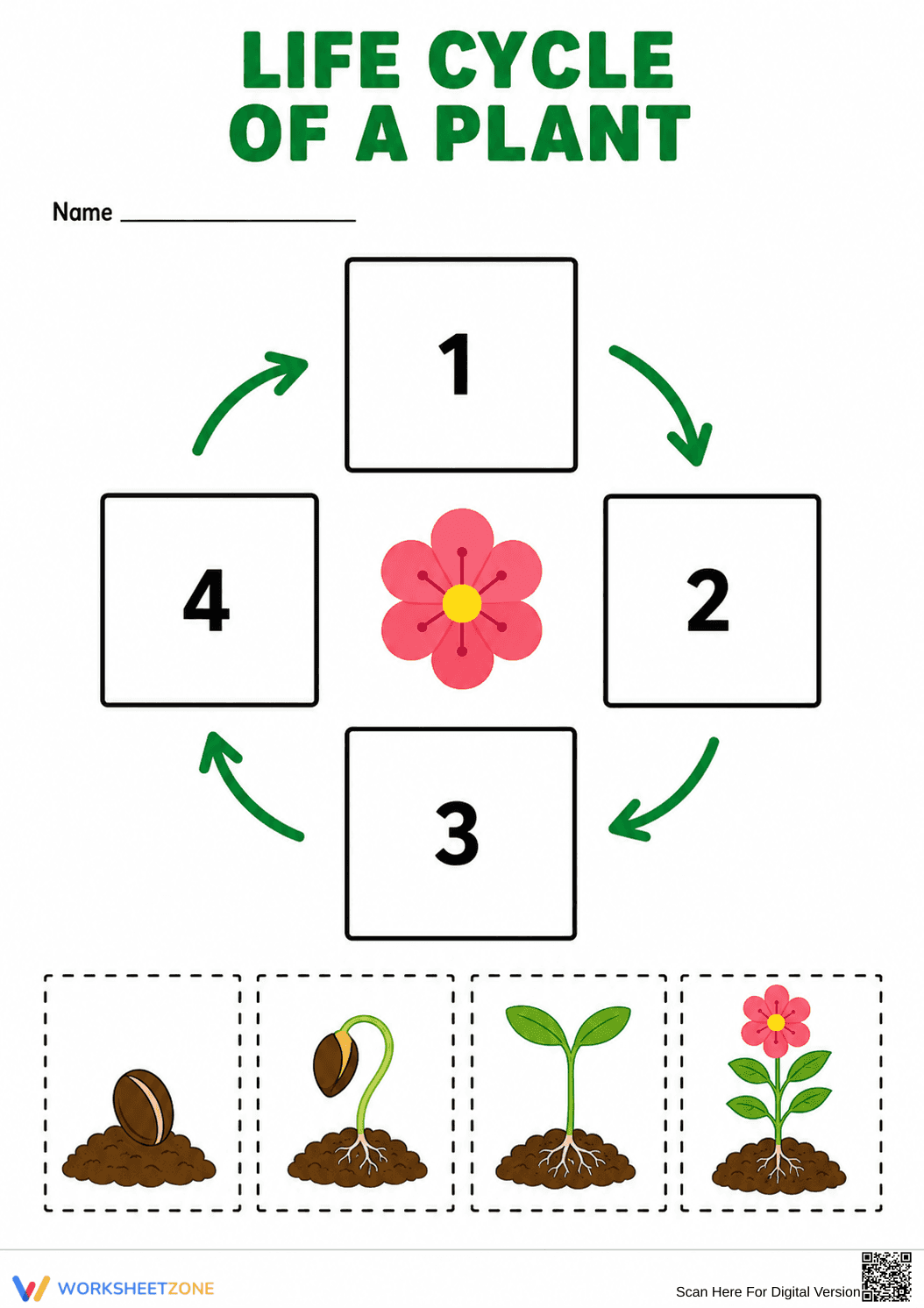
This plant life cycle worksheet provides a hands-on sequencing activity to help primary students master the stages of botanical growth. By identifying the progression from seed to mature flower, learners build a foundational understanding of biological patterns. This resource simplifies complex natural processes into a clear, four-step visual model for immediate classroom application.
At a Glance
- Grade: K-3 · Subject: Science
- Standard:
3-LS1-1— Develop models to describe that organisms have unique and diverse life cycles- Skill Focus: Sequencing plant growth stages
- Format: 1 page · 4 tasks · Answer key included · PDF
- Best For: Independent science centers and sub plans
- Time: 15–20 minutes
This single-page PDF features a circular flow diagram with four numbered stations. At the bottom of the page, students find four distinct, dashed-line illustrations representing a seed in soil, a germinating sprout, a young seedling, and a fully bloomed flower. The layout is designed for high-contrast printing, ensuring that the visual cues for each growth stage remain sharp and recognizable for young learners.
Zero-Prep Workflow
Teachers can implement this activity in under 2 minutes. First, print the required number of copies for the class. Second, distribute the sheets along with scissors and glue sticks. Third, allow students to work independently to cut, sort, and paste the images into the numbered sequence. Because the instructions are visual and intuitive, minimal verbal direction is required, making it an ideal choice for emergency sub folders.
Standards Alignment
The primary alignment is `3-LS1-1`, which requires students to develop models to describe that organisms have unique and diverse life cycles. This worksheet serves as a physical model of the "birth" and "growth" phases of a flowering plant. It also supports K-LS1-1 by helping students observe patterns in what plants need to grow. Both standard codes can be copied directly into lesson plans, IEP goals, or district curriculum mapping tools.
How to Use It
Use this worksheet as a formative assessment after a read-aloud about gardening or botany. Observe students as they sequence the images; if a student places the flower before the sprout, it provides an immediate opportunity for a "check for understanding" conversation about growth requirements. It also works well as a quiet-time activity for students who finish their primary science lab work early.
Who It's For
This resource is tailored for Kindergarten through 3rd-grade students, particularly those who benefit from tactile, kinesthetic learning. It is an excellent fit for English Language Learners (ELLs) because it relies on visual sequencing rather than heavy text. Pair this worksheet with a classroom seed-planting project or a digital time-lapse video of a sunflower growing to provide a multi-sensory learning experience.
According to the RAND AIRS 2024 report on elementary science instruction, hands-on modeling of biological cycles significantly improves long-term retention of core disciplinary ideas compared to passive observation alone. This worksheet aligns with the 3-LS1-1 standard by requiring students to construct a physical representation of the life cycle of a plant, moving from seed to maturity. By engaging in the tactile process of cutting and sequencing 4 specific stages, students internalize the chronological nature of botanical development. Research from Fisher & Frey (2014) suggests that such "check for understanding" tasks are vital for transitioning students from guided instruction to independent mastery. This resource provides a structured, low-stakes environment for students to demonstrate their grasp of the plant life cycle, ensuring they meet grade-level expectations for observing and describing natural patterns in the world around them.


