


























Views
Downloads
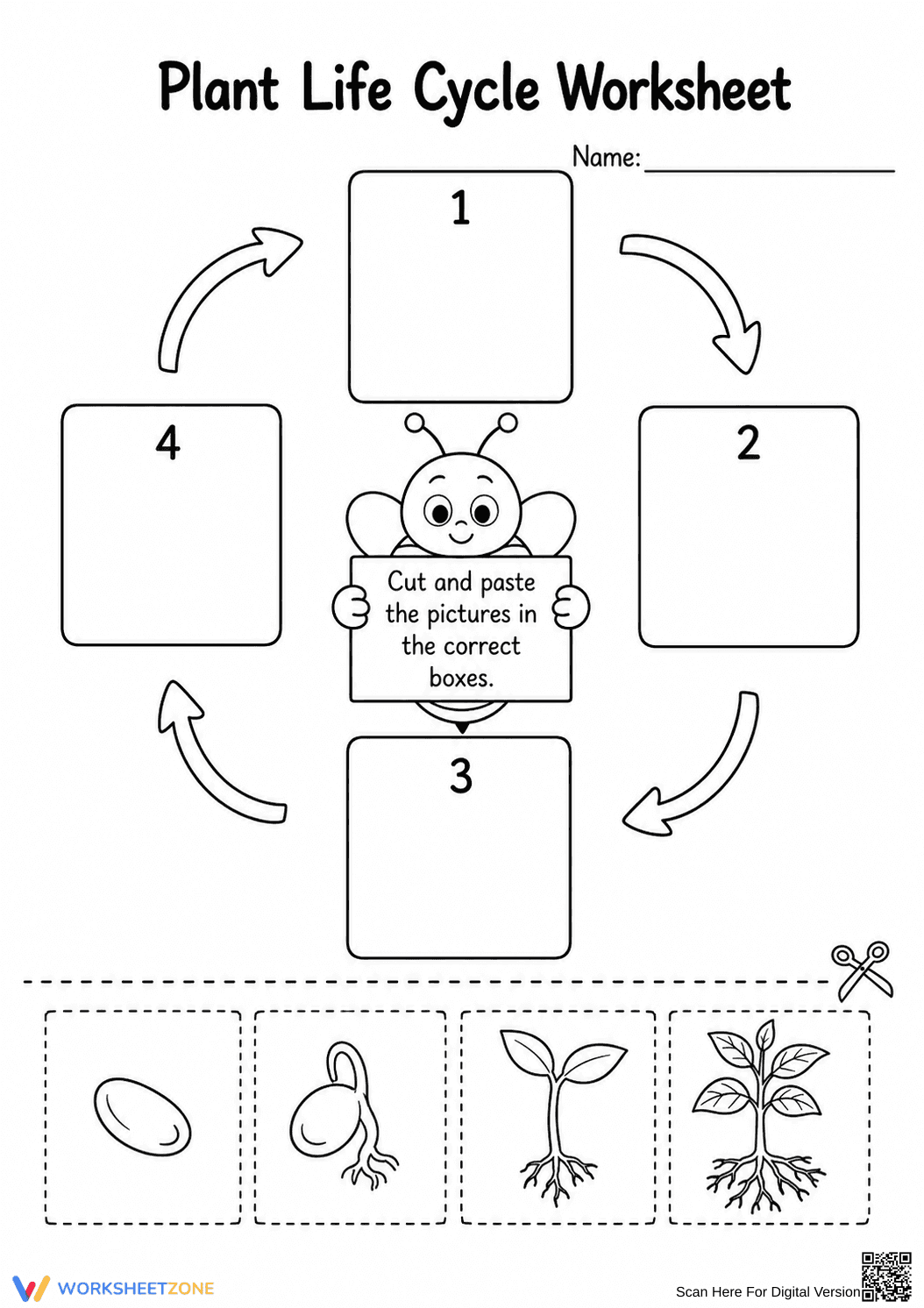

Grade 3 Plant Life Cycle — Printable No-Prep Worksheet
Paste this activity's link or code into your existing LMS (Google Classroom, Canvas, Teams, Schoology, Moodle, etc.).
Students can open and work on the activity right away, with no student login required.
You'll still be able to track student progress and results from your teacher account.
This Grade 3 science worksheet helps students visualize and sequence the stages of a plant's growth. By cutting and pasting four developmental phases—from seed to mature plant—learners actively build their understanding of biological life cycles while practicing fine motor skills.
At a Glance
- Grade: 3 · Subject: Science
- Standard:
3-LS1-1— Develop models to describe organism life cycles- Skill Focus: Sequencing plant growth stages
- Format: 1 page · 4 problems · PDF
- Best For: Independent practice or science centers
- Time: 15–20 minutes
This single-page resource features a circular graphic organizer with four numbered boxes and directional arrows. At the bottom, students will find four illustrations representing a seed, sprouting seed, seedling, and mature plant. A friendly bee character provides simple instructions, making the activity highly accessible.
Zero-Prep Workflow
Designed for immediate classroom implementation:
- Print (1 minute): Generate copies. The black-and-white design saves ink.
- Distribute (1 minute): Hand out worksheets, scissors, and glue. No complex instructions required.
- Review (3 minutes): Check student work as they paste the images.
With under two minutes of prep time, this is an excellent addition to any sub plan or science center.
Standards Alignment
This resource aligns to 3-LS1-1: Develop models to describe that organisms have unique and diverse life cycles but all have in common birth, growth, reproduction, and death. By arranging the visual model, students demonstrate comprehension of this biological process. Both standard codes can be copied directly into lesson plans, IEP goals, or district curriculum mapping tools.
How to Use It
This worksheet serves as an excellent follow-up activity after direct instruction about how plants grow. Students complete the sequencing task to solidify their understanding. Alternatively, use it as a hands-on science center station. As a formative assessment tip, observe students before they glue the pieces down to gauge if they understand the transition from sprouting seed to seedling. Expect completion within 15 to 20 minutes.
Who It's For
Designed for Grade 3 students exploring basic botany. The visual cut-and-paste format provides built-in differentiation for kinesthetic learners and students who benefit from hands-on manipulation rather than writing. It pairs perfectly with a classroom seed-planting experiment or an anchor chart.
Understanding biological sequences is a foundational component of early science education. Aligned with 3-LS1-1, this activity requires students to develop models to describe organism life cycles. According to a ScienceDirect TpT Analysis (2024), integrating hands-on manipulative tasks into science instruction significantly improves retention of sequential concepts for elementary learners. By physically moving the stages of plant growth into their correct chronological order, students engage multiple modalities, reinforcing the cognitive link between a seed and a mature plant. This multimodal approach supports fine motor development and deepens conceptual understanding of continuous biological loops.


