


























Views
Downloads

Grade 3 Plant Life Cycle — Printable No-Prep Worksheet
Paste this activity's link or code into your existing LMS (Google Classroom, Canvas, Teams, Schoology, Moodle, etc.).
Students can open and work on the activity right away, with no student login required.
You'll still be able to track student progress and results from your teacher account.
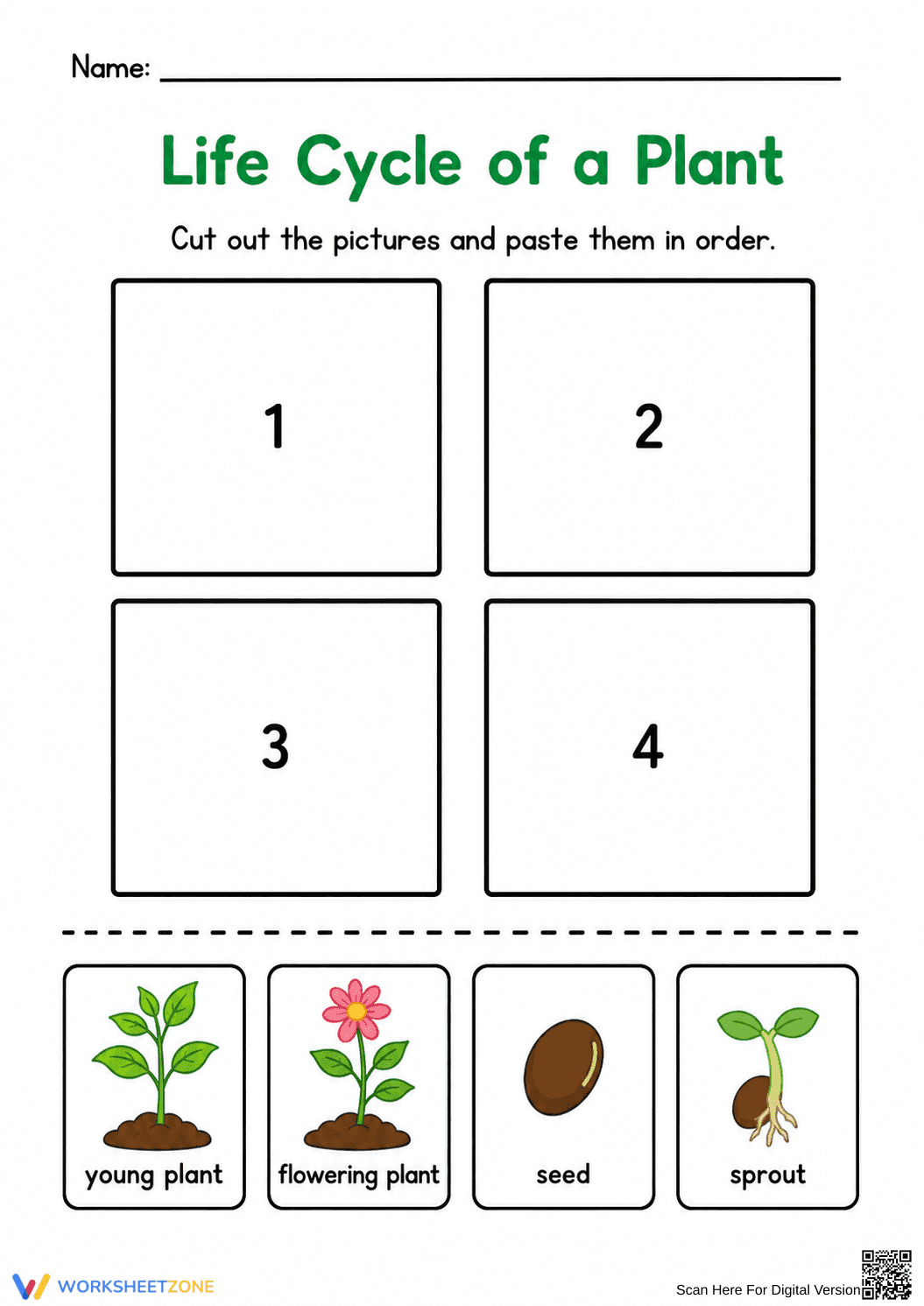
This hands-on science worksheet helps students master the stages of a plant's life cycle by sequencing key growth phases. By cutting and pasting images of a seed, sprout, young plant, and flowering plant into the correct order, learners actively build their understanding of biological progression and cause-and-effect relationships.
At a Glance
- Grade: 3 · Subject: Science
- Standard:
3-LS1-1— Develop models to describe organism life cycles- Skill Focus: Sequencing plant growth stages
- Format: 1 page · 4 problems · Answer key included · PDF
- Best For: Independent practice and science centers
- Time: 10–15 minutes
This single-page printable features four numbered sequencing boxes and four corresponding cut-out images with clear text labels. The straightforward layout requires no complex instructions, allowing students to immediately engage with the material. A complete answer key is included for quick grading or self-checking.
Zero-Prep Workflow
- Print (1 min): Simply print the PDF and provide scissors and glue. No special materials are required.
- Distribute (1 min): Hand out the worksheets as a standalone activity or science center station.
- Review (3 mins): Quickly check student sequences using the provided answer key or through a brief class discussion.
Total teacher prep time is under two minutes, making this an ideal resource for emergency sub plans.
Standards Alignment
Aligned to 3-LS1-1: Develop models to describe that organisms have unique and diverse life cycles but all have in common birth, growth, reproduction, and death. This activity serves as a foundational model of the plant life cycle. Both standard codes can be copied directly into lesson plans, IEP goals, or district curriculum mapping tools.
How to Use It
Use this worksheet after a direct instruction lesson on plant biology to reinforce the sequence of growth. It also works perfectly as an interactive science center activity where students can discuss the stages with peers. As a formative assessment tip, observe whether students can correctly identify the transition from sprout to young plant before they glue the pieces down. Expected completion time is 10 to 15 minutes.
Who It's For
This resource is designed for early elementary science students, particularly those who benefit from tactile, hands-on learning. The inclusion of both images and text labels provides built-in differentiation for emerging readers. It pairs excellently with a classroom anchor chart detailing the parts of a plant or a read-aloud book about seeds.
Understanding biological sequencing is a critical component of early science education that builds foundational knowledge for more complex ecological concepts. Aligned with 3-LS1-1, this activity requires students to develop models to describe organism life cycles. According to Fisher & Frey (2014), incorporating hands-on, manipulative tasks like cutting and pasting significantly increases student engagement and retention of sequential academic vocabulary. By physically moving the stages of a plant's life into the correct order, learners solidify their conceptual understanding of growth and reproduction in a developmentally appropriate format. This tactile approach ensures that abstract biological processes become concrete, observable events for young learners, bridging the gap between theoretical science and practical application in the classroom. Teachers can rely on this evidence-based method to support diverse learning needs while maintaining rigorous alignment to core science standards.


