


























Views
Downloads
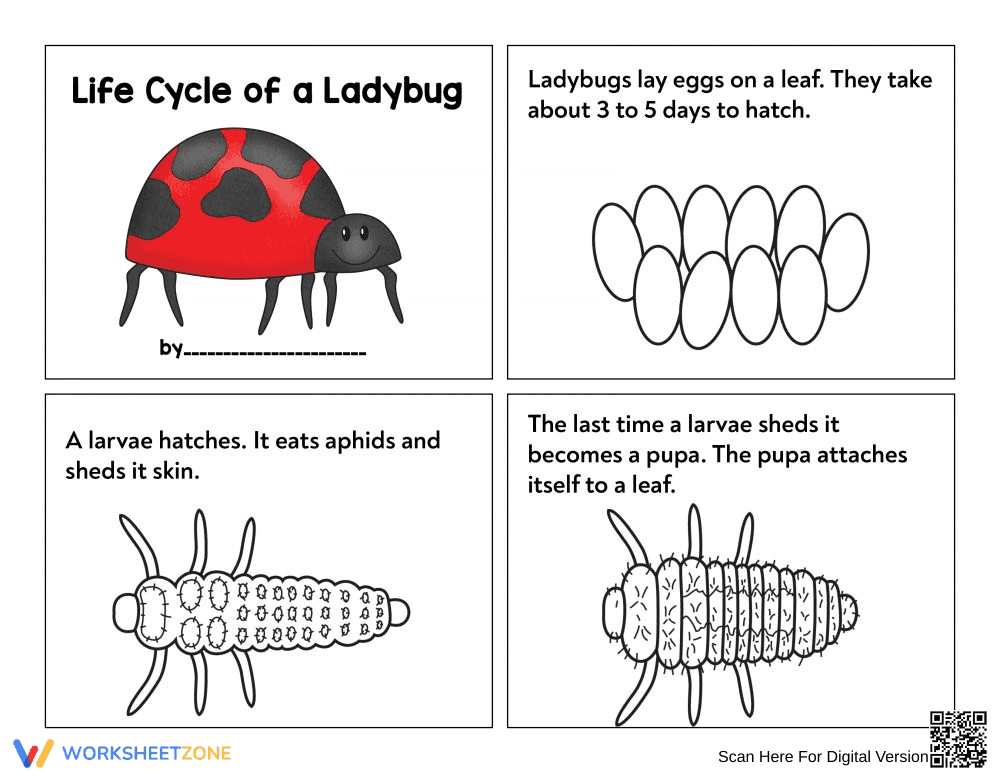

Printable Ladybug Life Cycle Worksheet | Grade 3 Science
Paste this activity's link or code into your existing LMS (Google Classroom, Canvas, Teams, Schoology, Moodle, etc.).
Students can open and work on the activity right away, with no student login required.
You'll still be able to track student progress and results from your teacher account.
This printable ladybug life cycle resource provides students with a clear, engaging introduction to insect metamorphosis. By reading four illustrated panels detailing the egg, larva, and pupa stages, young learners build foundational science vocabulary and sequence biological events. It offers an immediate, accessible way to explore organism growth.
At a Glance
- Grade: 3 · Subject: Science
- Standard:
3-LS1-1— Describe unique and diverse organism life cycles- Skill Focus: Life Cycles
- Format: 1 page · 4 panels · No answer key needed · PDF
- Best For: Independent reading and sequencing
- Time: 10–15 minutes
Inside this single-page download, educators find four informational panels usable as a mini-book or sequencing cards. Each section features a clear illustration paired with concise text explaining a specific stage of ladybug development, from eggs hatching to the pupa attaching itself. The straightforward layout removes visual clutter, allowing students to focus entirely on the biological sequence and key vocabulary terms like aphids, larvae, and pupa.
Zero-Prep Workflow
- Print (30 seconds): Generate enough copies of the single-page PDF for your entire class or a small group station.
- Distribute (30 seconds): Hand out the sheets along with scissors and staples if students are assembling mini-books.
- Review (1 minute): Read the panels aloud together to ensure pronunciation of new science terms before independent work.
Total teacher prep time is under two minutes. This self-explanatory format makes it an excellent addition to any emergency sub plan.
Standards Alignment
This resource aligns with Next Generation Science Standard 3-LS1-1: Develop models to describe that organisms have unique and diverse life cycles but all have in common birth, growth, reproduction, and death. It also supports early informational reading comprehension by pairing descriptive text with visual models. Both standard codes can be copied directly into lesson plans, IEP goals, or district curriculum mapping tools.
How to Use It
Introduce this material during the core science block before direct instruction on insect metamorphosis. Students can cut out the four panels and physically sequence them to demonstrate comprehension of chronological order. Alternatively, use it as an independent reading station where students assemble ladybug mini-books. As a formative assessment observation tip, watch how students order the larva and pupa stages, as these are frequently confused. Expected completion time is 10 to 15 minutes.
Who It's For
This worksheet is designed for third-grade general education students, though its highly visual nature makes it accessible for second graders and English Language Learners. To differentiate for students needing extra support, pre-cut the panels and highlight the transition words in the text. It pairs perfectly with a live ladybug habitat observation or a broader anchor chart detailing the life cycles of various insects.
Understanding biological sequences requires explicit instruction and clear visual models. Aligning with 3-LS1-1, this resource helps students describe unique and diverse organism life cycles through structured reading and sequencing tasks. According to a ScienceDirect TpT Analysis, integrating concise informational text with direct visual representations significantly improves retention of domain-specific science vocabulary in elementary classrooms. When students actively manipulate and read about the stages of a ladybug's growth, they internalize the continuous nature of biological development. This foundational knowledge prepares them for more complex ecological concepts in upper grades, such as food webs and environmental adaptations. By providing a straightforward, distraction-free format, educators can ensure that cognitive load remains focused entirely on mastering the scientific content rather than deciphering complex worksheet layouts. This approach maximizes instructional minutes and student comprehension.


