


























Views
Downloads
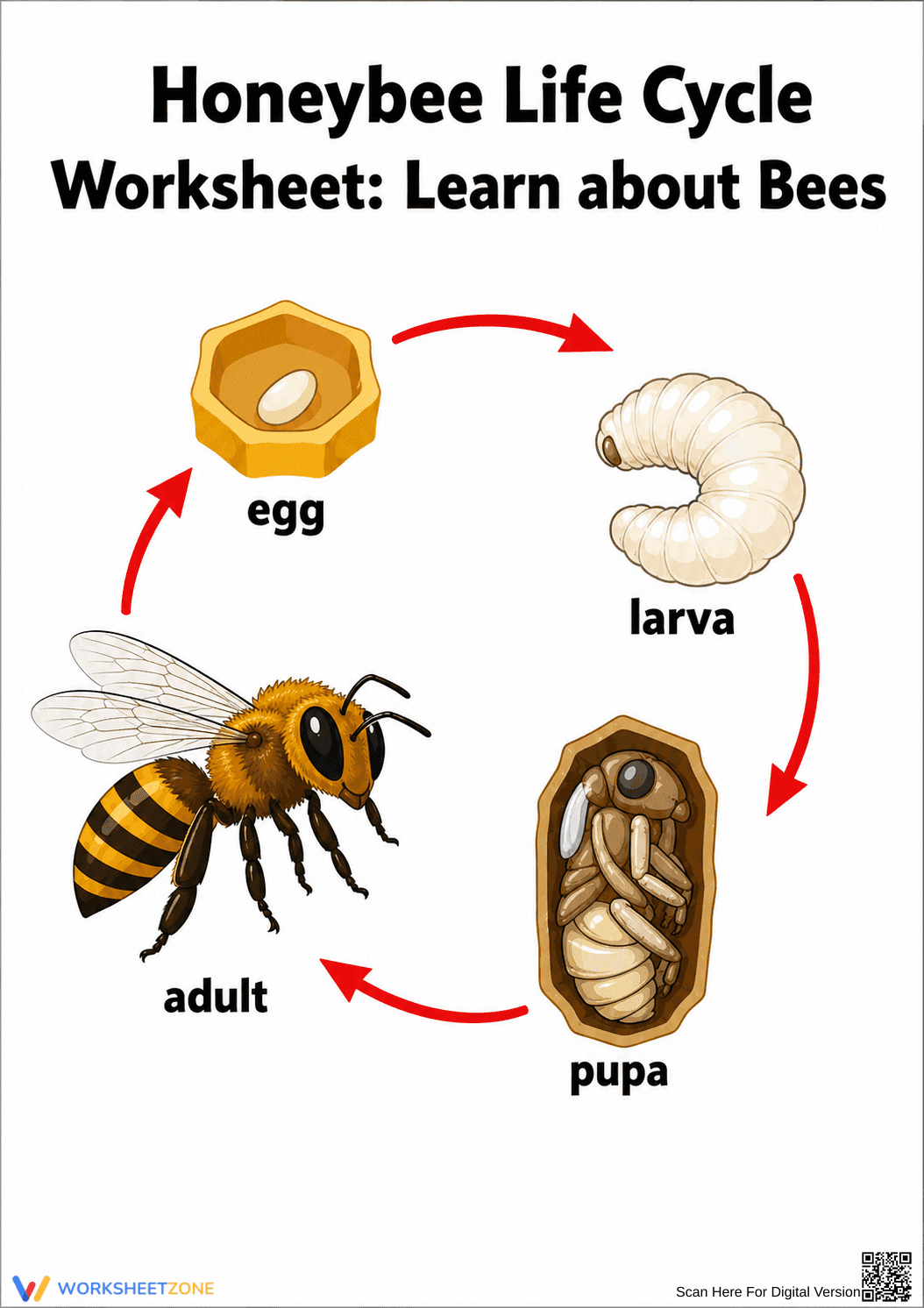

Printable Honeybee Life Cycle Diagram | Grade 3 Science
Paste this activity's link or code into your existing LMS (Google Classroom, Canvas, Teams, Schoology, Moodle, etc.).
Students can open and work on the activity right away, with no student login required.
You'll still be able to track student progress and results from your teacher account.
This foundational science resource provides a clear, visual model of the honeybee life cycle to help students understand biological development. By examining the four distinct stages of metamorphosis, young learners will build essential observation skills and grasp how organisms grow and change over time.
At a Glance
- Grade: 3 · Subject: Science
- Standard:
3-LS1-1— Develop models to describe organism life cycles- Skill Focus: Life Cycles and Metamorphosis
- Format: 1 page · 1 visual diagram · No answer key needed · PDF
- Best For: Visual reference and science centers
- Time: 10–15 minutes
This single-page printable features a full-color, labeled diagram illustrating the complete metamorphosis of a honeybee. The visual includes four clearly defined stages: egg, larva, pupa, and adult. Directional arrows guide students through the continuous sequence of development, making complex biological concepts accessible. The high-quality illustrations serve as an excellent anchor chart or interactive notebook insert without requiring any additional teacher preparation.
- Print (1 minute): Simply download the PDF and print copies for individual student folders or a large version for your classroom science wall.
- Distribute (1 minute): Hand out the diagram at the beginning of your entomology or life cycles unit to give students an immediate visual framework.
- Review (5 minutes): Walk through the arrows as a class, discussing how the bee transforms inside the honeycomb cell before emerging as an adult.
With zero teacher setup required, this resource is perfect for busy educators or as a reliable addition to a substitute teacher's lesson plan.
Aligned to primary standard 3-LS1-1: Develop models to describe that organisms have unique and diverse life cycles but all have in common birth, growth, reproduction, and death. This diagram acts as a direct model of the growth and development phases specific to pollinating insects. Both standard codes can be copied directly into lesson plans, IEP goals, or district curriculum mapping tools.
Use this diagram before direct instruction to activate prior knowledge and introduce new vocabulary like "pupa" and "larva." Alternatively, provide it during a hands-on science center where students are tasked with creating their own clay or paper plate dioramas of the bee life cycle. As a formative assessment observation tip, ask students to cover the labels and verbally explain what is happening at each stage to a partner. Expect students to spend 10 to 15 minutes analyzing the chart.
This resource is designed for elementary school students, particularly those in third grade, as well as homeschooling parents introducing basic biology. It provides excellent visual scaffolding for English Language Learners (ELLs) who benefit from clear picture-to-word associations. Pair this diagram with a non-fiction reading passage about hive behavior or a direct instruction lesson on pollination.
Integrating visual models into elementary science instruction significantly enhances student comprehension of complex biological processes. According to a ScienceDirect TpT Analysis, utilizing clear, sequenced diagrams helps young learners transition from concrete observations to abstract scientific reasoning. This resource directly supports 3-LS1-1 by allowing students to develop models to describe organism life cycles. By mapping out the distinct phases of a honeybee's metamorphosis—from egg to adult—educators provide a cognitive anchor that reduces working memory load during vocabulary acquisition. Explicitly teaching these stages through high-quality visual aids ensures that foundational concepts of birth, growth, and development are firmly established before students encounter more advanced ecological systems in later grades. This evidence-based approach fosters deeper engagement, builds scientific literacy, and ensures long-term retention of essential life science standards.


