




























Views
Downloads
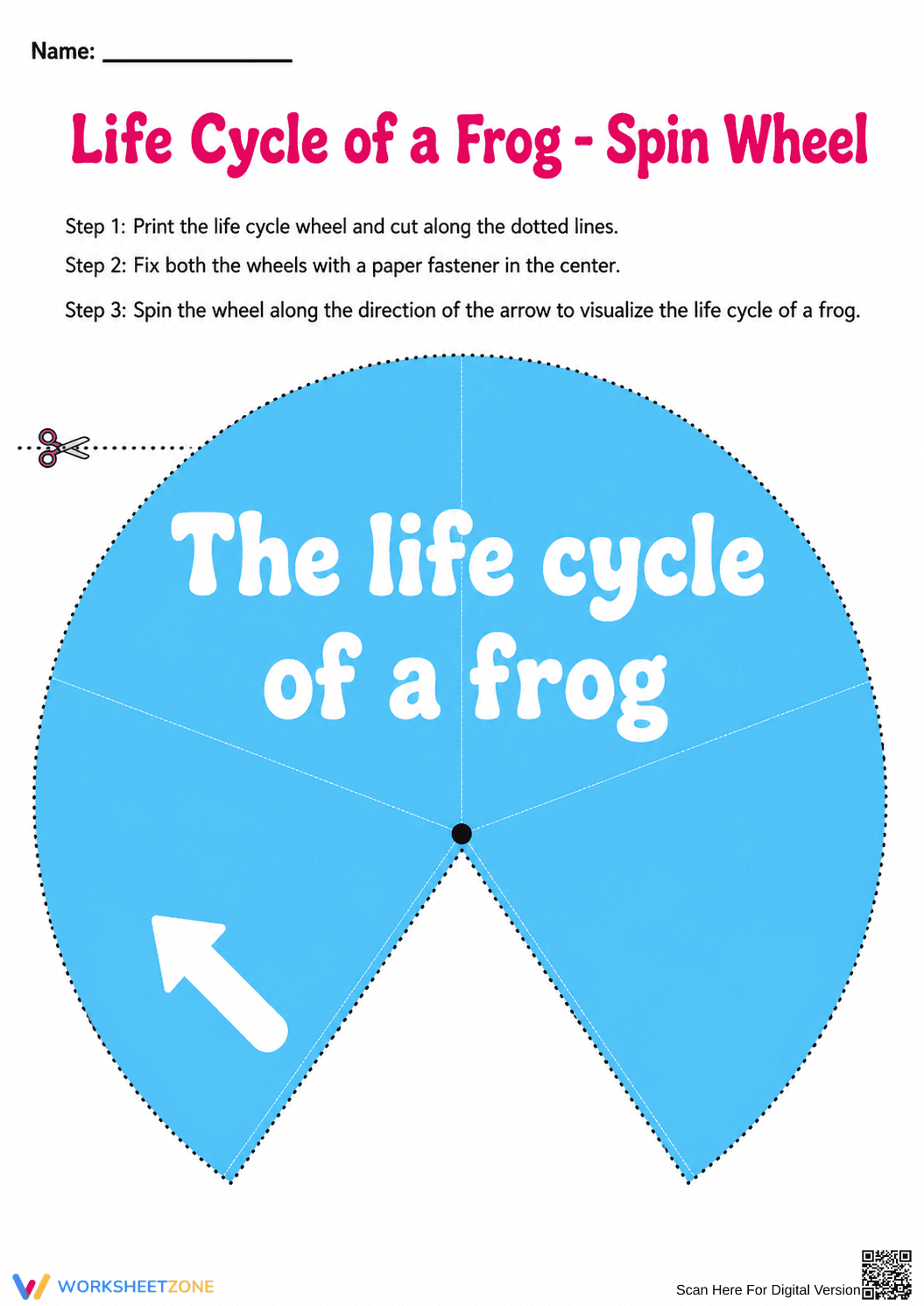

Frog Life Cycle Spin Wheel | Grade 3 Printable Worksheet

Paste this activity's link or code into your existing LMS (Google Classroom, Canvas, Teams, Schoology, Moodle, etc.).
Students can open and work on the activity right away, with no student login required.
You'll still be able to track student progress and results from your teacher account.
This interactive life cycle of a frog spin wheel worksheet transforms biological concepts into a hands-on learning experience for elementary students. By constructing a functional model of metamorphosis, learners visualize the transition from egg to adult frog. This essential tool simplifies complex life science standards into an engaging activity that promotes long-term retention of developmental stages.
At a Glance
- Grade: 3 · Subject: Living Things
- Standard:
3-LS1-1— Develop models to describe that organisms have unique and diverse life cycles- Skill Focus: Metamorphosis and life cycle sequencing
- Format: 2 pages · 1 activity · Interactive craft · PDF
- Best For: Interactive science notebooks and center activities
- Time: 15–20 minutes
The PDF contains a two-page interactive template designed for immediate classroom implementation. The first page features the primary spin wheel cover with clear cut-out indicators and a directional arrow to guide the sequence. The second page provides the base wheel illustrated with the distinct stages of a frog's development. Step-by-step instructions are printed directly on the worksheet to facilitate independent student work, requiring only scissors and a paper fastener for assembly.
The zero-prep design of this worksheet ensures a efficient classroom workflow. 1. Print the templates on standard paper or cardstock (1 minute). 2. Distribute materials to students who follow the visual guides to cut and assemble their wheels (10 minutes). 3. Review the life cycle stages as a class by spinning the wheel together to verify sequential understanding (5 minutes). This activity is perfectly suited for substitute teacher plans or as a quick-start science lesson.
This resource is directly aligned to `3-LS1-1`, which requires students to develop models to describe the unique and diverse life cycles of organisms. By physically manipulating the wheel, students demonstrate the common patterns of birth, growth, reproduction, and death. This standard code can be copied directly into lesson plans, IEP goals, or district curriculum mapping tools to ensure instructional compliance.
Use this spin wheel as a summative assessment after a unit on amphibians to check for stage recognition. Alternatively, introduce it during direct instruction as a guided note-taking tool. During assembly, observe student groups to see if they can correctly name the 'tadpole' and 'froglet' stages; this provides an immediate formative assessment of prior knowledge and sequential logic.
This activity is designed for Grade 3 and Grade 4 students, particularly those who benefit from kinesthetic and visual learning modalities. It serves as a natural pairing resource with a reading passage about wetland habitats or a classroom anchor chart detailing vertebrate characteristics. The interactive nature provides built-in differentiation for students who struggle with traditional written descriptions of biological sequences.
According to a ScienceDirect TpT Analysis of educational materials, interactive models like this frog life cycle spin wheel significantly improve cognitive engagement compared to static worksheets. This 3-LS1-1 aligned resource utilizes the specific skill of sequential modeling to bridge the gap between abstract biological concepts and concrete visualization. Research indicates that hands-on manipulation of physical diagrams aids in the encoding of temporal sequences, which is critical for mastering life science standards in the elementary grades. By providing a clear, step-by-step framework for constructing a biological model, this worksheet supports the gradual release of responsibility. Teachers can transition from modeling the assembly to allowing students to explain the metamorphosis process independently using their completed wheel. This approach ensures that learners not only memorize the names of the stages but also understand the continuous nature of growth within the ecosystem.


