




























Views
Downloads

Fish Life Cycle Worksheet | Grade 3 Essential

Paste this activity's link or code into your existing LMS (Google Classroom, Canvas, Teams, Schoology, Moodle, etc.).
Students can open and work on the activity right away, with no student login required.
You'll still be able to track student progress and results from your teacher account.
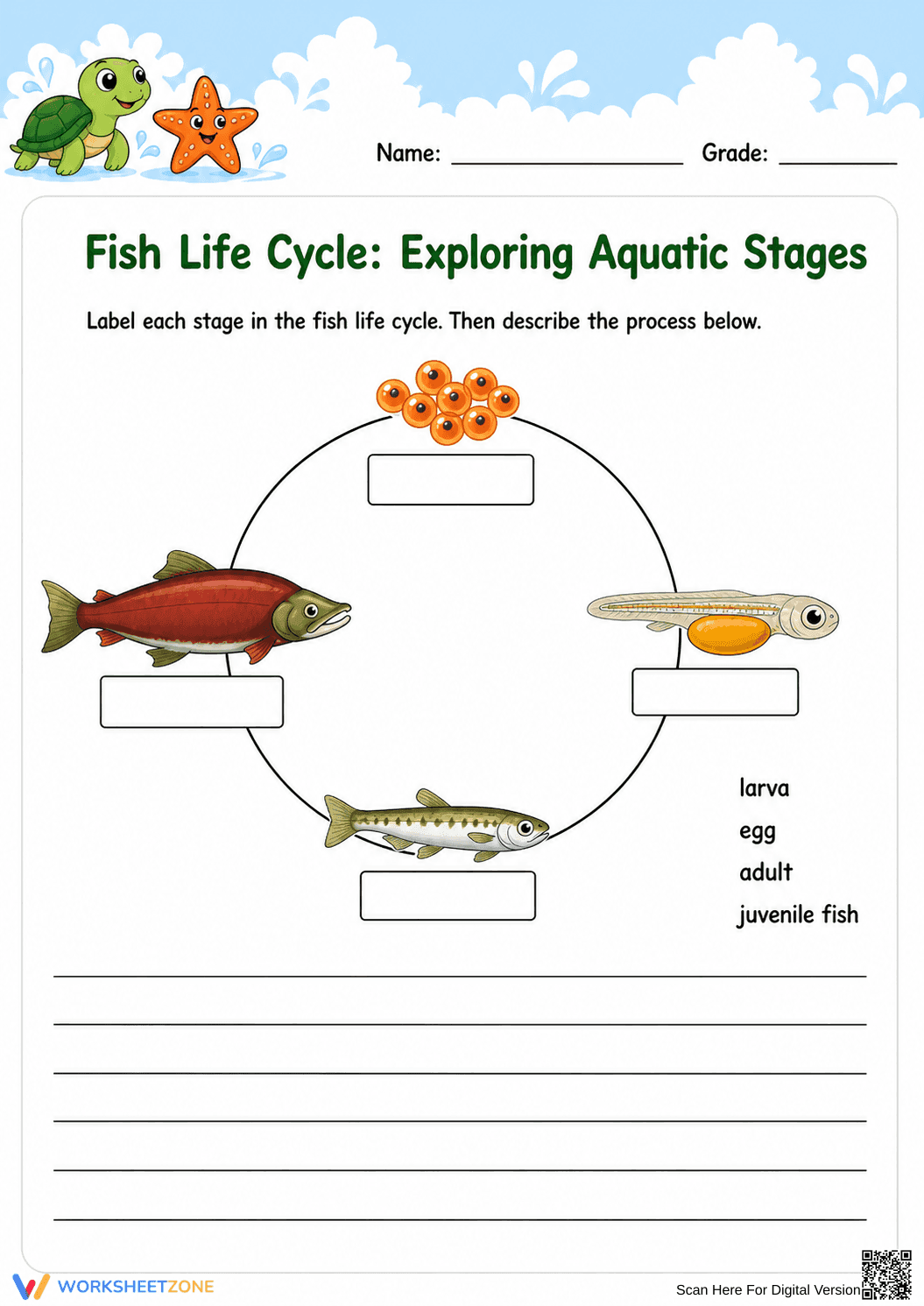
This Grade 3 fish life cycle worksheet provides a structured way for students to identify and describe the four primary stages of aquatic development. By labeling a circular diagram and writing a summary of the process, learners demonstrate their understanding of biological growth and reproduction. This resource ensures students can visualize the transition from egg to adult fish with clarity.
At a Glance
- Grade: 3 · Subject: Science
- Standard:
3-LS1-1— Develop models to describe that organisms have unique and diverse life cycles.- Skill Focus: Fish Life Cycle Stages
- Format: 1 page · 5 problems · Answer key included · PDF
- Best For: Independent practice or quick formative assessment
- Time: 15–20 minutes
The worksheet features a high-quality circular diagram illustrating the life cycle of a fish. It includes a clear word bank containing the terms larva, egg, adult, and juvenile fish to support vocabulary acquisition. Below the diagram, six ruled lines provide ample space for students to synthesize their learning through a written summary. The single-page layout is designed for clarity and ease of use in any classroom setting.
The zero-prep design of this resource ensures that teachers can integrate it into their science block with minimal lead time. First, print the single-page PDF (30 seconds). Second, distribute the worksheet to students during the independent practice phase of your lesson (1 minute). Finally, use the included answer key to review the labeling and descriptive responses as a whole class (5 minutes). This workflow makes it an ideal choice for emergency sub plans.
This resource is primarily aligned with 3-LS1-1: "Develop models to describe that organisms have unique and diverse life cycles but all have in common birth, growth, reproduction, and death." It also supports ELA writing standards by requiring students to compose a short informative text explaining a scientific process. Both standard codes can be copied directly into lesson plans, IEP goals, or district curriculum mapping tools.
Use this worksheet as a formative assessment after a direct instruction lesson on animal life cycles. It is effective when paired with a video or live observation of fish development. Teachers should observe students during the labeling phase to identify any confusion between the larva and juvenile stages. The expected completion time is 15 to 20 minutes, depending on the depth of the written description provided by the student.
This resource is designed for elementary students in grades 2 through 4 who are exploring biology or aquatic habitats. It provides necessary scaffolding for English Language Learners through the use of a word bank and visual cues. It pairs naturally with an anchor chart showing various animal life cycles or a reading passage about salmon migration and spawning habits.
According to the RAND AIRS 2024 report on elementary science instruction, the use of visual models in life cycle education significantly improves long-term retention of biological sequences. This worksheet aligns with the 3-LS1-1 standard, which requires students to develop models describing how organisms have unique and diverse life cycles. By identifying the specific stages of the fish life cycle—egg, larva, juvenile, and adult—students move beyond rote memorization toward a conceptual understanding of growth and development. The inclusion of a descriptive writing component further reinforces the transition from visual identification to scientific explanation, a key shift in middle-elementary literacy. Research from Fisher & Frey (2014) supports this gradual release of responsibility, where students first interact with a word bank before synthesizing their knowledge in an open-ended format. This resource provides a structured, evidence-based approach to mastering aquatic biology fundamentals.


