




























Views
Downloads

Desert Tortoise Life Cycle Worksheet | Grade 3 Essential

Paste this activity's link or code into your existing LMS (Google Classroom, Canvas, Teams, Schoology, Moodle, etc.).
Students can open and work on the activity right away, with no student login required.
You'll still be able to track student progress and results from your teacher account.
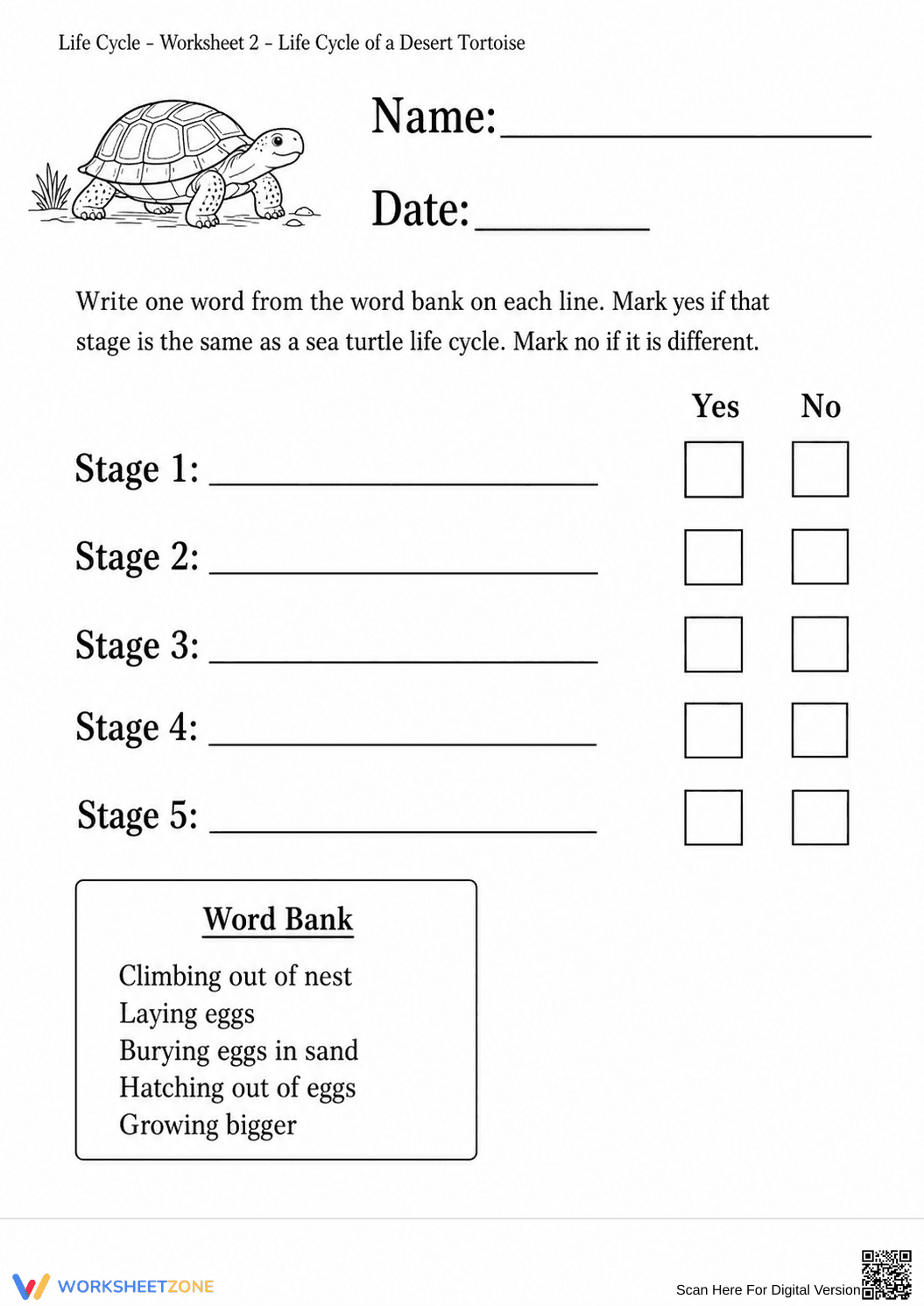
This Grade 3 science worksheet helps students master the developmental stages of the desert tortoise through structured identification and comparative analysis. By sequencing biological events and contrasting them with other species, learners build a concrete understanding of reptilian growth patterns and environmental adaptations.
At a Glance
- Grade: 3 · Subject: Science
- Standard:
3-LS1-1— Develop models to describe that organisms have unique and diverse life cycles- Skill Focus: Life cycle sequencing and comparison
- Format: 1 page · 10 tasks · Answer key included · PDF
- Best For: Quick formative assessment or science centers
- Time: 15–20 minutes
The worksheet features a clear, single-page layout containing a 5-stage sequencing task. Students utilize a provided word bank to identify key developmental milestones, such as hatching and nesting. A secondary "Yes/No" comparison column challenges students to evaluate similarities between desert tortoises and sea turtles, promoting higher-order thinking and vocabulary acquisition.
Zero-Prep Workflow
- Print: Generate the PDF and print class sets in under 1 minute.
- Distribute: Hand out the single-page sheet for immediate student engagement with zero teacher setup.
- Review: Grade the 10-task set in less than 2 minutes using the included answer key for rapid feedback.
This resource serves as an ideal "grab-and-go" activity for substitute folders or unexpected schedule changes.
Standards Alignment
Aligned to `3-LS1-1`, students develop a model to describe that organisms have unique and diverse life cycles. The comparison task supports the standard's emphasis on identifying commonalities (birth, growth, reproduction, death) across different species. Both standard codes can be copied directly into lesson plans, IEP goals, or district curriculum mapping tools.
How to Use It
Use this worksheet during the "Explain" phase of a 5E lesson model to solidify vocabulary after a reading on desert habitats. Alternatively, assign it as a formative assessment exit ticket to gauge student ability to differentiate between terrestrial and marine reptile development. Expected completion time ranges from 15 to 20 minutes.
Who It's For
This activity is tailored for elementary students in Grades 2 through 5 who are exploring biology or animal adaptations. It is particularly effective for visual learners and can be paired with a desert tortoise anchor chart or a short video clip showing tortoise hatchlings for maximum instructional impact.
According to the RAND AIRS 2024 report on elementary science instruction, structured sequencing tasks significantly improve long-term retention of biological concepts in early learners. This worksheet utilizes a scaffolded word bank and comparative logic to meet the requirements of the 3-LS1-1 standard, which mandates that students understand the diversity of life cycles while recognizing universal patterns of growth. By requiring students to distinguish between the nesting habits of desert and sea turtles, the activity moves beyond rote memorization into cross-species analysis. Research from Fisher & Frey (2014) suggests that such "check for understanding" tasks are vital for the gradual release of responsibility, allowing teachers to identify misconceptions about animal development in real-time. This 1-page resource provides the necessary evidence of student mastery for inclusion in science portfolios or progress monitoring reports.


