


























Views
Downloads
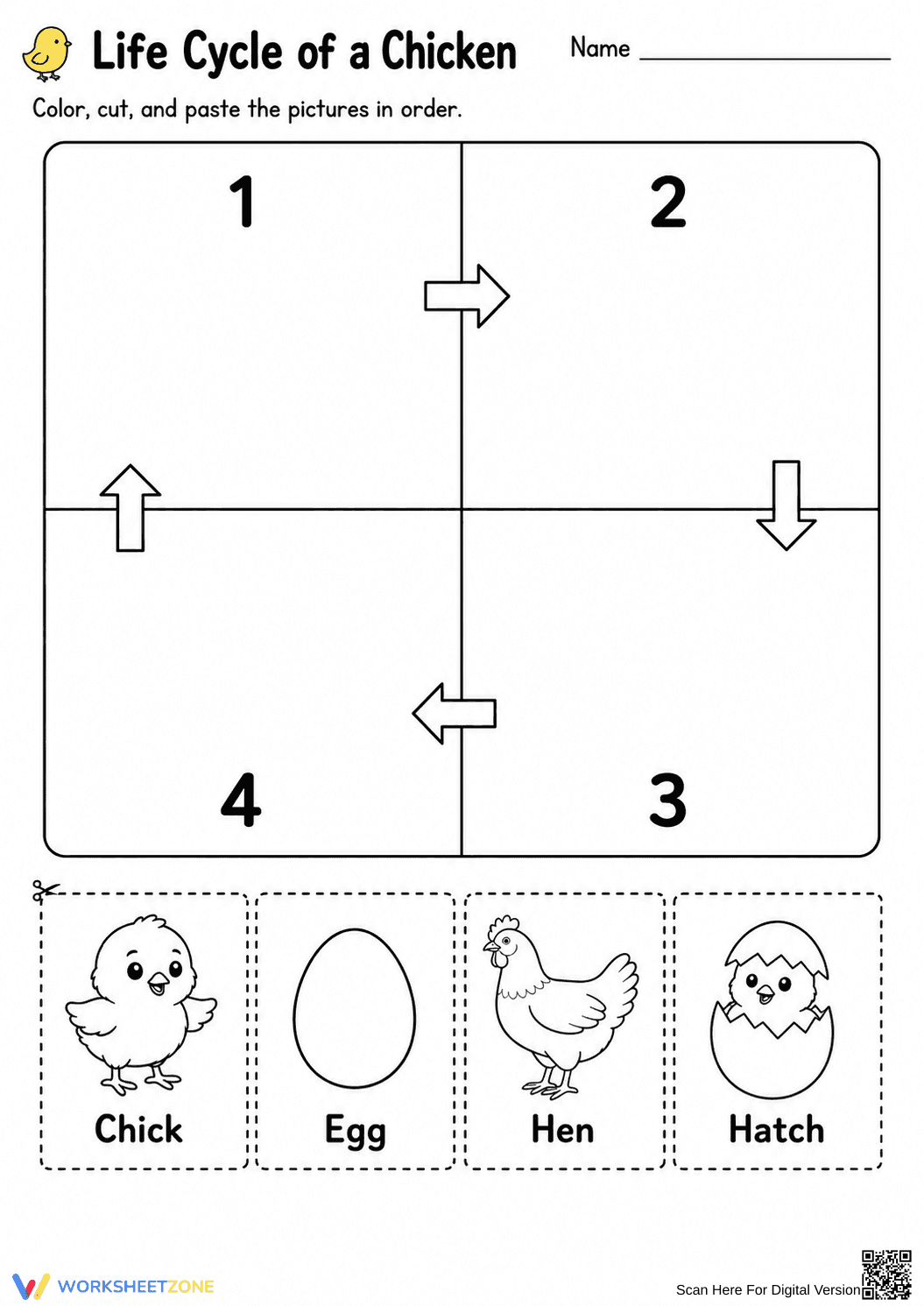

Grade 1 Chicken Life Cycle — Printable No-Prep Worksheet
Paste this activity's link or code into your existing LMS (Google Classroom, Canvas, Teams, Schoology, Moodle, etc.).
Students can open and work on the activity right away, with no student login required.
You'll still be able to track student progress and results from your teacher account.
This Grade 1 Science worksheet helps students master the chicken life cycle by sequencing developmental stages. Young learners will color, cut, and paste four distinct stages—egg, hatch, chick, and hen—into the correct chronological order, building foundational biological knowledge and fine motor skills simultaneously.
At a Glance
- Grade: 1 · Subject: Science
- Standard:
1-LS1-2— Identify patterns in behavior and development to help offspring survive- Skill Focus: Sequencing the chicken life cycle
- Format: 1 page · 4 tasks · Answer key included · PDF
- Best For: Zero-prep science centers
- Time: 15–20 minutes
This single-page PDF features a clear four-step cycle diagram with directional arrows and a cut-and-paste section. Students are provided with four distinct illustrations—Hen, Hatch, Egg, and Chick—which they must color, cut out, and glue into the corresponding numbered boxes. The worksheet includes an answer key for quick grading and a space for student names, making it a complete instructional resource for any primary classroom.
Zero-Prep Workflow
The zero-prep workflow for this resource is designed for maximum teacher efficiency. First, print the single-page PDF (30 seconds). Second, distribute the sheets along with scissors and glue to your students (1 minute). Third, allow students to work independently or in pairs while you observe, then review the completed cycles using the included answer key (1 minute). Total teacher preparation time is under two minutes, making this an ideal sub plan.
Standards Alignment
This resource is primarily aligned to 1-LS1-2: "Read texts and use media to determine patterns in behavior of parents and offspring that help offspring survive." By identifying the stages of growth, students recognize the repeating patterns inherent in living systems. Both standard codes can be copied directly into lesson plans, IEP goals, or district curriculum mapping tools.
How to Use It
Use this worksheet as a formative assessment during a unit on living things. It is best implemented after direct instruction on animal life cycles to verify student understanding of chronological order. For a more interactive experience, have students work in science centers where they can discuss why each stage must come before the next. As a formative assessment observation tip, watch how students sequence the "hatch" and "chick" stages to ensure they grasp the immediate post-egg development. Expected completion time ranges from 15 to 20 minutes.
Who It's For
This resource is designed for Grade 1 students but is highly effective for Kindergarten learners or English Language Learners (ELLs) who benefit from visual-heavy, low-text supports. The simple labels and clear illustrations provide excellent differentiation for students who need concrete manipulatives to grasp abstract concepts. It pairs naturally with non-fiction passages about farm animals or classroom incubator projects.
According to the RAND AIRS 2024 report on early childhood science education, hands-on sequencing activities are critical for developing cognitive schemas related to temporal order and biological processes. This Grade 1 life cycle of a chicken worksheet utilizes a cut-and-paste format to reinforce standard 1-LS1-2, requiring students to physically manipulate information to demonstrate mastery in sequencing the chicken life cycle. Interactive tasks facilitate the gradual release of responsibility, moving students from guided observation to independent application. By focusing on the specific stages of Hen, Hatch, Egg, and Chick, this tool provides the structural scaffolding necessary for young learners to identify repeating patterns in nature. The activity's dual focus on fine motor skills and conceptual understanding aligns with modern pedagogical standards for primary science. Educators can confidently integrate this worksheet into diverse curricula to meet NGSS requirements.


