


























Views
Downloads

Printable Bird Life Cycle Worksheet | Grade 3 Science
Paste this activity's link or code into your existing LMS (Google Classroom, Canvas, Teams, Schoology, Moodle, etc.).
Students can open and work on the activity right away, with no student login required.
You'll still be able to track student progress and results from your teacher account.
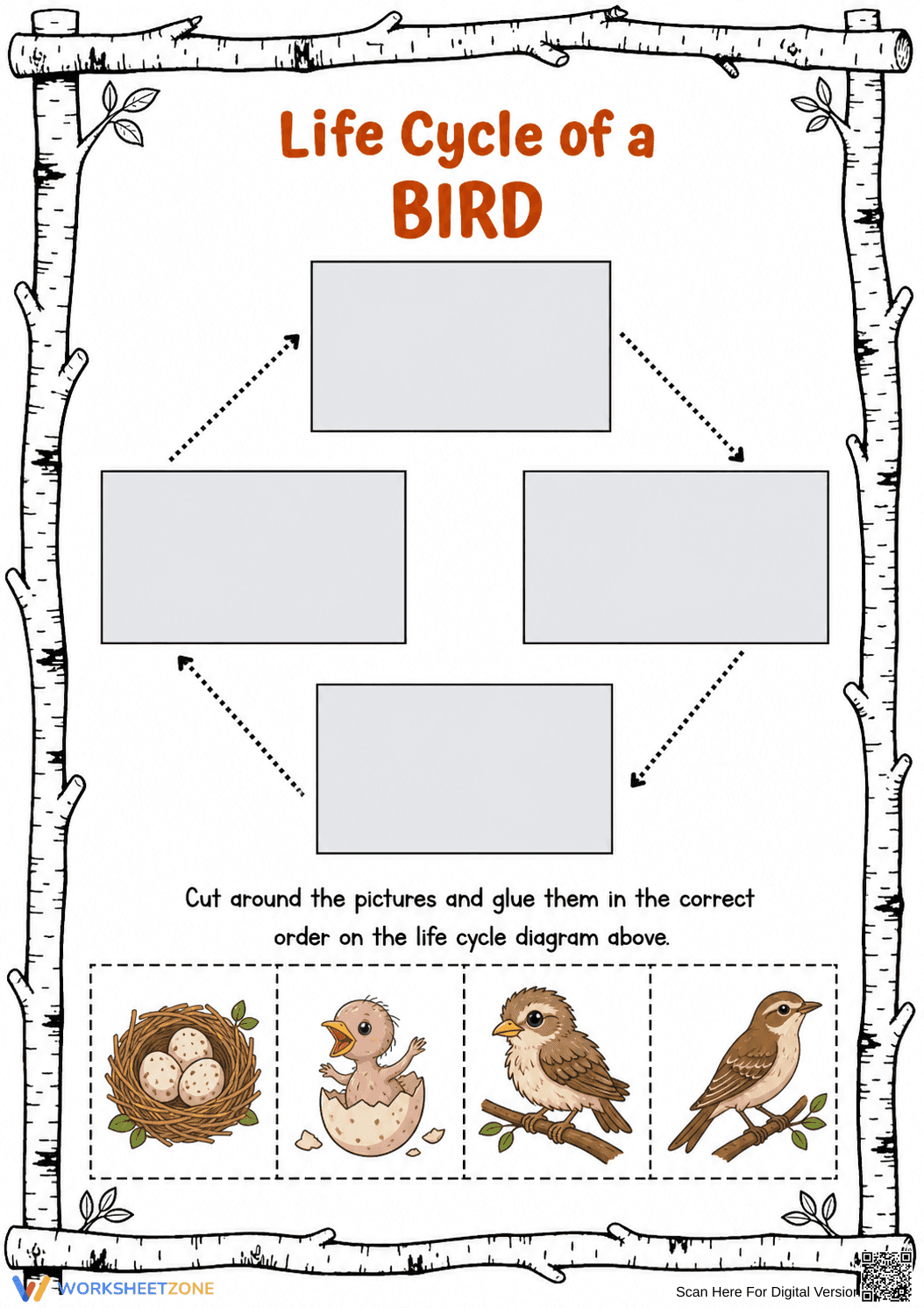
This printable Grade 3 science worksheet helps students visualize and sequence the biological growth stages of a bird. By cutting and pasting four distinct developmental phases into a continuous cycle diagram, learners actively construct a model that demonstrates how organisms grow and change from egg to adult.
At a Glance
- Grade: 3 · Subject: Science
- Standard:
3-LS1-1— Develop models describing unique and diverse organism life cycles.- Skill Focus: Sequencing life cycle stages
- Format: 1 page · 4 problems · Answer key included · PDF
- Best For: Independent practice and science centers
- Time: 15–20 minutes
This single-page resource features a beautifully illustrated, diamond-shaped cycle diagram framed by a rustic birch branch border. At the bottom of the page, students will find four square stage illustrations: speckled eggs in a nest, a newly hatched chick, a juvenile bird, and a fully grown adult. The worksheet requires students to cut out these four images and paste them into the correct chronological order within the provided grey rectangular boxes, following the clockwise arrows to complete the biological sequence. A complete answer key is included for quick verification.
Zero-Prep Workflow
- Print (1 minute): Simply print the PDF and ensure students have scissors and glue sticks available.
- Distribute (1 minute): Hand out the worksheet during your science block or place it in a designated science center.
- Review (3 minutes): After students complete the cut-and-paste activity, quickly check their sequence against the provided answer key or have them explain the cycle to a peer.
With under two minutes of total teacher prep time, this activity is an excellent, self-explanatory option for emergency sub plans or independent morning work.
Standards Alignment
Aligned to primary standard 3-LS1-1: Develop models to describe that organisms have unique and diverse life cycles but all have in common birth, growth, reproduction, and death. This hands-on sequencing activity serves as a foundational model for understanding these biological patterns. Both standard codes can be copied directly into lesson plans, IEP goals, or district curriculum mapping tools.
How to Use It
Use this worksheet as an independent practice activity after a direct instruction lesson on animal life cycles. It also works perfectly as a hands-on science center station where students can practice fine motor skills alongside biological sequencing. As a formative assessment observation tip, watch to see if students correctly identify the hatchling as the stage immediately following the eggs before they glue the pieces down. Expected completion time ranges from 15 to 20 minutes.
Who It's For
This resource is primarily designed for third-grade science students, though it is easily adaptable for younger learners practicing basic sequencing and scissor skills. For students needing extra support, pre-cut the image squares to reduce fine motor demands and focus solely on the scientific sequence. Pair this worksheet with a non-fiction read-aloud about birds or a classroom anchor chart detailing different animal life cycles.
Integrating hands-on modeling activities into elementary science instruction significantly reinforces student comprehension of biological processes. When students actively manipulate components to build a model, such as sequencing the stages of a bird's development, they internalize the continuous nature of biological growth. This aligns directly with standard 3-LS1-1, requiring students to develop models describing unique and diverse organism life cycles. According to a recent EdReports 2024 analysis, instructional materials that combine tactile engagement with core scientific concepts yield higher retention rates and deeper conceptual understanding in early elementary grades. By physically organizing the progression from egg to adult, learners move beyond rote memorization and begin to recognize the universal patterns of birth, growth, reproduction, and death that govern all living organisms.


