




























Views
Downloads

Bird Life Cycle Diagram Worksheet | Grade 3 Essential

Paste this activity's link or code into your existing LMS (Google Classroom, Canvas, Teams, Schoology, Moodle, etc.).
Students can open and work on the activity right away, with no student login required.
You'll still be able to track student progress and results from your teacher account.
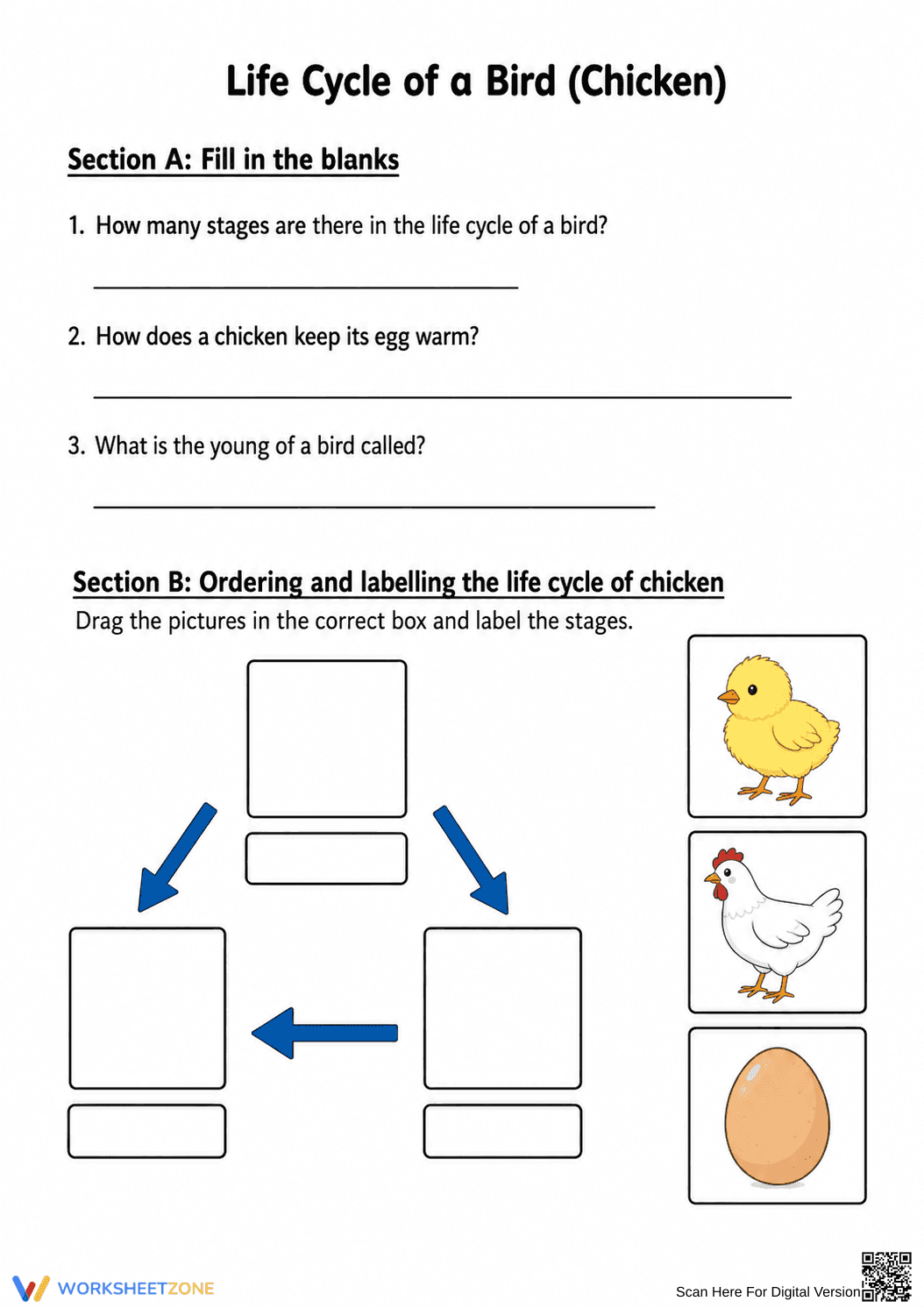
This Grade 3 bird life cycle worksheet helps students master the biological stages of avian development through structured sequencing and recall. By identifying key characteristics and ordering the growth process from egg to adult, learners build a foundational understanding of biological patterns and organism growth.
At a Glance
- Grade: 3 · Subject: Science
- Standard:
3-LS1-1— Develop models to describe that organisms have unique and diverse life cycles- Skill Focus: Life cycle sequencing and labeling
- Format: 1 page · 9 tasks · Answer key included · PDF
- Best For: Independent practice or formative assessment
- Time: 15–20 minutes
The worksheet features two distinct sections designed for comprehensive review. Section A contains 3 fill-in-the-blank questions that test factual recall regarding bird development and parental care. Section B provides a visual flowchart where students must order and label three specific stages: the egg, the chick, and the adult chicken. The layout includes clear boxes for image placement and text fields for vocabulary reinforcement.
This resource is designed for a zero-prep classroom workflow. Teachers can print the single-page PDF in less than 1 minute. Distribution takes approximately 30 seconds, as the instructions are self-explanatory for Grade 3 readers. Reviewing the completed diagrams as a whole-class activity takes roughly 5 minutes using the included answer key, making this an ideal solution for sub plans or morning work.
Aligned to 3-LS1-1, this worksheet requires students to develop models to describe that organisms have unique and diverse life cycles but all have in common birth, growth, reproduction, and death. It specifically focuses on the birth and growth phases of the avian cycle. Both standard codes can be copied directly into lesson plans, IEP goals, or district curriculum mapping tools.
Use this worksheet as a formative assessment after a direct instruction lesson on vertebrates. Observe students during Section B to see if they recognize the directional arrows of the cycle. It also serves as an excellent science center activity where students can work in pairs to discuss the differences between the chick and adult stages. Completion typically ranges from 15 to 20 minutes.
This resource is tailored for elementary students in Grades 2 and 3, but is also highly effective for ESL/ELL learners due to the heavy visual support in the diagram section. It pairs naturally with a non-fiction passage about farm animals or an anchor chart detailing the characteristics of birds.
According to the RAND AIRS 2024 report on elementary science instruction, visual modeling of biological processes significantly improves long-term retention of life science concepts among early learners. This worksheet utilizes the 3-LS1-1 standard to bridge the gap between abstract biological concepts and concrete visual representations. By requiring students to actively sequence the egg, chick, and adult stages, the activity reinforces the concept that all organisms follow a predictable pattern of growth and development. Research indicates that worksheets combining linguistic recall with spatial reasoning provide a dual-coding advantage that supports diverse learning styles. This specific resource ensures that students not only memorize the names of the stages but also understand the chronological relationship between them. It is a high-utility tool for educators seeking to meet NGSS requirements while maintaining a low-barrier entry for student participation in science curriculum.


