


























Views
Downloads
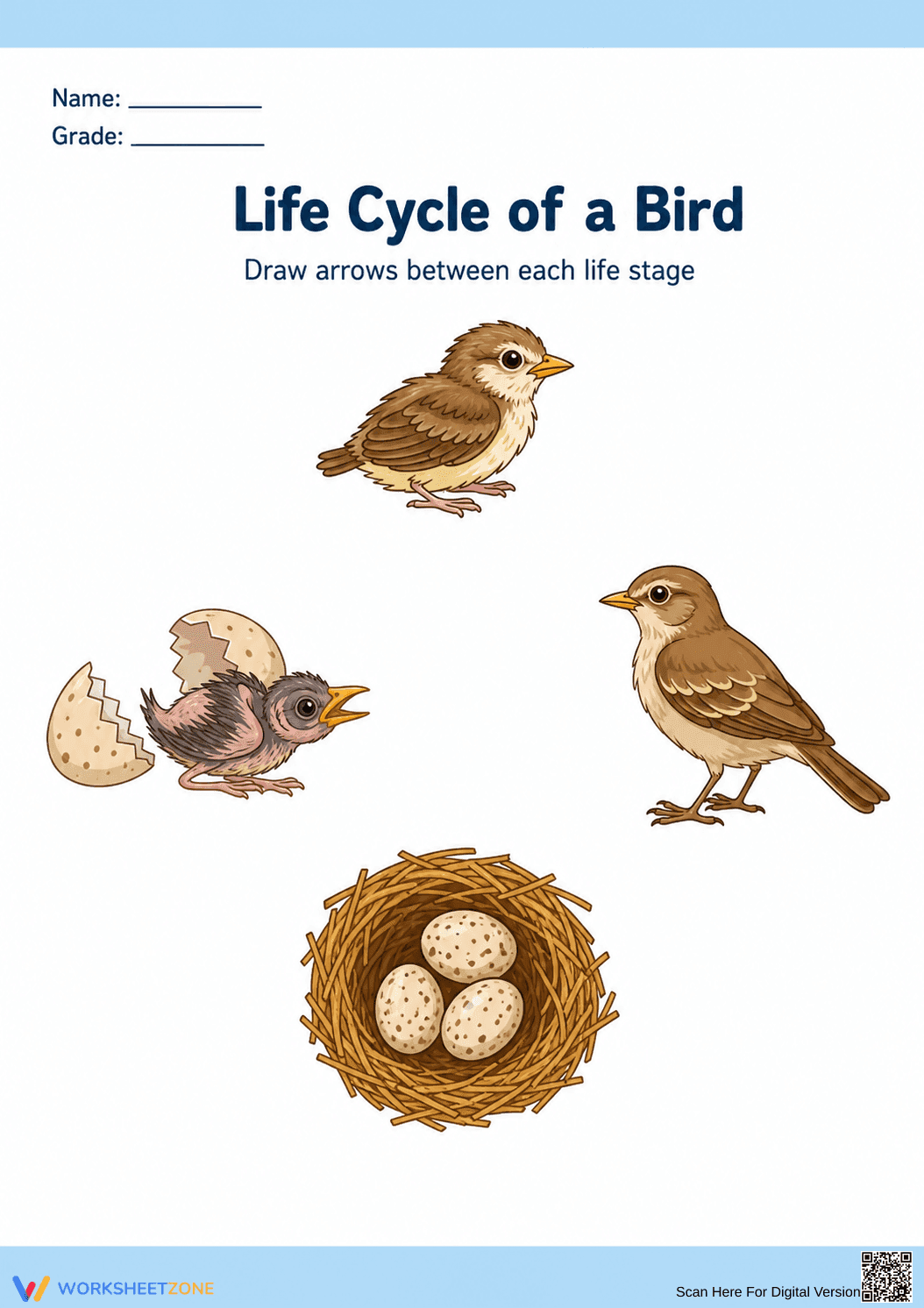

Bird Life Cycle Worksheet | Essential Grade 3 Science
Paste this activity's link or code into your existing LMS (Google Classroom, Canvas, Teams, Schoology, Moodle, etc.).
Students can open and work on the activity right away, with no student login required.
You'll still be able to track student progress and results from your teacher account.
This Grade 3 bird life cycle worksheet helps students visualize and sequence the biological stages of avian development. By connecting images of eggs, hatchlings, and adults, learners build a foundational understanding of how organisms grow and change over time. It is an ideal resource for introducing life science concepts in a clear, engaging format that prioritizes student comprehension.
At a Glance
- Grade: 3 · Subject: Science
- Standard:
3-LS1-1— Develop models to describe that organisms have unique and diverse life cycles- Skill Focus: Biological sequencing
- Format: 1 page · 4 stages · Answer key included · PDF
- Best For: Introduction to animal life cycles
- Time: 10–15 minutes
What's Inside
This single-page PDF features four high-quality illustrations representing the primary stages of a bird's life: eggs in a nest, a newly hatched chick, a fledgling, and a mature adult. The layout includes dedicated fields for student identification and clear instructions for the sequencing task. A teacher's answer key is provided to ensure quick and accurate grading, making it easy to track student progress during the lesson.
Zero-Prep Workflow
- Print: Send the single-page PDF to your printer in seconds.
- Distribute: Hand out the sheets to students during your life science block or as a morning warm-up.
- Review: Use the included answer key for a 5-minute whole-class formative check.
Total teacher preparation time is under 2 minutes, making this a perfect emergency sub plan or a quick supplemental activity for your biology unit.
Standards Alignment
This resource aligns with `3-LS1-1`: "Develop models to describe that organisms have unique and diverse life cycles but all have in common birth, growth, reproduction, and death." It specifically addresses the growth and birth components of the standard through visual modeling. Both standard codes can be copied directly into lesson plans, IEP goals, or district curriculum mapping tools.
How to Use It
Use this worksheet as a formative assessment after a direct instruction lesson on vertebrates. It works well as a "ticket out the door" to verify that students can distinguish between the fledgling and adult stages. Observe if students correctly identify the starting point of the cycle (the nest) to gauge their understanding of biological beginnings. The expected completion time is approximately 12 minutes.
Who It's For
This worksheet is designed for third-grade general education classrooms, but its visual nature makes it excellent for English Language Learners (ELLs) and students with IEPs requiring simplified tasks. Pair this resource with a non-fiction passage about robins or an anchor chart showing various animal life cycles for a comprehensive science lesson.
According to the RAND AIRS 2024 report, high-quality visual models are critical for early elementary students to internalize complex biological processes like avian development. This worksheet utilizes the 3-LS1-1 standard to provide a structured framework for students to practice biological sequencing, a skill that correlates with higher retention of life science concepts in later grades. By focusing on the 4 distinct stages of a bird's life, the resource reduces cognitive load while reinforcing the concept that all living things undergo a predictable pattern of growth. Research from Fisher & Frey (2014) suggests that such scaffolds help bridge the gap between observation and scientific modeling. This 1-page PDF provides the necessary visual cues for students to demonstrate mastery of life cycle progression independently, ensuring they meet grade-level expectations for modeling biological systems.


