




























Views
Downloads
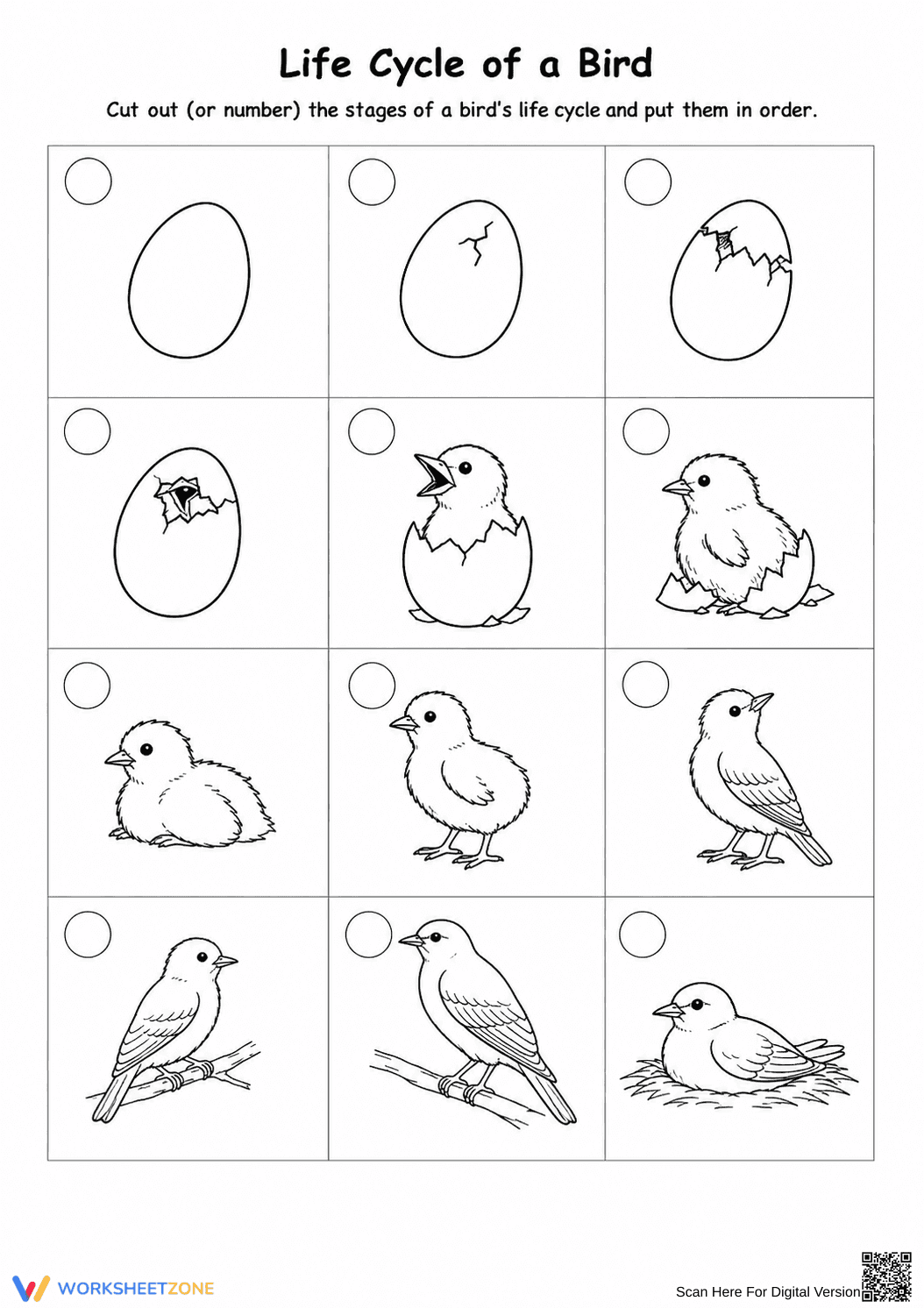

Grade 3 Bird Life Cycle — Printable No-Prep Worksheet

Paste this activity's link or code into your existing LMS (Google Classroom, Canvas, Teams, Schoology, Moodle, etc.).
Students can open and work on the activity right away, with no student login required.
You'll still be able to track student progress and results from your teacher account.
This Grade 3 science worksheet helps students master biological sequencing by ordering the developmental stages of a bird. By cutting out or numbering the twelve distinct growth phases, learners actively build a visual model of an organism's life cycle from egg to adult, reinforcing core life science concepts.
At a Glance
- Grade: 3 · Subject: Science
- Standard:
3-LS1-1— Sequence the developmental stages of an organism- Skill Focus: Life Cycle Sequencing
- Format: 1 page · 12 problems · Answer key included · PDF
- Best For: Independent practice
- Time: 15–20 minutes
This single-page resource features twelve clear illustrations depicting the chronological growth of a bird. Students are tasked with either cutting and pasting the squares into the correct sequence or writing numbers in the provided circles. The visual format includes stages such as the intact egg, hatching process, nestling, and fully mature adult bird, accompanied by a straightforward answer key for quick grading.
Designed for immediate classroom implementation, this activity requires minimal teacher setup. First, print the PDF copies (under one minute). Next, distribute the sheets along with scissors and glue if utilizing the cut-and-paste method (two minutes). Finally, review the correct sequence together using the included key (five minutes). With a total teacher prep time of under two minutes, this self-explanatory activity serves as an excellent emergency sub plan or independent science center task.
This resource is directly aligned to 3-LS1-1: Develop models to describe that organisms have unique and diverse life cycles but all have in common birth, growth, reproduction, and death. By organizing the visual model of the bird's development, students demonstrate comprehension of continuous biological growth. Both standard codes can be copied directly into lesson plans, IEP goals, or district curriculum mapping tools.
Deploy this worksheet during a life science unit after direct instruction on animal life cycles. It works well as an independent desk activity while the teacher monitors understanding. Alternatively, use it as a collaborative science station where small groups debate the correct order before finalizing answers. As a formative assessment observation tip, watch how students sequence the middle stages to identify misconceptions about early developmental phases. Expected completion time ranges from fifteen to twenty minutes.
This activity is primarily designed for third-grade science students, though its highly visual nature makes it accessible for English Language Learners and students requiring modified assignments. For differentiation, students needing fine motor support can simply number the circles rather than cutting the squares. Pair this worksheet with a non-fiction read-aloud about birds or a classroom anchor chart detailing the universal stages of birth, growth, and reproduction.
Understanding biological progressions through visual modeling is a fundamental component of early elementary science education. When students sequence the developmental stages of an organism, as outlined in standard 3-LS1-1, they build essential cognitive frameworks for comprehending complex ecological systems. According to a recent ScienceDirect TpT Analysis, hands-on sequencing tasks that incorporate visual aids significantly improve long-term retention of life cycle concepts compared to text-only instruction. By physically manipulating or numerically ordering the twelve distinct stages of a bird's life, learners transition from passive observation to active conceptualization. This active engagement helps solidify the universal biological patterns of birth, growth, reproduction, and maturity. Providing structured opportunities to map these biological timelines ensures students meet foundational science benchmarks while simultaneously developing the critical analytical and chronological reasoning skills necessary for future STEM coursework and advanced biological studies.


