




























Views
Downloads
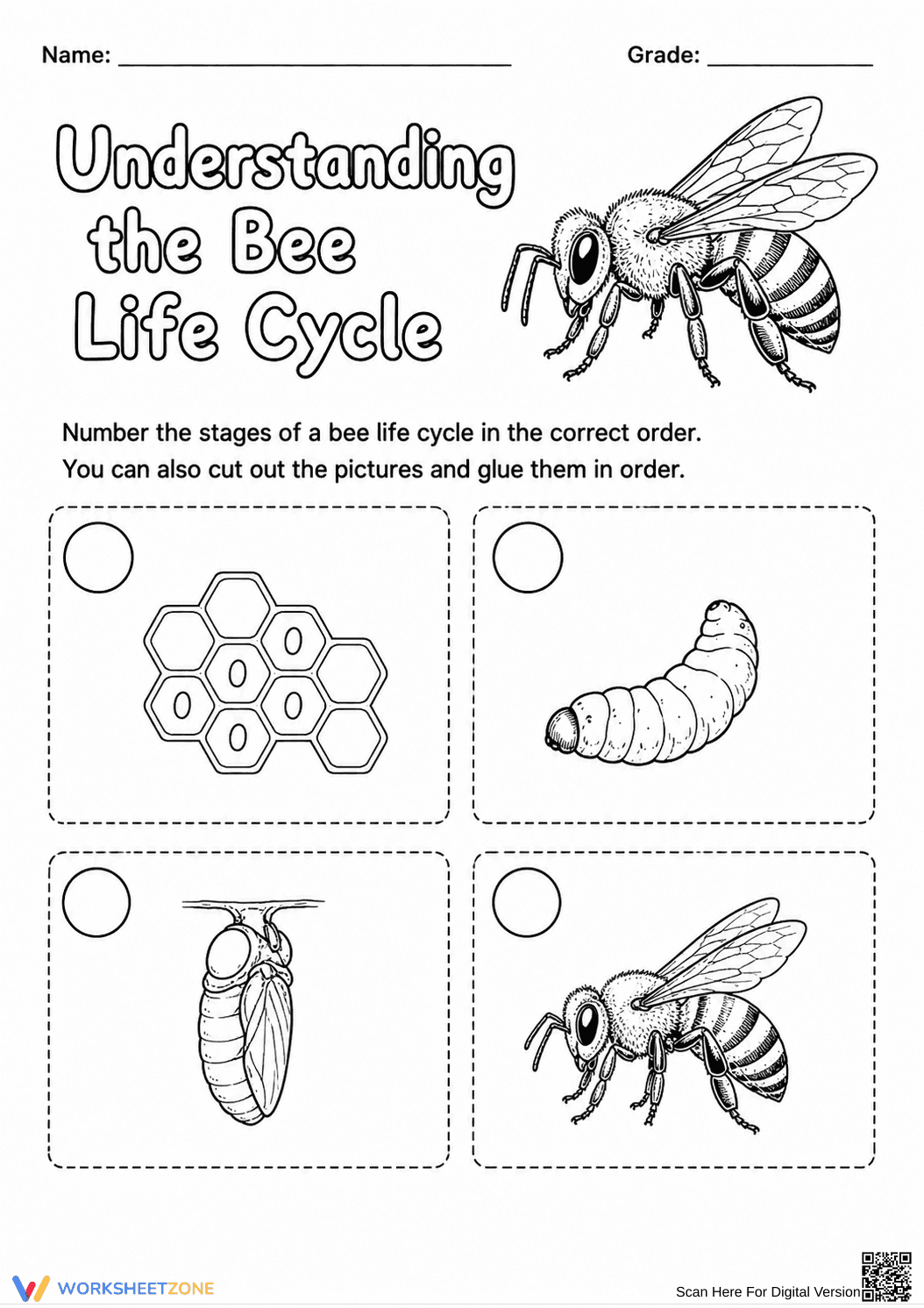

Printable Bee Life Cycle Worksheet | Grade 3 Science

Paste this activity's link or code into your existing LMS (Google Classroom, Canvas, Teams, Schoology, Moodle, etc.).
Students can open and work on the activity right away, with no student login required.
You'll still be able to track student progress and results from your teacher account.
This printable science worksheet helps students master the biological sequencing of a bee's development. By numbering or cutting and pasting the four distinct phases—egg, larva, pupa, and adult—learners actively construct a visual model of insect metamorphosis. It provides immediate, hands-on reinforcement of core life science concepts.
At a Glance
- Grade: 3 · Subject: Science
- Standard:
3-LS1-1— Describe that organisms have unique and diverse life cycles.- Skill Focus: Sequencing life cycle stages
- Format: 1 page · 4 problems · Answer key included · PDF
- Best For: Independent practice or science centers
- Time: 10–15 minutes
This single-page resource features clear illustrations of the four primary stages of a honeybee's development: eggs, larva, pupa, and adult. The flexible design allows learners to either write numbers 1 through 4 in the provided circles to indicate chronological order, or physically cut out the boxes and glue them into a sequence. A complete answer key is provided.
Zero-Prep Workflow
- Print (1 minute): The design is optimized for standard classroom printers and requires no special materials beyond scissors and glue.
- Distribute (1 minute): Hand out the single page to students. The instructions are simple and self-explanatory, requiring minimal teacher modeling.
- Review (2 minutes): Use the included answer key to quickly verify student sequences or project it on the board for self-correction. Total teacher prep time is under two minutes, making this an excellent emergency sub plan.
This activity is directly aligned with Next Generation Science Standard 3-LS1-1: Develop models to describe that organisms have unique and diverse life cycles but all have in common birth, growth, reproduction, and death. By organizing the visual model of the bee's development, students demonstrate comprehension of these universal biological patterns. Both standard codes can be copied directly into lesson plans, IEP goals, or district curriculum mapping tools.
Deploy this worksheet during a life sciences unit after introducing metamorphosis. It serves as excellent independent practice following a read-aloud about insects. Alternatively, place it in a science center where students can complete the cut-and-paste version collaboratively. As a formative assessment tip, observe whether students correctly identify the pupa stage, which is often confused with the larva. Expected completion time is 10 to 15 minutes.
This resource is designed for second, third, and fourth-grade general education students, as well as homeschool learners. The dual-instruction format offers built-in differentiation for students who benefit from tactile, fine-motor activities versus those who prefer quick cognitive sequencing. Pair this worksheet with an anchor chart detailing the life cycles of other pollinators like butterflies to encourage comparative analysis.
Understanding biological sequencing through visual models is a foundational component of early elementary science education. This resource aligns with 3-LS1-1, requiring students to describe that organisms have unique and diverse life cycles. According to Fisher & Frey (2014), providing students with structured, multimodal tasks—such as combining visual identification with physical sequencing—significantly increases retention of domain-specific vocabulary and conceptual frameworks. By manipulating the stages of a bee's development, learners transition from passive observation to active modeling. This instructional approach supports cognitive schema building, allowing students to generalize the concepts of birth, growth, and reproduction across different species. The clear, distraction-free design ensures that cognitive load remains focused entirely on the scientific phenomena rather than complex formatting, maximizing instructional efficiency in the science classroom.


