




























Views
Downloads
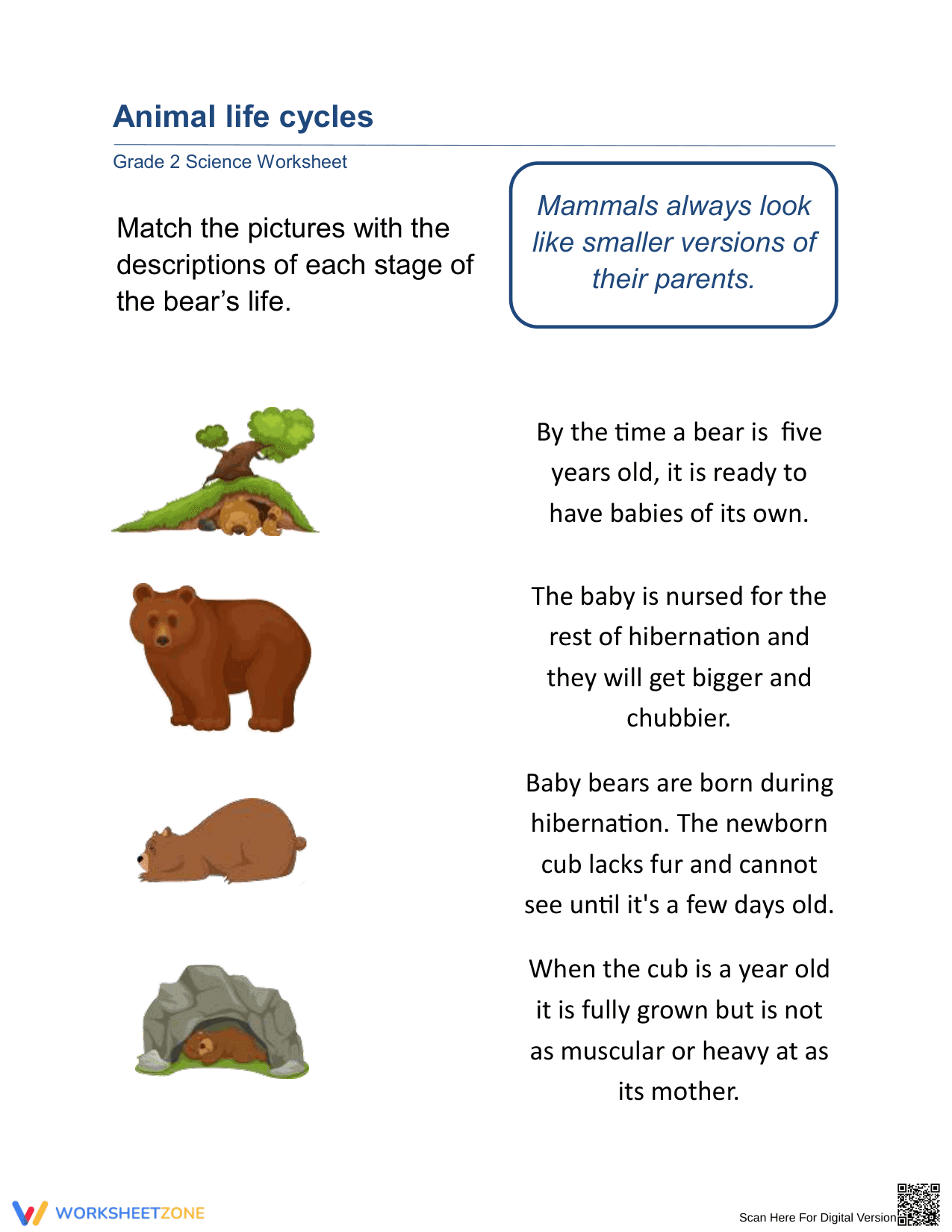
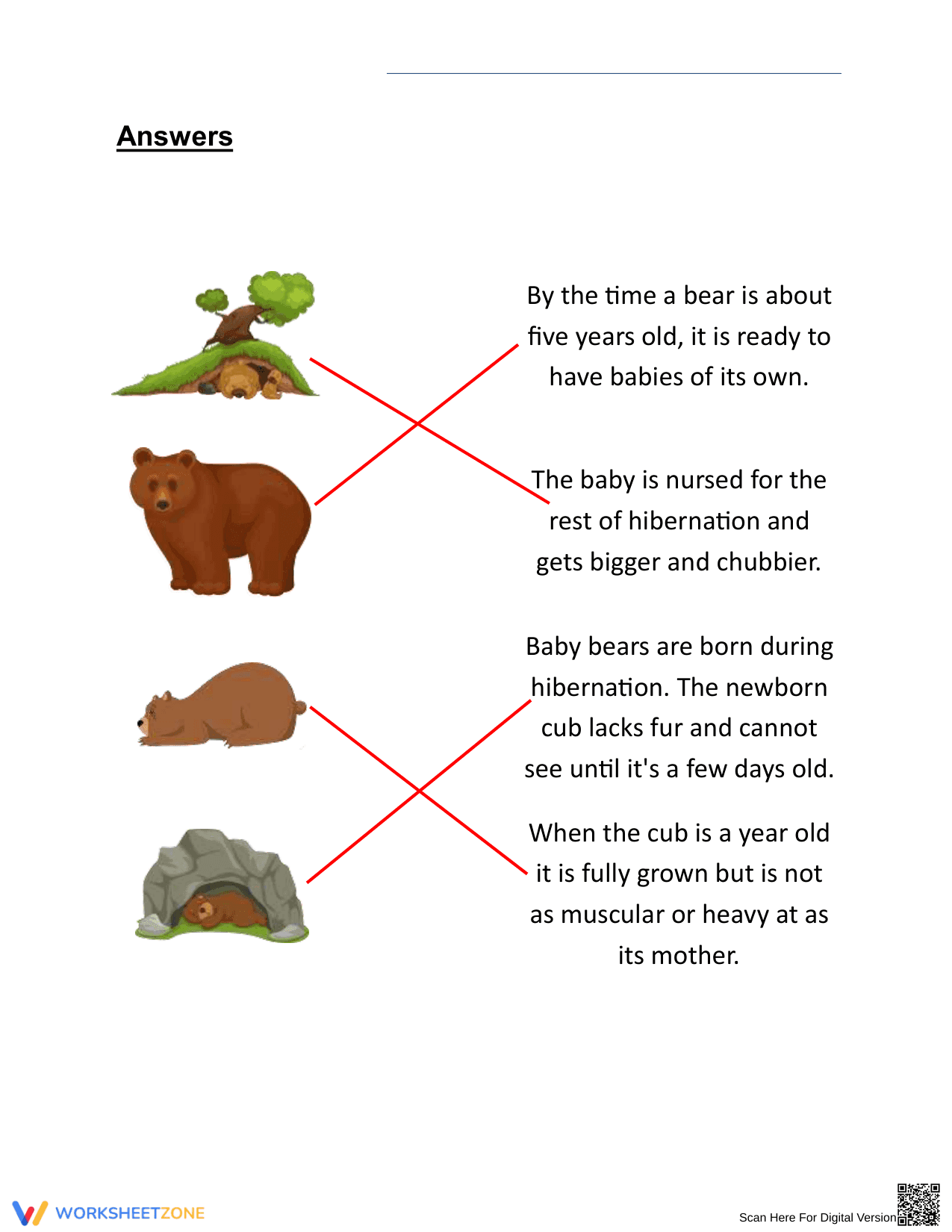

Grade 2 Life Cycle of a Bear — Printable No-Prep Worksheet

Paste this activity's link or code into your existing LMS (Google Classroom, Canvas, Teams, Schoology, Moodle, etc.).
Students can open and work on the activity right away, with no student login required.
You'll still be able to track student progress and results from your teacher account.
Students explore the biological progression of North American brown bears through this targeted matching exercise. By connecting descriptive text to visual representations, learners identify key developmental milestones from birth in the den to adult reproductive maturity. This worksheet transforms complex ecological concepts into an accessible, structured activity that builds foundational scientific literacy and observation skills.
At a Glance
- Grade: 2 · Subject: Science
- Standard:
3-LS1-1— Develop models to describe how organisms have unique and diverse life cycles- Skill Focus: Bear life cycle stages
- Format: 1 page · 4 problems · Answer key included · PDF
- Best For: Essential introduction to mammalian life cycles in primary grades
- Time: 10–15 minutes
What's Inside
This resource features a high-quality single-page layout containing four distinct illustrations of a bear’s life stages alongside corresponding informational text blocks. The matching format requires students to process details regarding birth, nursing, yearling status, and reproductive age. An answer key is provided for rapid grading and immediate student feedback.
Zero-Prep Workflow
The workflow is designed for efficiency. First, print the single-page PDF (30 seconds). Second, distribute the copies to students as a morning warm-up or science transition activity (1 minute). Third, review the matching pairs as a whole class to clarify vocabulary (2 minutes). The total teacher preparation time is under two minutes, making this an ideal solution for emergency sub plans.
Standards Alignment
This activity aligns with 3-LS1-1: students develop models to describe that organisms have unique and diverse life cycles but all have in common birth, growth, reproduction, and death. By sequencing the bear's development, students see a concrete example of this pattern. Both standard codes can be copied directly into lesson plans, IEP goals, or district curriculum mapping tools.
How to Use It
Use this during the initial phase of a unit on living things to gauge prior knowledge about animal growth. It works effectively as guided practice after reading a non-fiction text about forest animals. For formative assessment, observe students differentiating between stages; this reveals their ability to parse physiological details from the text.
Who It's For
Designed for second-graders, this is also suitable for first-grade enrichment or third-grade review. Visual scaffolds support ELL and IEP students by providing context for complex vocabulary. It pairs naturally with an anchor chart detailing the common traits of mammals or a short video clip showing bears in their natural habitat.
Scientific inquiry in early elementary education is most effective when students engage with concrete models of biological systems, as highlighted in Fisher & Frey (2014). This matching activity leverages the gradual release of responsibility by providing clear visual cues that anchor abstract temporal concepts like growth and maturation. By identifying the specific stages of the bear's life cycle, students build the mental schema necessary to compare and contrast different species later in their academic careers. The use of standards-aligned vocabulary ensures that students are not just identifying animals, but are actively participating in the discourse of the life sciences. According to Fisher & Frey (2014), visual-to-textual mapping is a critical component of informational literacy, particularly when students are tasked with understanding sequential processes. This worksheet provides that exact scaffold, ensuring that Grade 2 learners meet the rigorous demands of 3-LS1-1 through structured, evidence-based practice.


