


























Views
Downloads



Letter Z Beginning Sound Worksheet | Essential Grade K-2
Paste this activity's link or code into your existing LMS (Google Classroom, Canvas, Teams, Schoology, Moodle, etc.).
Students can open and work on the activity right away, with no student login required.
You'll still be able to track student progress and results from your teacher account.
This comprehensive Letter Z beginning sound worksheet helps early learners master the final letter of the alphabet through a multi-sensory approach. Students practice tracing, identifying, and matching the letter Z to its corresponding sound, ensuring a solid foundation for phonemic awareness. By engaging with both uppercase and lowercase forms, learners develop the visual discrimination skills required for fluent reading and writing.
At a Glance
- Grade: K-2 · Subject: ELA Phonics
- Standard:
CCSS.ELA-LITERACY.RF.K.1.D— Recognize and name all upper- and lowercase letters of the alphabet- Skill Focus: Letter Z recognition and initial sound identification
- Format: 3 pages · 45 tasks · Answer key included · PDF
- Best For: Independent literacy centers and morning work
- Time: 15–20 minutes
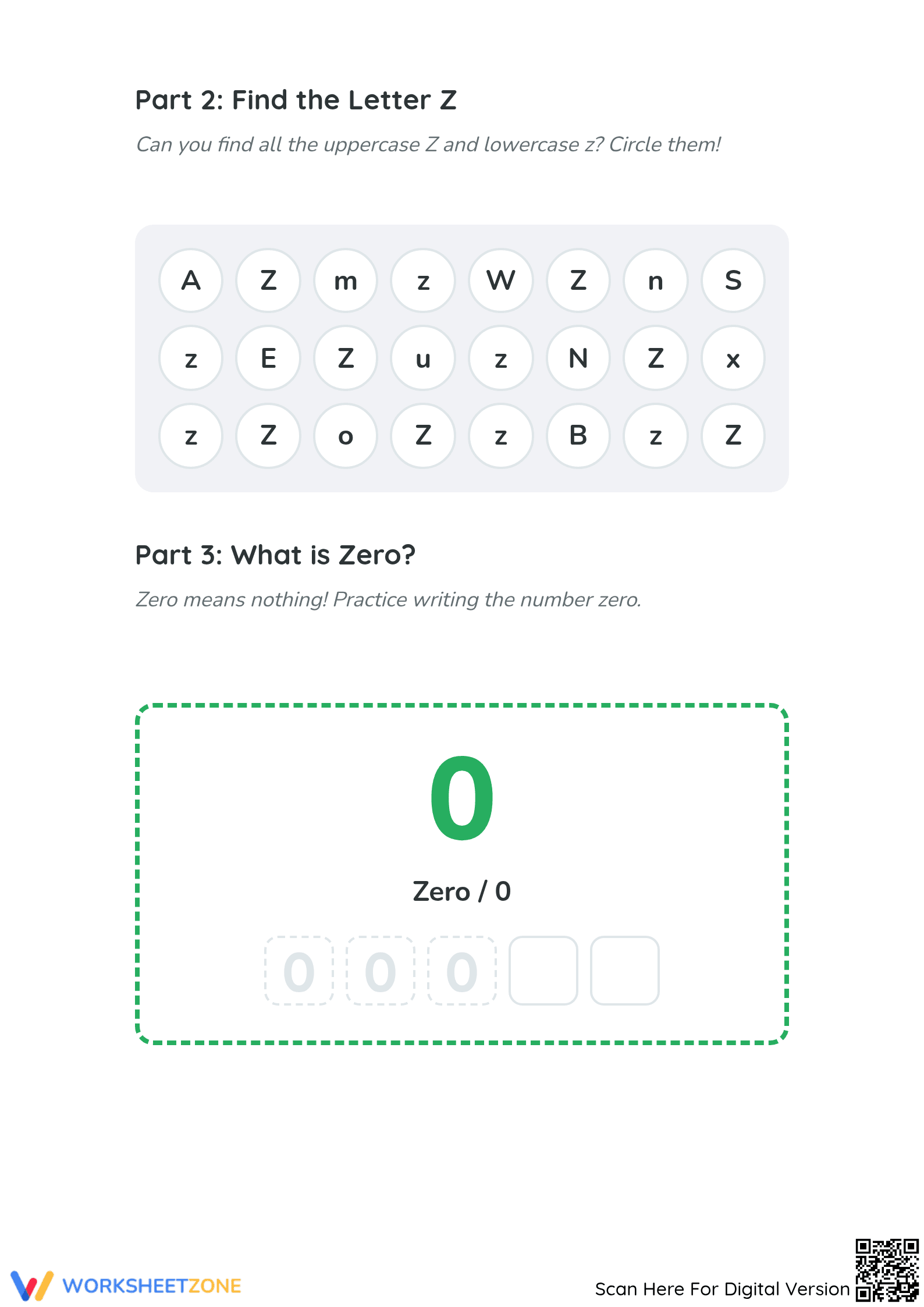
The resource contains three pages of practice. Page one focuses on the mechanics of writing with guided tracing lines for uppercase and lowercase Z. Page two challenges students to find the letter Z within a grid of various alphabet characters, enhancing letter recognition. It also includes a section for tracing the number zero. Page three features a matching activity where students connect the letter Z to images representing the /z/ sound, such as a zebra and a zipper.
The zero-prep design allows for immediate implementation. First, print the three-page PDF (30 seconds). Second, distribute the sheets to students during your phonics block or as a transition activity (1 minute). Third, review the letter search and sound matching sections as a whole group to provide immediate feedback (5 minutes). This workflow requires less than 2 minutes of teacher preparation, making it an ideal choice for substitute plans.
This resource is primarily aligned with CCSS.ELA-LITERACY.RF.K.1.D, which requires students to recognize and name all upper- and lowercase letters. Additionally, it supports CCSS.ELA-LITERACY.RF.K.3.A by asking students to demonstrate knowledge of letter-sound correspondences. Both standard codes can be copied directly into lesson plans, IEP goals, or district curriculum mapping tools to ensure instructional compliance and tracking.
Assign this worksheet during the independent practice phase of a phonics lesson. It works well as a quiet morning work activity to settle students. For formative assessment, observe students during the letter search; students who struggle to distinguish Z from N or W may need additional visual discrimination support. Completion typically takes 15 to 20 minutes depending on student fine motor speed.
This worksheet is designed for Kindergarten and Grade 1 students developing foundational literacy skills. It is also suitable for Grade 2 students requiring intervention or English Language Learners practicing basic phonics. Pair this resource with a Letter Z anchor chart or a short reading passage featuring Z vocabulary to provide a rich, contextualized learning experience for all student populations.
Research by Fisher & Frey (2014) emphasizes the importance of the gradual release of responsibility in early literacy, particularly when introducing phonemic awareness and grapheme recognition. This worksheet applies these principles by moving students from guided tracing of the Letter Z to independent identification within a field of distractors. By connecting the visual form of the letter with its corresponding initial sound /z/ through vocabulary like zebra and zipper, the resource reinforces the alphabetic principle essential for decoding. Furthermore, the integration of the number zero provides a cross-curricular link that strengthens cognitive associations between phonics and early numeracy. According to the NAEP, early mastery of letter-sound correspondence is a primary predictor of later reading fluency. This CCSS.ELA-LITERACY.RF.K.1.D aligned resource ensures that students develop the foundational skills necessary for literacy success through structured practice that builds confidence and automaticity in young learners.


