




























Views
Downloads
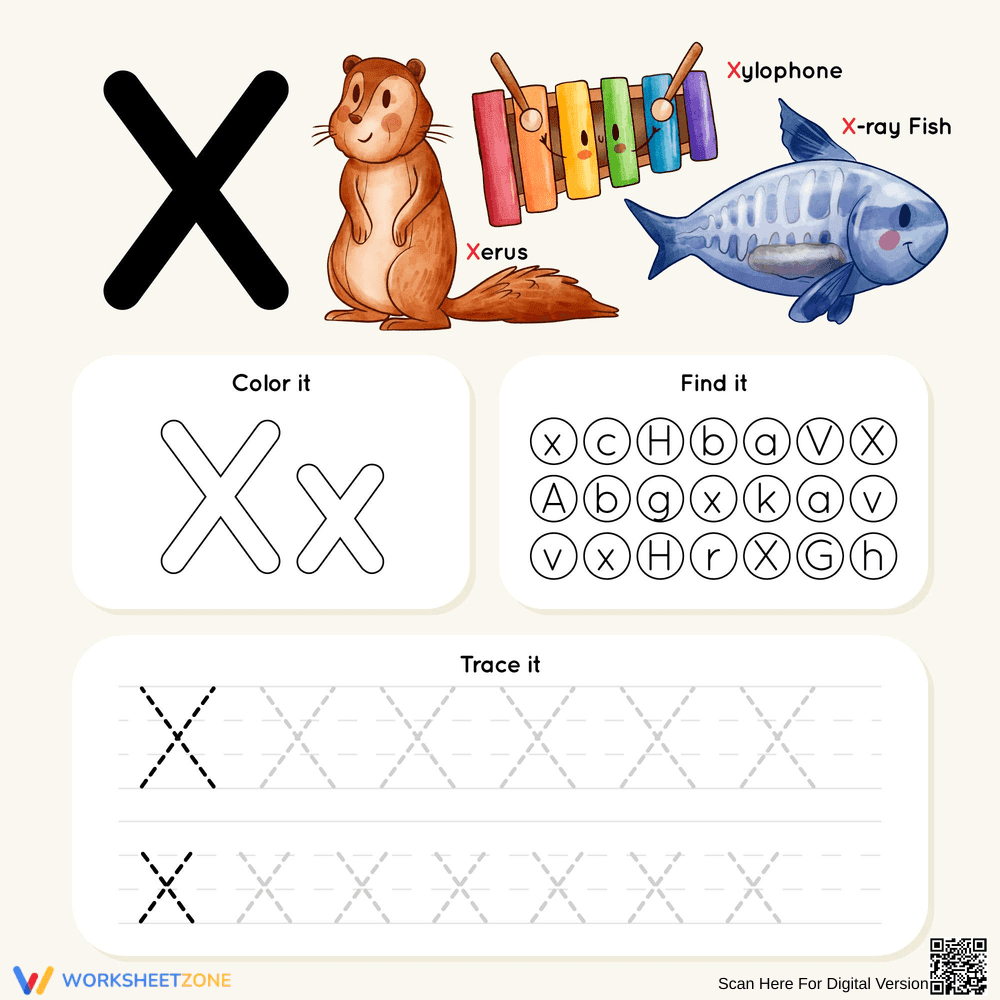

Printable Letter X Tracing Worksheet | Grade K

Paste this activity's link or code into your existing LMS (Google Classroom, Canvas, Teams, Schoology, Moodle, etc.).
Students can open and work on the activity right away, with no student login required.
You'll still be able to track student progress and results from your teacher account.
This printable Letter X worksheet helps early learners master alphabet recognition and handwriting fundamentals. By combining visual vocabulary, letter identification, and guided tracing, students develop essential fine motor skills and phonemic awareness. The engaging layout ensures young readers stay focused while practicing both uppercase and lowercase forms.
At a Glance
- Grade: K · Subject: English
- Standard:
CCSS.ELA-LITERACY.RF.K.1.D— Recognize and name all upper- and lowercase letters- Skill Focus: Letter X recognition and tracing
- Format: 1 page · 3 problems · No answer key · PDF
- Best For: Morning work and literacy centers
- Time: 10–15 minutes
This single-page resource features three distinct activity zones designed for early childhood education. At the top, vibrant illustrations introduce Letter X vocabulary words like Xerus, Xylophone, and X-ray Fish. The middle section includes a "Color it" block for bubble letters and a "Find it" letter hunt containing 21 mixed-case letters. The bottom section provides two rows of dashed-line tracing practice for both uppercase and lowercase X, offering 14 total tracing opportunities.
This resource offers a zero-prep classroom experience.
- Print (1 minute): Simply download the PDF and print the required number of copies. It prints beautifully in grayscale.
- Distribute (1 minute): Hand out the worksheets along with crayons and pencils. The layout requires minimal instruction.
- Review (1 minute): Quickly scan the "Find it" section to check for accurate letter identification and assess tracing neatness.
Total teacher preparation time is under two minutes, making this an ideal activity for emergency sub plans or quick transitions.
This worksheet aligns directly with CCSS.ELA-LITERACY.RF.K.1.D: Recognize and name all upper- and lowercase letters of the alphabet. It also supports early handwriting development by providing structured tracing paths for proper letter formation. Both standard codes can be copied directly into lesson plans, IEP goals, or district curriculum mapping tools.
Use this worksheet during morning arrival as an independent activity to settle the classroom. Alternatively, it works perfectly within a literacy center rotation focused on the alphabet. As a formative assessment tip, observe students while they complete the "Find it" section to ensure they are not confusing the lowercase "x" with similar intersecting shapes or letters. Expected completion time ranges from 10 to 15 minutes depending on the student's fine motor proficiency.
Designed for Kindergarteners, this also serves as remedial practice for first graders needing handwriting reinforcement. The visual cues and structured tracing lines provide built-in differentiation for students developing fine motor control. Pair this worksheet with a read-aloud alphabet book or a classroom anchor chart featuring Letter X words to reinforce the phonetic connections.
Mastering alphabet recognition through targeted practice is a foundational step in early literacy development. This worksheet directly addresses CCSS.ELA-LITERACY.RF.K.1.D by requiring students to recognize and name all upper- and lowercase letters in various contexts. According to a recent ScienceDirect TpT Analysis, early childhood educational resources that combine multimodal tasks—such as coloring, visual scanning, and physical tracing—significantly improve letter retention and fine motor automaticity compared to isolated, single-mode drills. By integrating visual vocabulary like "xylophone" and "xerus" alongside the physical act of tracing dashed lines, young learners build stronger neural pathways connecting the visual symbol of the letter X to its phonetic applications. This structured, multi-sensory approach ensures that students not only memorize the letter's shape but also understand its function within written language, setting a strong, evidence-based baseline for future phonics instruction and reading fluency.


