


























Views
Downloads
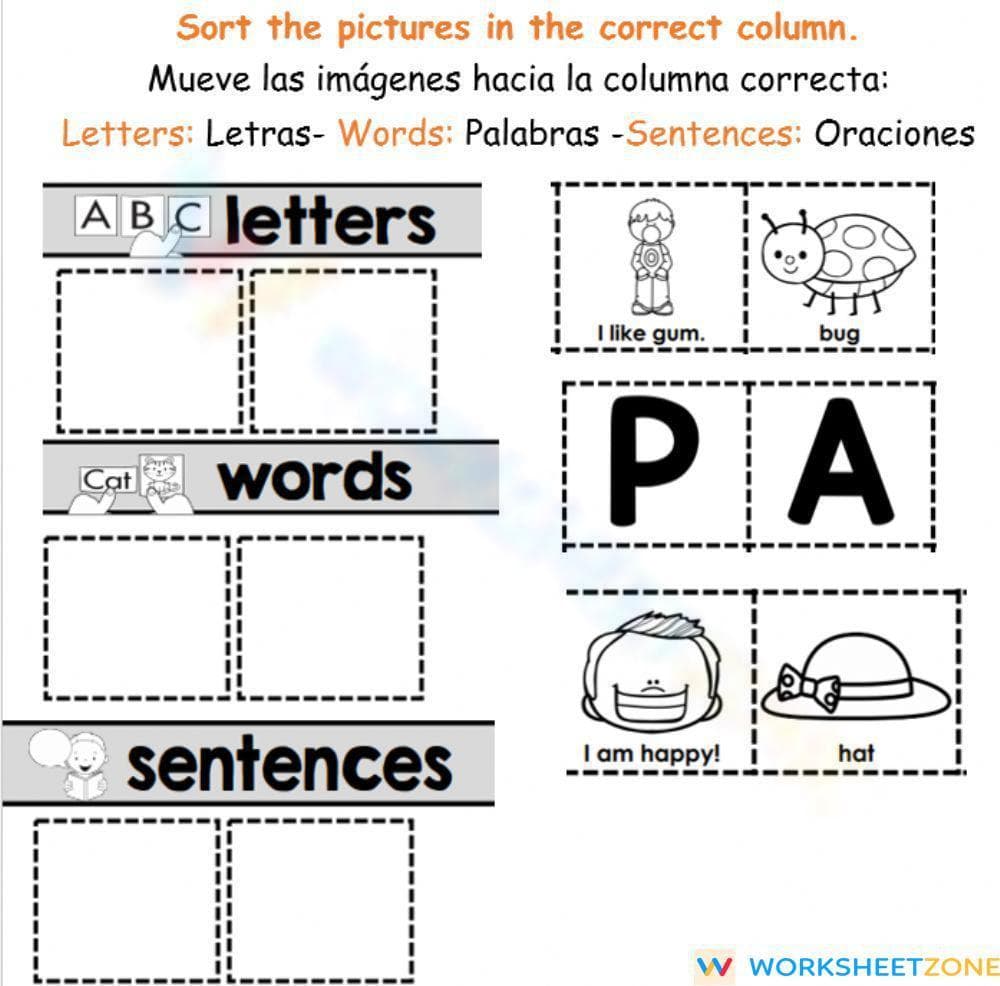

Grade K Concepts of Print — Printable No-Prep Worksheet
Paste this activity's link or code into your existing LMS (Google Classroom, Canvas, Teams, Schoology, Moodle, etc.).
Students can open and work on the activity right away, with no student login required.
You'll still be able to track student progress and results from your teacher account.
This worksheet provides essential, hands-on practice for early learners mastering concepts of print. Students sort items into three categories: letters, words, and sentences. This foundational activity helps Kindergarteners visually distinguish between the basic building blocks of written English, reinforcing what defines each component.
At a Glance
- Grade: Kindergarten · Subject: English Language Arts (ELA)
- Standard:
CCSS.ELA-LITERACY.RF.K.1— Demonstrate understanding of the organization and basic features of print.- Skill Focus: Distinguishing Letters, Words, and Sentences
- Format: 1 page · 6 sorting tasks · Interactive or Printable PDF
- Best For: Literacy centers, morning work, or concept reinforcement
- Time: 5–10 minutes
What's Inside
This single-page resource features a clear three-column layout for sorting. Students will categorize six simple items as either a letter, a word, or a complete sentence. The format is designed for easy implementation as a cut-and-paste activity or a digital drag-and-drop exercise. No answer key is required due to the task's straightforward nature.
A Seamless Zero-Prep Workflow
Designed for immediate classroom use, this worksheet takes less than two minutes to get started.
- Print (30 seconds): The worksheet is a single, self-contained page. Just print one copy for each student.
- Distribute (60 seconds): Hand out the sheet with scissors and glue. The intuitive visual layout requires minimal verbal instruction.
- Review (2 minutes): Quickly check student work as they finish, providing immediate formative assessment data.
Its simple design makes it a perfect, reliable resource for substitute plans or literacy centers.
Standards Alignment
This worksheet is directly aligned with a key Common Core standard for Kindergarten foundational skills:
CCSS.ELA-LITERACY.RF.K.1: Demonstrate understanding of the organization and basic features of print.
The activity provides targeted practice for this skill, and the standard code can be copied directly into lesson plans or curriculum maps.
How to Use This Worksheet
Use this resource after direct instruction on concepts of print. Following a read-aloud where you point out letters, words, and sentences, this sheet serves as an ideal independent check for understanding. It also functions perfectly as a small group activity within a literacy center rotation.
For assessment, observe which category proves most difficult for students. This quick sort can reveal misunderstandings in just a few minutes, with most students completing the task in 5-10 minutes.
Who It's For
This worksheet is ideal for Kindergarten students and also serves as an effective review for first graders. The clear visuals make it accessible for all learners, including English Language Learners. It pairs well with an anchor chart that defines letters, words, and sentences, providing a helpful reference for students as they complete the task.
This activity reinforces a critical early literacy skill identified in numerous studies on reading acquisition. By requiring students to categorize print at the letter, word, and sentence level, the worksheet provides concrete practice aligned with CCSS.ELA-LITERACY.RF.K.1. This standard, focusing on the basic features of print, is a prerequisite for fluent reading. Research summarized by Fisher & Frey (2014) emphasizes the importance of moving from foundational skills to complex texts, and this worksheet serves that initial step. It provides a simple, direct method for teachers to assess a student's ability to "demonstrate understanding of the organization and basic features of print." This type of discrete skill practice helps build the automaticity needed for students to dedicate cognitive resources to comprehension as they encounter more challenging material, a cornerstone of effective reading instruction.


