


























Views
Downloads

Letter T Beginning Sound Worksheet | Essential Grade K-1
Paste this activity's link or code into your existing LMS (Google Classroom, Canvas, Teams, Schoology, Moodle, etc.).
Students can open and work on the activity right away, with no student login required.
You'll still be able to track student progress and results from your teacher account.
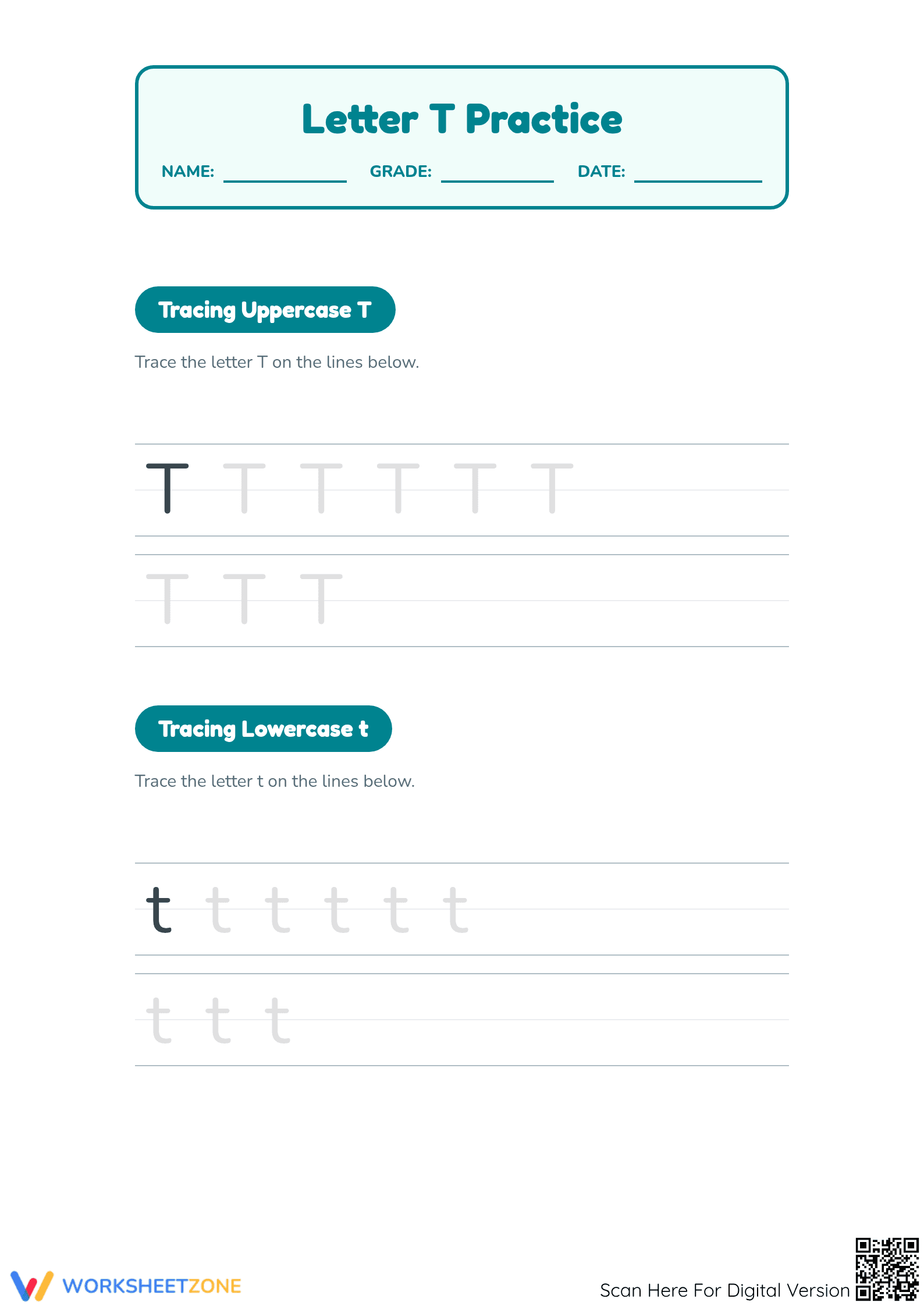
This Grade Kindergarten and Grade 1 phonics worksheet provides comprehensive practice for the letter T. Students develop fine motor skills through tracing and phonemic awareness by identifying beginning sounds in common words. By connecting visual symbols to auditory cues, learners build the foundational literacy skills necessary for early reading success and letter recognition.
At a Glance
- Grade: Kindergarten · Subject: ELA Phonics
- Standard:
CCSS.ELA-LITERACY.RF.K.3.A— Demonstrate basic knowledge of one-to-one letter-sound correspondences- Skill Focus: Letter T formation and beginning sounds
- Format: 2 pages · 25 tasks · Answer key included · PDF
- Best For: Morning work or phonics centers
- Time: 15–20 minutes
What's Inside
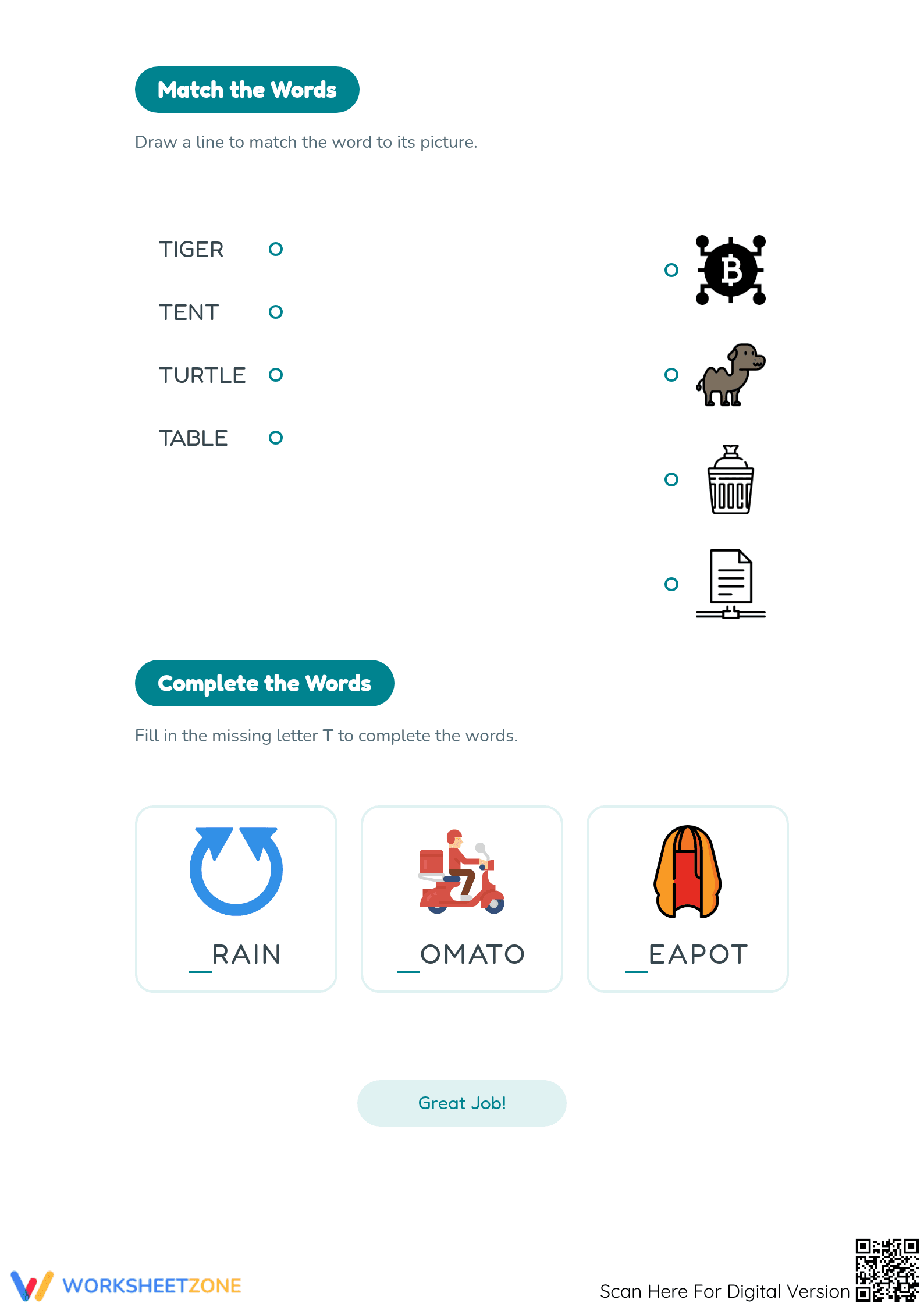
This two-page PDF includes a dedicated tracing section for both uppercase "T" and lowercase "t" to reinforce proper stroke order. The second page features a matching activity where students link vocabulary words like "Tiger" and "Turtle" to their corresponding images, followed by a fill-in-the-blank section to complete words like "Tomato" and "Teapot." A full answer key is provided for easy grading.
Zero-Prep Workflow
- Print: Select the two-page document and print enough copies for your group (30 seconds).
- Distribute: Hand out the sheets during your phonics block or as a quiet morning arrival activity (1 minute).
- Review: Use the included answer key for a quick visual check or to guide a whole-class review of the /t/ sound (30 seconds).
This resource serves as an ideal "grab-and-go" activity for substitute folders or unexpected schedule changes.
Standards Alignment
The primary focus is `CCSS.ELA-LITERACY.RF.K.3.A`, which requires students to demonstrate basic knowledge of one-to-one letter-sound correspondences by producing the primary sound for each consonant. It also supports `CCSS.ELA-LITERACY.RF.K.1.D` regarding alphabet recognition and formation. Both standard codes can be copied directly into lesson plans, IEP goals, or district curriculum mapping tools.
How to Use It
Use this worksheet during the independent practice phase of a phonics lesson after introducing the letter T sound. It also works well as a formative assessment tool; observe students during the matching task to see if they can isolate the initial /t/ sound without teacher prompting. Expected completion typically takes 15 to 20 minutes depending on the student's fine motor proficiency.
Who It's For
This resource is tailored for Kindergarten students beginning their phonics journey, though it provides excellent remedial support for Grade 1 or 2 learners who need extra practice with letter formation. It pairs naturally with an alphabet anchor chart or a read-aloud book featuring "T" words to provide a rich, multi-sensory learning experience for early readers.
According to the RAND AIRS 2024 report on early literacy, structured phonics practice that integrates both handwriting and phonemic awareness is critical for long-term reading fluency. This worksheet addresses these needs by combining tactile tracing with auditory-visual matching for the letter T. By focusing on `CCSS.ELA-LITERACY.RF.K.3.A`, the activity ensures students meet the foundational requirement of one-to-one letter-sound correspondence. Research from Fisher & Frey (2014) emphasizes that gradual release of responsibility—moving from guided tracing to independent sound identification—supports cognitive retention in early learners. This 2-page resource provides approximately 25 distinct opportunities for students to engage with the target phoneme, ensuring high-frequency exposure. Educators can utilize this tool to bridge the gap between letter recognition and word decoding, providing a measurable data point for student progress in foundational ELA skills.


