


























Views
Downloads
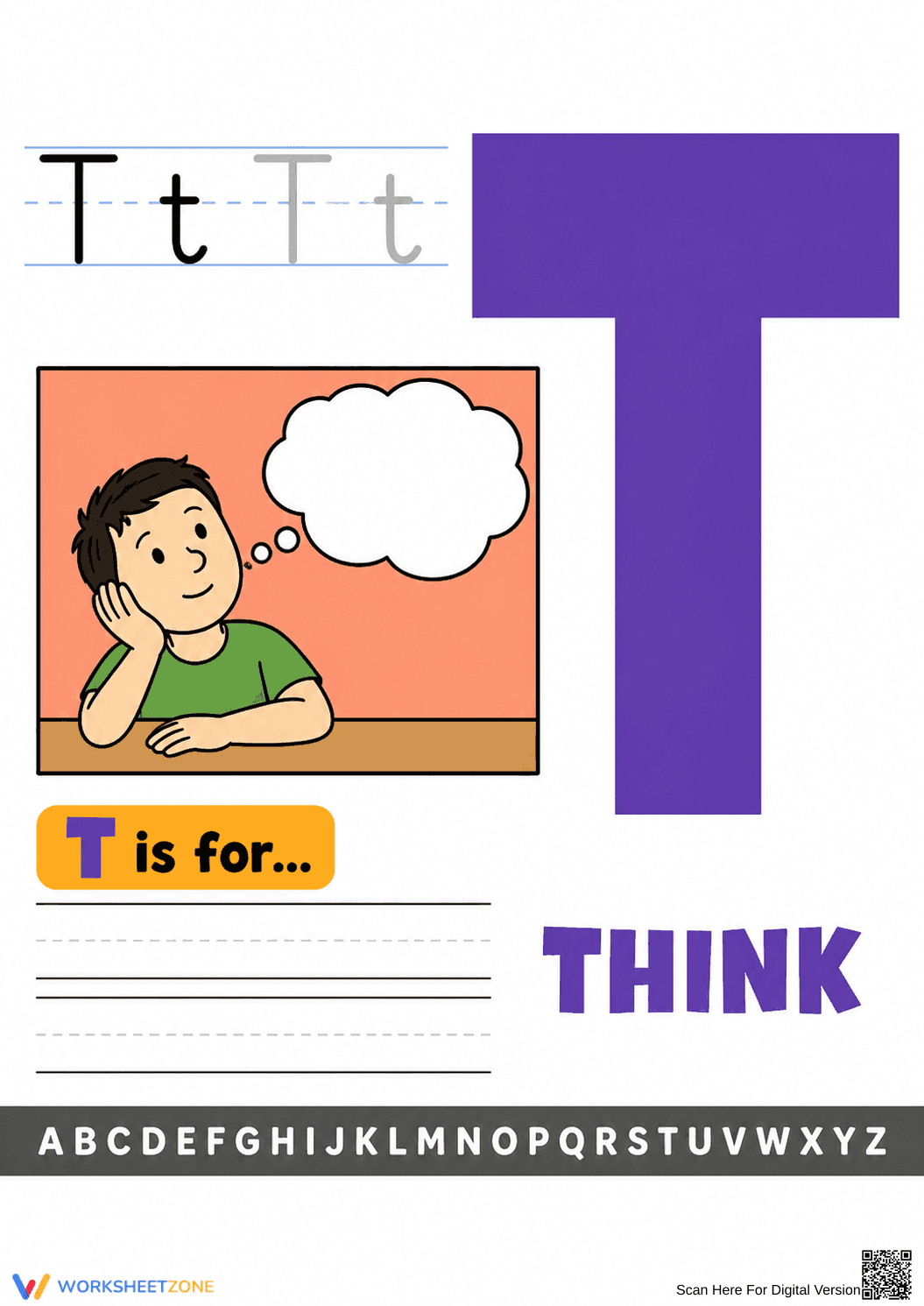

Essential Letter T Beginning Sound Worksheet | Grade K-2
Paste this activity's link or code into your existing LMS (Google Classroom, Canvas, Teams, Schoology, Moodle, etc.).
Students can open and work on the activity right away, with no student login required.
You'll still be able to track student progress and results from your teacher account.
This Letter T beginning sound worksheet helps early learners identify and produce the /t/ sound through visual association and handwriting practice. Students connect the letterform to the word "think," reinforcing phonemic awareness and fine motor skills simultaneously. It provides a clear, structured path toward letter-sound mastery in early literacy.
At a Glance
- Grade: Kindergarten · Subject: Phonics
- Standard:
CCSS.ELA-LITERACY.RF.K.3.A— Produce the primary sound for each consonant- Skill Focus: Letter T Identification & Phonics
- Format: 1 page · 2 tasks · Answer key included · PDF
- Best For: Initial phonics instruction and handwriting practice
- Time: 10–15 minutes
Inside this resource, you will find a high-contrast layout featuring both uppercase and lowercase T. The page includes a dedicated tracing section with primary-ruled lines for handwriting accuracy, a "T is for..." visual prompt featuring the word "THINK," and a full alphabet reference strip at the bottom to help students locate the letter within the sequence.
- Guided practice: Students observe the large-format Letter T and the "THINK" illustration to establish the initial phoneme connection.
- Supported practice: Learners use the provided tracing lines to practice the specific strokes required for both capital and lowercase letterforms.
- Independent practice: Students identify the letter T on the alphabet strip and complete the "T is for..." prompt to demonstrate sound-symbol recognition.
This worksheet follows a gradual-release model, moving from visual recognition to active production through the I Do, We Do, You Do instructional framework.
This worksheet aligns with `CCSS.ELA-LITERACY.RF.K.3.A`, which requires students to produce the primary sound for each consonant. It also supports `CCSS.ELA-LITERACY.RF.K.1.D` by focusing on the recognition and naming of all upper- and lowercase letters of the alphabet. Both standard codes can be copied directly into lesson plans, IEP goals, or district curriculum mapping tools.
Use this worksheet during the independent practice portion of a phonics lesson after introducing the /t/ sound with an anchor chart. It serves as an excellent formative assessment tool; teachers should observe if students start their pencil strokes from the top line. Expected completion time is 10 to 15 minutes depending on student fine motor development.
This resource is designed for Kindergarten students, though it provides valuable remediation for Grade 1 and Grade 2 learners struggling with letter reversals. It pairs naturally with a "Letter T" alphabet book or a tactile sand-tray tracing activity to reinforce the physical shape of the letter for diverse learners.
According to the RAND AIRS 2024 report, early phonics instruction that integrates handwriting with sound-symbol correspondence significantly improves long-term orthographic mapping. This worksheet targets the /t/ sound, a high-frequency consonant essential for early decoding. By providing a clear visual anchor like "think" alongside structured tracing lines, the resource adheres to evidence-based practices for foundational literacy. Research from Fisher & Frey (2014) emphasizes that such multi-modal tasks—combining visual, auditory, and kinesthetic elements—help solidify the alphabetic principle in young learners. This specific worksheet provides the necessary repetition for students to achieve automaticity in letter recognition and production, which is a prerequisite for fluent reading. The inclusion of the full alphabet strip further supports spatial awareness and sequential learning, ensuring students understand the letter's position within the broader linguistic system.


