


























Views
Downloads

Letter Q Beginning Sound Worksheet | Essential Phonics
Paste this activity's link or code into your existing LMS (Google Classroom, Canvas, Teams, Schoology, Moodle, etc.).
Students can open and work on the activity right away, with no student login required.
You'll still be able to track student progress and results from your teacher account.
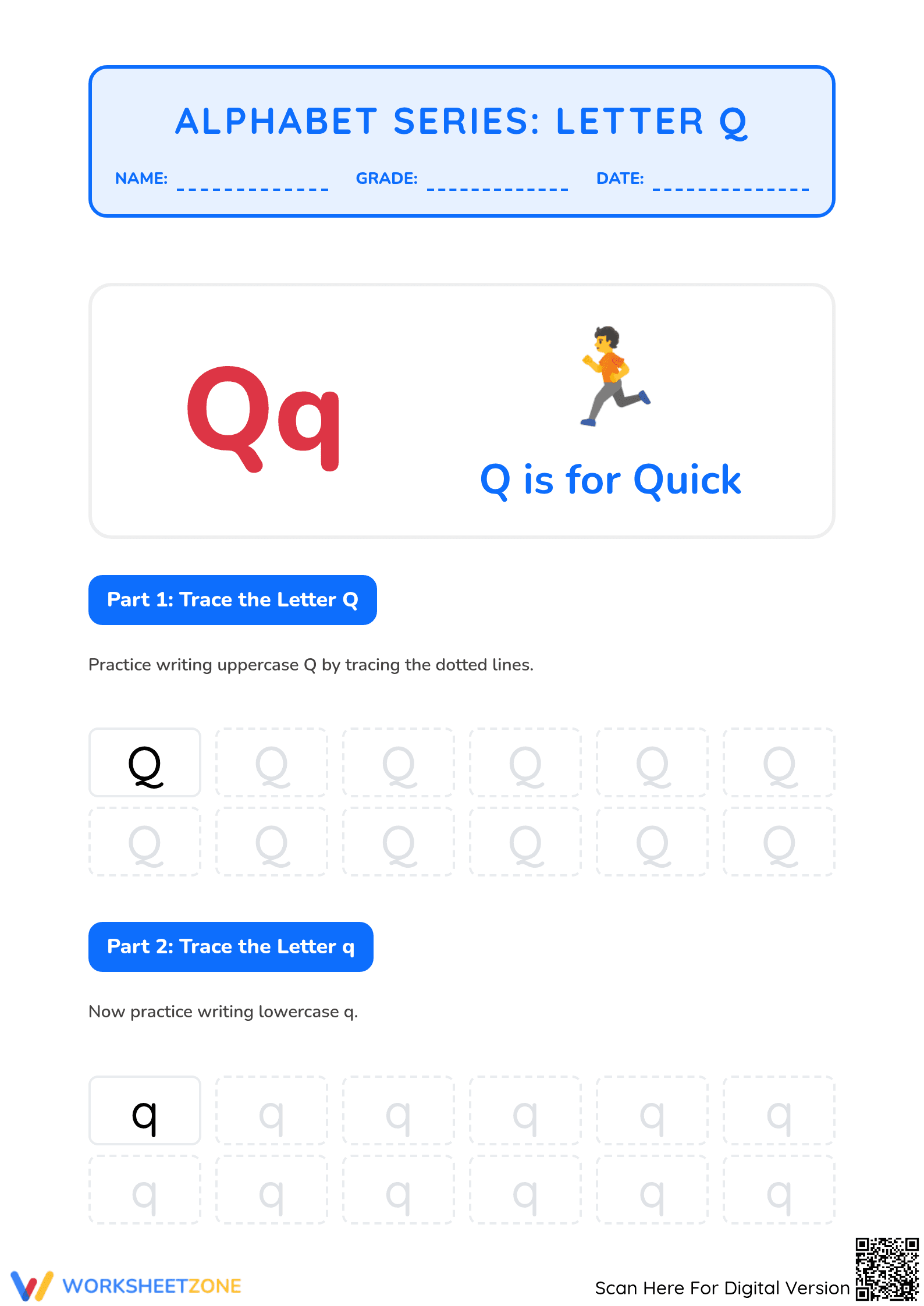
This Letter Q beginning sound worksheet helps early learners master phonemic awareness and letter formation through five structured activities. Students identify the unique "qu" sound, practice writing both uppercase and lowercase forms, and distinguish the letter from similar-looking characters. It provides a comprehensive foundation for literacy development in kindergarten and first grade.
At a Glance
- Grade: Kindergarten · Subject: ELA Phonics
- Standard:
CCSS.ELA-LITERACY.RF.K.3.A— Demonstrate basic knowledge of one-to-one letter-sound correspondences by producing the primary sound- Skill Focus: Letter Q Recognition & Sound
- Format: 3 pages · 35+ problems · Answer key included · PDF
- Best For: Initial phonics instruction and letter mastery
- Time: 15–20 minutes
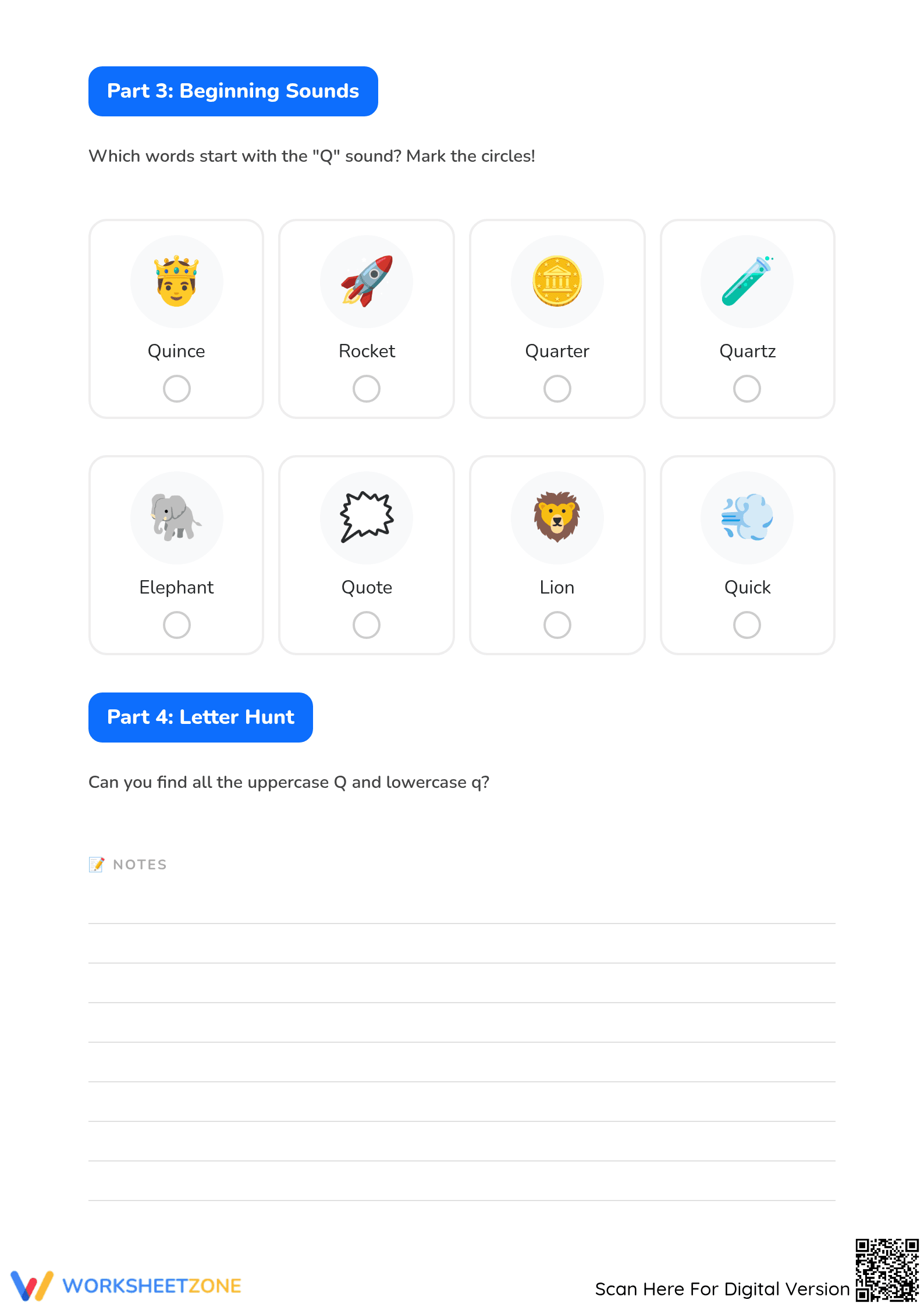
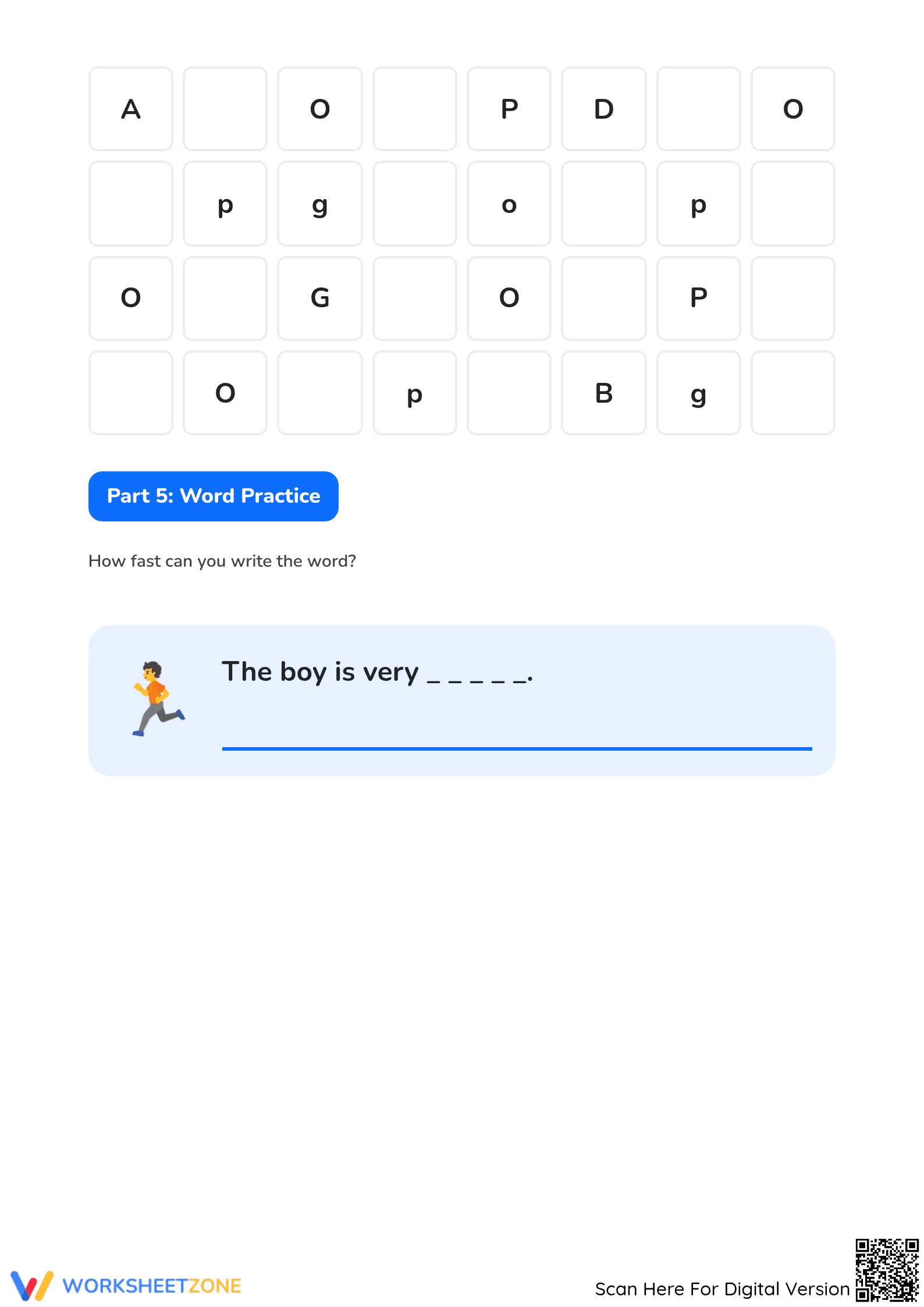
Inside this 3-page PDF, you will find a multi-sensory approach to the letter Q. The packet includes dedicated tracing rows for uppercase and lowercase letters, a visual "Beginning Sounds" sorting task with eight distinct images, a "Letter Hunt" grid to improve visual discrimination, and a "Word Practice" sentence completion task. A full answer key is provided for quick grading.
Skill Progression
- Guided Practice: Students begin with 24 tracing opportunities, using dotted lines to master the specific curves and tails of uppercase Q and lowercase q.
- Supported Practice: The "Beginning Sounds" and "Letter Hunt" sections provide 40 visual cues where students must identify the letter and its sound among distractors.
- Independent Practice: The final "Word Practice" task requires students to apply their knowledge by writing the word "quick" to complete a contextual sentence.
This sequence follows the gradual-release model to ensure students move from mechanical tracing to conceptual sound application.
Standards Alignment
This resource is aligned with `CCSS.ELA-LITERACY.RF.K.3.A`, which requires students to produce the primary sound for each consonant. It also supports `CCSS.ELA-LITERACY.RF.K.1.D` by focusing on the recognition and naming of all upper- and lowercase letters of the alphabet. Both standard codes can be copied directly into lesson plans, IEP goals, or district curriculum mapping tools.
How to Use It
Use this worksheet during your initial "Letter of the Week" instruction or as a focused intervention for students struggling with the Q/O or Q/P distinction. It works best after a brief oral phonemic awareness warm-up where students brainstorm "Q" words. Expect students to complete the three pages in approximately 15 to 20 minutes during independent center time.
Who It's For
This packet is designed for kindergarten students, though it serves as an excellent review for first graders or a challenge for preschool learners. It is particularly helpful for English Language Learners who need visual support to connect sounds to symbols. Pair this with a "Letter Q" anchor chart or a picture book featuring "qu" words.
According to the RAND AIRS 2024 report on early literacy, systematic phonics instruction that combines letter-sound correspondence with handwriting practice significantly improves long-term reading fluency. This worksheet addresses the specific challenges of the letter Q, which often requires higher visual discrimination skills due to its similarity to other rounded characters like O, P, and G. By utilizing the CCSS.ELA-LITERACY.RF.K.3.A standard, this resource ensures that students are not just memorizing a shape but are actively producing the primary sound associated with the grapheme. Research from Fisher & Frey (2014) emphasizes that the gradual release of responsibility—moving from guided tracing to independent word application—is the most effective way to cement these foundational skills in young minds. This 3-page set provides the necessary repetition and variety to move students toward mastery of the beginning "qu" sound in a classroom-ready format.


