


























Views
Downloads

Essential Letter O Beginning Sound Worksheet | Grade K-2
Paste this activity's link or code into your existing LMS (Google Classroom, Canvas, Teams, Schoology, Moodle, etc.).
Students can open and work on the activity right away, with no student login required.
You'll still be able to track student progress and results from your teacher account.
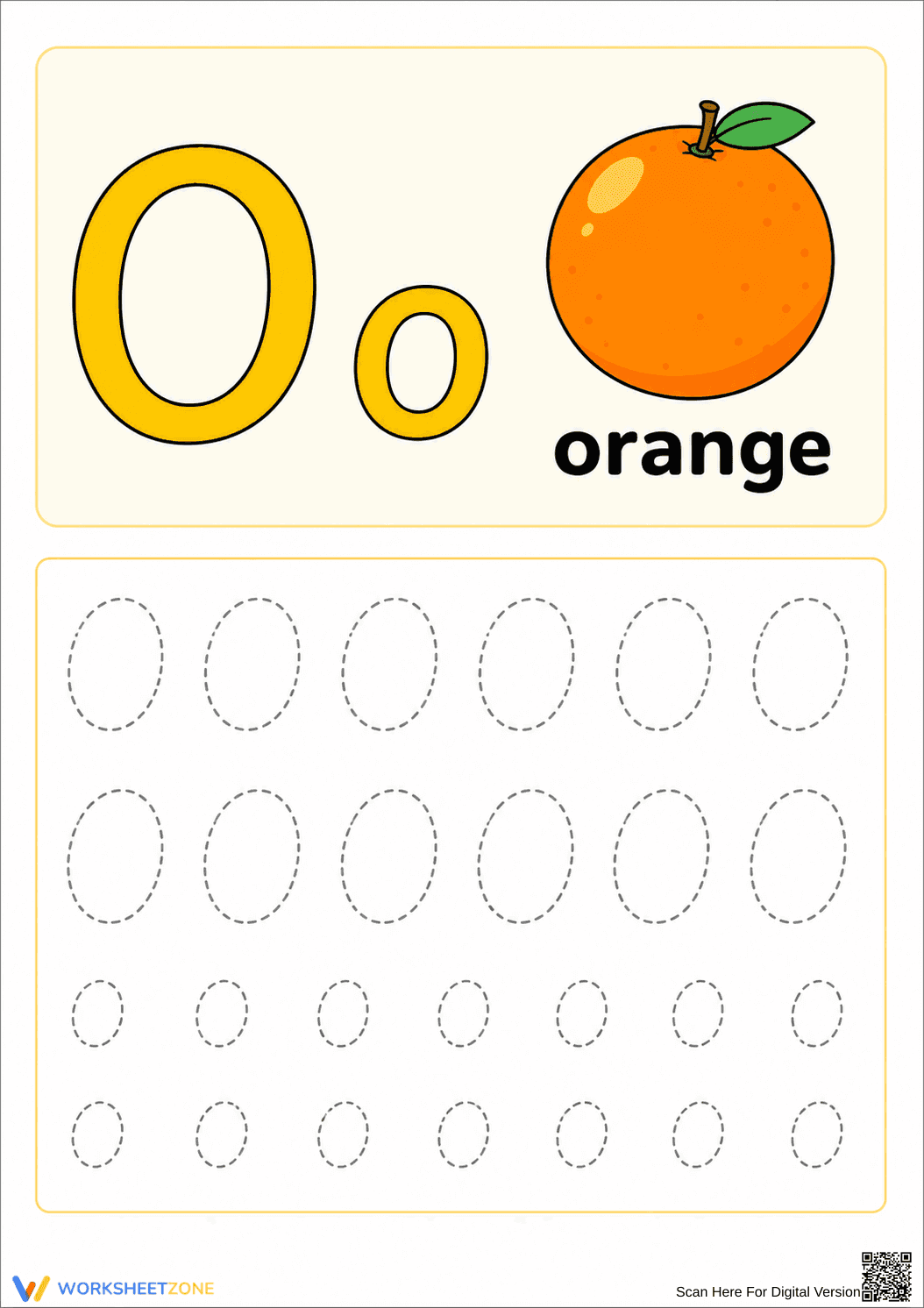
This Grade K-2 phonics worksheet helps early learners master the letter O through focused tracing and beginning sound identification. By connecting the visual shape of the letter to the orange anchor image, students build the foundational phonemic awareness necessary for reading fluency. It provides immediate practice for letter formation and sound-symbol correspondence.
At a Glance
- Grade: K-2 · Subject: ELA Phonics
- Standard:
CCSS.ELA-LITERACY.RF.K.1.D— Recognize and name all upper- and lowercase letters of the alphabet- Skill Focus: Letter O formation and sound
- Format: 1 page · 26 tasks · Answer key included · PDF
- Best For: Morning work or literacy centers
- Time: 10–15 minutes
The worksheet features a large visual anchor with an orange illustration to reinforce the short /o/ sound. Below the header, students find two distinct rows for uppercase O tracing and two rows for lowercase o tracing. The 26 tracing tasks use dashed lines to guide fine motor development, ensuring students learn the correct circular stroke direction for this specific character.
This resource is designed for a zero-prep classroom workflow. First, print the single-page PDF (30 seconds). Second, distribute the sheets to students during your phonics block or as a transition activity (1 minute). Third, review the beginning sound by having students say "O is for orange" aloud (30 seconds). Total teacher preparation time is under 2 minutes, making it an ideal sub-plan or emergency literacy filler.
This activity aligns with `CCSS.ELA-LITERACY.RF.K.1.D`, which requires students to recognize and name all upper- and lowercase letters. It also supports supporting standards by linking the letter shape to its primary vowel sound. Both standard codes can be copied directly into lesson plans, IEP goals, or district curriculum mapping tools.
Use this worksheet during the independent practice phase of a lesson after demonstrating the letter O on a whiteboard. It serves as an excellent formative assessment; observe students to ensure they are starting their circles at the top rather than the bottom. This 10-15 minute task provides a clear snapshot of fine motor control and letter recognition.
This resource is perfect for Kindergarten students just starting the alphabet, as well as Grade 1 or 2 students requiring Tier 2 intervention for letter reversals. It pairs naturally with a Letter of the Week anchor chart or a short vowel reading passage. The high-contrast design supports students with visual processing needs and ensures clear printing.
According to the RAND AIRS 2024 report, repetitive tracing combined with visual anchor images significantly improves letter-sound correspondence in early childhood settings. This worksheet utilizes these evidence-based practices by providing 26 specific tracing opportunities for the letter O. By isolating the beginning sound with the orange prompt, the resource reduces cognitive load, allowing students to focus entirely on the relationship between the grapheme and the phoneme. Research from Fisher & Frey (2014) suggests that such focused, short-duration tasks are essential for building the muscle memory required for fluent handwriting. This printable PDF ensures that students meet the CCSS.ELA-LITERACY.RF.K.1.D standard through structured, independent practice. Educators can use this tool to bridge the gap between whole-group instruction and individual mastery, providing a reliable data point for phonics progress monitoring throughout the school year.


