




























Views
Downloads
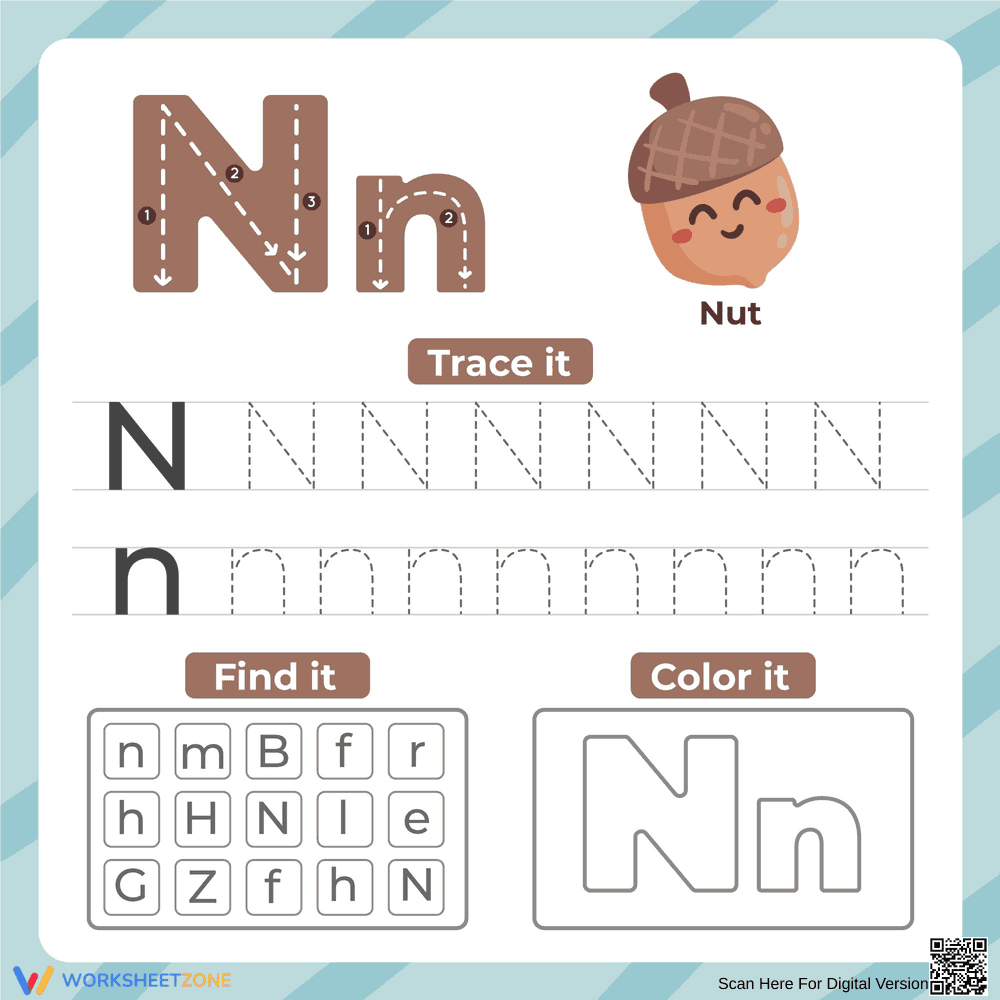

Letter N Tracing Worksheet | Printable Pre-K & K

Paste this activity's link or code into your existing LMS (Google Classroom, Canvas, Teams, Schoology, Moodle, etc.).
Students can open and work on the activity right away, with no student login required.
You'll still be able to track student progress and results from your teacher account.
This printable Letter N worksheet helps early learners master alphabet recognition and handwriting fundamentals. By combining tracing, finding, and coloring activities, students build fine motor skills while reinforcing their understanding of uppercase and lowercase N. The clear layout ensures young students can practice independently with confidence.
At a Glance
- Grade: Kindergarten · Subject: English
- Standard:
CCSS.ELA-LITERACY.L.K.1.A— Print many upper- and lowercase letters- Skill Focus: Letter N recognition and tracing
- Format: 1 page · 3 tasks · No answer key · PDF
- Best For: Morning work or literacy centers
- Time: 10–15 minutes
This single-page resource features three distinct activity zones designed for early childhood development. At the top, a large instructional graphic demonstrates proper stroke order for the letter N alongside a helpful "Nut" illustration. The "Trace it" section provides guided dotted lines for both uppercase and lowercase letters. Below that, a "Find it" grid challenges students to visually discriminate the target letter among distractors, while a "Color it" block offers creative space to reinforce letter shape.
Zero-Prep Workflow
This resource is designed for immediate classroom implementation with minimal teacher preparation:
- Print (1 minute): Simply download the PDF and print the required number of copies. The black-and-white design is ink-friendly.
- Distribute (1 minute): Hand out the sheets along with pencils and crayons. The visual cues make instructions self-evident.
- Review (3 minutes): Quickly check the "Find it" grid to ensure students correctly identified the target letters.
With under two minutes of total prep time, this worksheet is an excellent addition to emergency sub plans or spontaneous instructional shifts.
Standards Alignment
This activity aligns directly with CCSS.ELA-LITERACY.L.K.1.A, requiring students to print many upper- and lowercase letters. It also supports foundational reading skills by having students recognize and name letters of the alphabet. Both standard codes can be copied directly into lesson plans, IEP goals, or district curriculum mapping tools.
How to Use It
Deploy this worksheet during morning work to establish a calm, focused start to the day. It also functions perfectly as an independent station during literacy centers. While students work, teachers can conduct formative assessments by observing pencil grip and stroke direction during the tracing portion. Expect most kindergarteners to complete the three tasks within 10 to 15 minutes.
Who It's For
This resource is primarily designed for preschool and kindergarten students developing early literacy and fine motor skills. It serves as an effective intervention tool for first graders needing extra handwriting support. Pair this worksheet with an alphabet anchor chart or a read-aloud focused on the "N" sound to create a comprehensive phonics lesson.
Mastering alphabet fundamentals through structured practice is a critical step in early childhood education. This resource targets CCSS.ELA-LITERACY.L.K.1.A, helping students print many upper- and lowercase letters accurately. According to a 2024 report by EdReports, integrating multimodal tasks—such as tracing, visual discrimination, and coloring—significantly improves letter retention and fine motor development in young learners. By combining these distinct cognitive tasks into a single, cohesive activity, educators can provide targeted reinforcement that respects the developmental capabilities of kindergarteners. The guided stroke arrows ensure correct muscle memory formation, while the visual search grid builds essential pre-reading skills. Consistent exposure to these foundational exercises establishes the groundwork for future reading fluency and writing proficiency, making this targeted letter practice an essential component of any early literacy curriculum.


