


























Views
Downloads
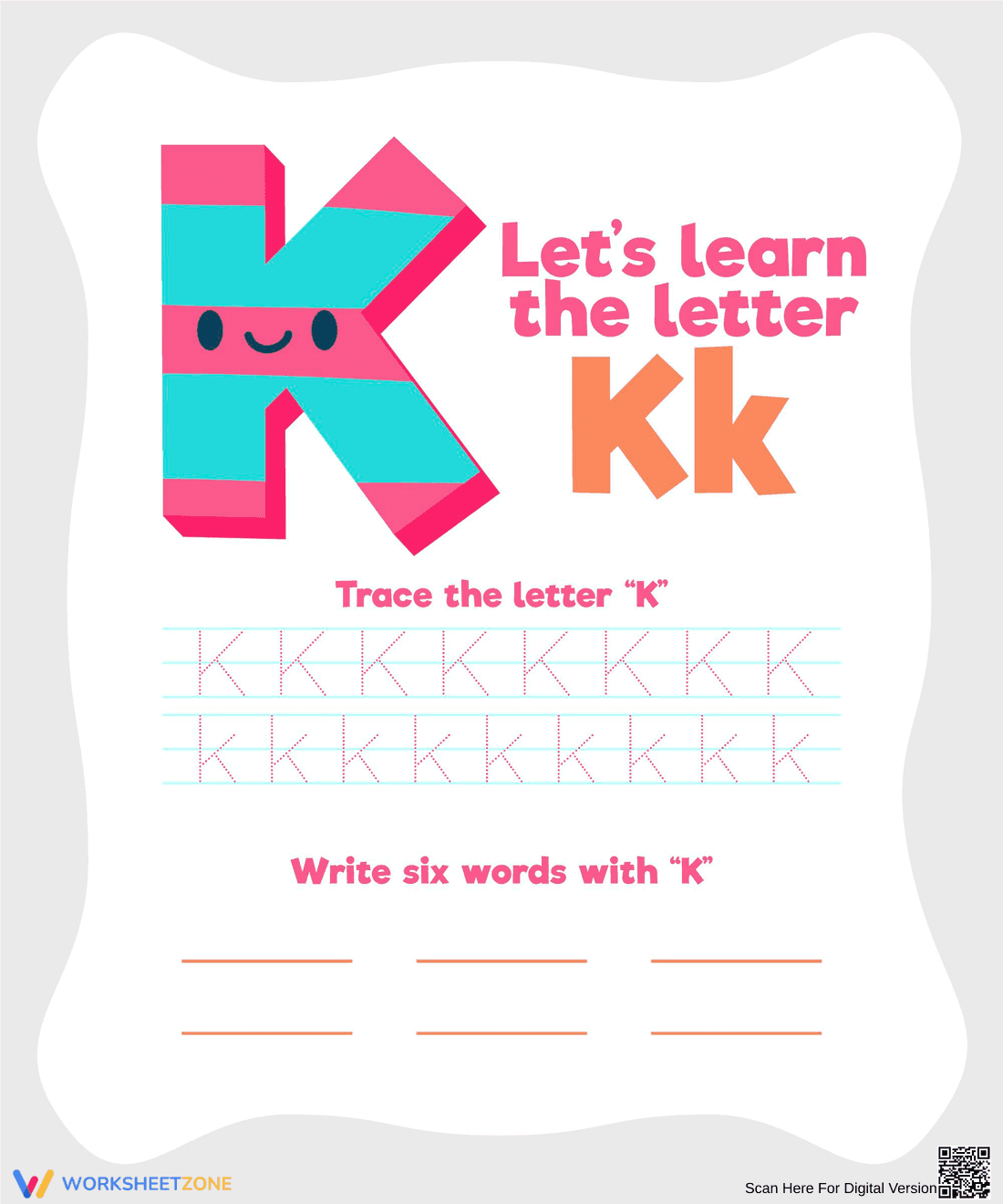

Grade 1 Letter K — Printable No-Prep Worksheet
Paste this activity's link or code into your existing LMS (Google Classroom, Canvas, Teams, Schoology, Moodle, etc.).
Students can open and work on the activity right away, with no student login required.
You'll still be able to track student progress and results from your teacher account.
This Grade 1 English worksheet provides focused practice on printing and vocabulary generation for the letter K. Students develop fine motor control by tracing uppercase and lowercase forms before applying their phonics knowledge to write six original words starting with the target letter.
At a Glance
- Grade: 1 · Subject: English
- Standard:
CCSS.ELA-LITERACY.L.1.1.A— Print all upper- and lowercase letters- Skill Focus: Letter K tracing and vocabulary
- Format: 1 page · 24 tasks · No answer key · PDF
- Best For: Independent practice and centers
- Time: 10–15 minutes
This single-page resource features two distinct activity sections designed to reinforce letter recognition and formation. The top half includes 18 guided tracing paths for both uppercase and lowercase K, utilizing dashed lines for precise handwriting support. The bottom half challenges students with six blank writing lines, prompting them to brainstorm and spell words that begin with the letter K.
This resource is designed for immediate classroom implementation with a streamlined zero-prep workflow:
- Print (1 minute): Generate copies directly from the PDF file.
- Distribute (1 minute): Hand out the single page to students. The instructions are highly visual and self-explanatory.
- Review (3 minutes): Quickly scan student pages to check letter formation accuracy and verify the six generated words.
With a total teacher prep time of under two minutes, this worksheet serves as an ideal emergency sub plan or quick morning work activity.
This worksheet is directly aligned to primary standard CCSS.ELA-LITERACY.L.1.1.A, requiring students to print all upper- and lowercase letters accurately. By incorporating the vocabulary generation task, it also supports foundational phonics and word recognition skills. Both standard codes can be copied directly into lesson plans, IEP goals, or district curriculum mapping tools.
Teachers can deploy this worksheet during morning work routines to establish a focused start to the day. Alternatively, it functions perfectly as an independent literacy center activity. As a formative assessment observation tip, watch how students grip their pencils during the tracing portion; this provides immediate feedback on fine motor development and allows for quick ergonomic corrections. Expected completion time ranges from 10 to 15 minutes.
This resource is primarily designed for Grade 1 students mastering their alphabet and basic handwriting skills. It also serves as an excellent remediation tool for older students needing targeted fine motor practice or English Language Learners building foundational vocabulary. For a complete lesson experience, pair this worksheet with a read-aloud book that heavily features the letter K or a classroom anchor chart displaying common K-words.
Effective handwriting instruction remains a critical component of early literacy development. According to a comprehensive review by Fisher & Frey (2014), explicit instruction in letter formation, such as the tracing activities provided here, significantly improves both reading fluency and written expression in primary grades. When students practice standard CCSS.ELA-LITERACY.L.1.1.A to print all upper- and lowercase letters, they reduce the cognitive load required for physical writing, freeing up mental resources for higher-order tasks like vocabulary generation and spelling. This worksheet integrates both mechanical practice and cognitive application by asking students to trace the letter K and subsequently generate six original words. Such dual-purpose activities ensure that foundational skills are not taught in isolation but are immediately applied to meaningful literacy contexts, fostering stronger neural connections and better long-term retention.


