


























Views
Downloads
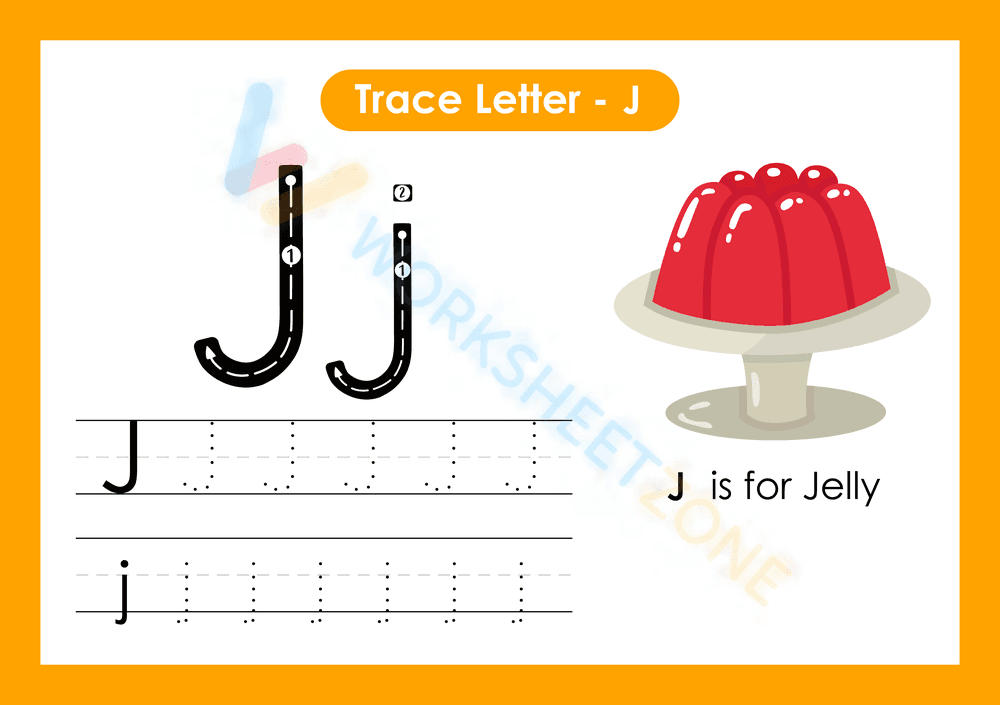

Printable Letter J Tracing Worksheet for Kindergarten
Paste this activity's link or code into your existing LMS (Google Classroom, Canvas, Teams, Schoology, Moodle, etc.).
Students can open and work on the activity right away, with no student login required.
You'll still be able to track student progress and results from your teacher account.
This printable letter J tracing worksheet helps early learners master uppercase and lowercase letter formation while reinforcing phonics. Students trace the letters and associate the letter J with the beginning sound of "jelly." This resource builds handwriting muscle memory and print awareness.
At a Glance
- Grade: Kindergarten · Subject: English Language Arts
- Standard:
CCSS.ELA-LITERACY.RF.K.1.D— Recognize and name lowercase and uppercase letters of the alphabet- Skill Focus: Letter J formation and beginning sound association
- Format: 1 page · 12 tracing tasks · No answer key required · PDF
- Best For: Morning work and independent handwriting practice
- Time: 10–15 minutes
This single-page PDF contains structured handwriting practice for the letter J. It features large stroke-order diagrams for both uppercase J and lowercase j, complete with numbered directional arrows to guide young writers. Below the diagrams, students practice tracing 6 uppercase and 6 lowercase letters on primary writing lines. A colorful illustration of jelly reinforces the beginning sound association.
Zero-Prep Workflow
Implement this worksheet with this simple three-step process:
- Print (1 minute): Print the single-page PDF. Make copies or laminate a set for reusable dry-erase practice.
- Distribute (1 minute): Hand out the sheets with pencils. No additional setup is required.
- Review (5 minutes): Observe grip and stroke direction as students trace, providing immediate feedback.
Total teacher prep time is under 2 minutes, making this ideal for sub plans.
Standards Alignment
This worksheet aligns directly with the Common Core State Standard CCSS.ELA-LITERACY.RF.K.1.D, which requires students to recognize and write upper- and lowercase letters. By connecting the letter shape to the word "jelly," it also supports early phonics development. Both standard codes can be copied directly into lesson plans, IEP goals, or district curriculum mapping tools.
How to Use It
Use this worksheet during your phonics block after direct instruction on the letter J. Introduce the letter sound, point to the jelly illustration, and model stroke order. Students then complete the tracing tasks independently. Alternatively, place this sheet in a literacy center inside a plastic sleeve for write-and-wipe practice. During the activity, observe if students start strokes from the top line to assess fine motor progression. Expect completion within 10 to 15 minutes.
Who It's For
This resource is designed for kindergarten students learning letter formation, but it also serves as excellent intervention material for first-grade students struggling with handwriting. Pair this worksheet with a letter J read-aloud book or an anchor chart displaying common J words to deepen phonics connections and support diverse learners.
Early childhood handwriting instruction directly impacts later reading and writing fluency. According to research from Fisher & Frey (2014) on the gradual release of responsibility, structured tracing activities provide the necessary scaffolding for novice writers to transition from guided imitation to independent letter production. This worksheet targets CCSS.ELA-LITERACY.RF.K.1.D by offering clear visual cues, including numbered arrows and dotted guidelines, which reduce cognitive load during fine motor tasks. By pairing letter formation with the beginning sound of "jelly," the activity reinforces phonemic awareness alongside orthographic mapping. Educators can confidently integrate this tool into daily phonics routines, knowing that repetitive, guided motor practice builds the neural pathways required for automatic letter recognition. This automaticity ultimately frees up cognitive resources for higher-level composition and comprehension tasks in later grades.


