


























Views
Downloads
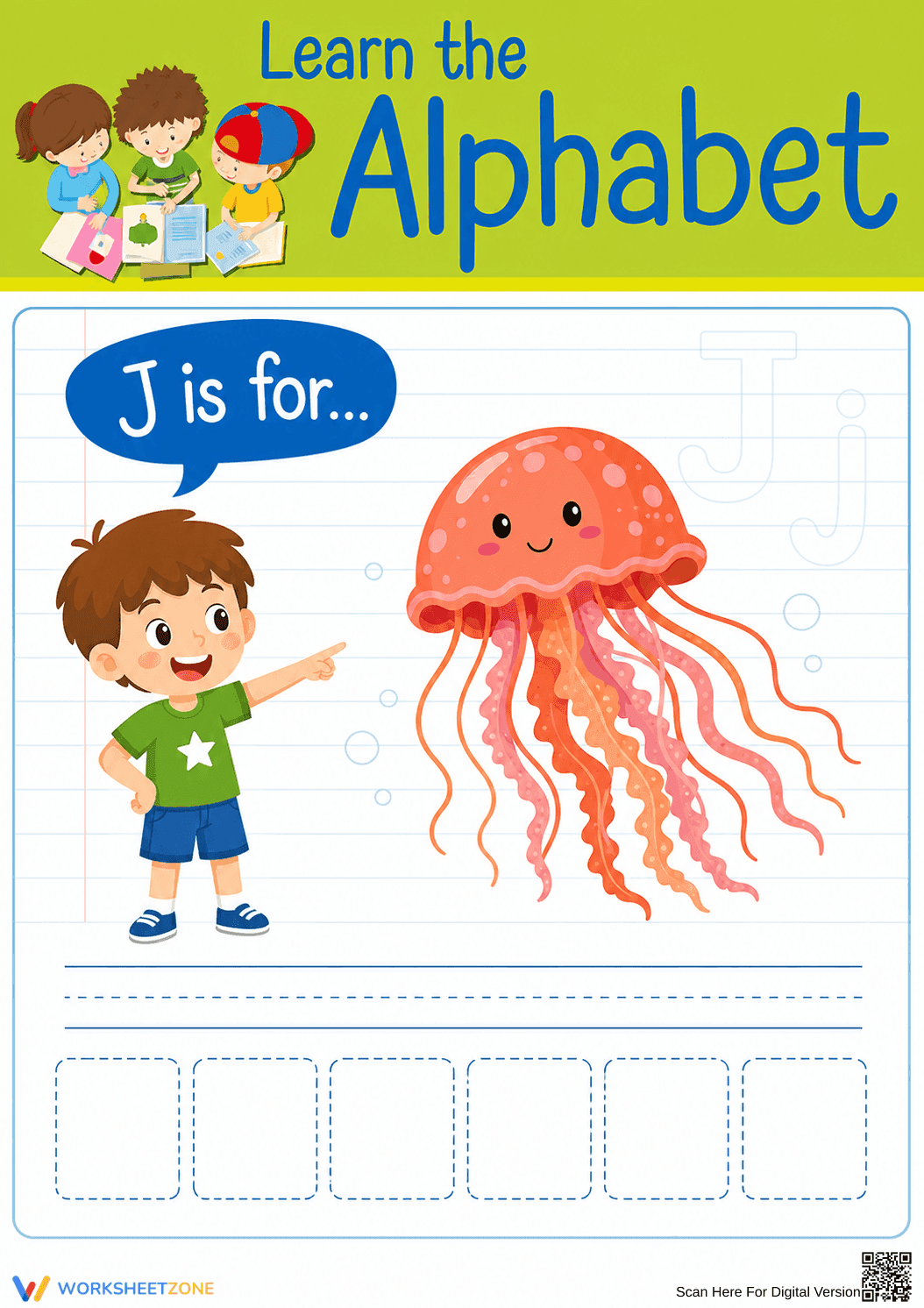

Letter J Beginning Sound Worksheet | Printable Grade K ELA
Paste this activity's link or code into your existing LMS (Google Classroom, Canvas, Teams, Schoology, Moodle, etc.).
Students can open and work on the activity right away, with no student login required.
You'll still be able to track student progress and results from your teacher account.
This printable phonics worksheet helps early learners master the letter J beginning sound by connecting visual cues with letter formation. Students practice identifying the initial sound of familiar words, tracing uppercase and lowercase letters, and writing independently to build foundational reading and spelling skills.
At a Glance
- Grade: K · Subject: ELA
- Standard:
CCSS.ELA-LITERACY.RF.K.3.A— Produce primary sounds for consonants- Skill Focus: Letter J Beginning Sound
- Format: 1 page · 3 activities · No answer key · PDF
- Best For: Morning work or literacy centers
- Time: 10–15 minutes
This single-page resource features a vibrant illustration of a jellyfish to anchor the letter-sound connection. The page includes a guided tracing section for both uppercase and lowercase J, a primary handwriting line for independent letter formation, and five blank boxes designed for spelling practice or cut-and-paste letter matching. The clear, uncluttered layout ensures young students can focus entirely on the phonics task without visual distraction.
Zero-Prep Workflow
Designed for immediate classroom implementation:
- Print (1 minute): Generate the PDF and print a class set directly from your computer.
- Distribute (1 minute): Hand out the pages along with pencils and crayons. The self-explanatory layout means students can begin working almost immediately.
- Review (3 minutes): Quickly circulate to check letter formation and sound association.
With under two minutes of total teacher prep time, this resource is an excellent addition to any emergency sub plan or last-minute literacy center rotation.
Standards Alignment
This phonics activity is directly aligned to CCSS.ELA-LITERACY.RF.K.3.A, which requires students to demonstrate basic knowledge of one-to-one letter-sound correspondences by producing the primary sound or many of the most frequent sounds for each consonant. By linking the visual of the jellyfish to the written letter J, students reinforce this critical decoding skill. Both standard codes can be copied directly into lesson plans, IEP goals, or district curriculum mapping tools.
How to Use It
Use this worksheet during morning work to activate alphabet knowledge before formal instruction. It also functions perfectly as an independent station during literacy centers. As a formative assessment tip, observe students while they trace the letters; watch for proper pencil grip and correct top-to-bottom stroke order. The entire activity has an expected completion time range of 10 to 15 minutes, making it a highly efficient tool for daily phonics practice.
Who It's For
This resource is primarily designed for Kindergarten students developing early literacy skills, though it serves as an effective intervention tool for first-grade students who need additional phonics reinforcement. For differentiation, teachers can provide letter tiles for students struggling with handwriting to place in the blank boxes. This worksheet pairs naturally with an alphabet anchor chart or a direct instruction lesson on consonant sounds.
Mastering the letter J beginning sound is a critical step in early phonics development. According to an EdReports 2024 analysis, explicit instruction in letter-sound correspondence, such as the skills in CCSS.ELA-LITERACY.RF.K.3.A, accelerates decoding proficiency. When students practice producing primary sounds for consonants alongside visual anchors and handwriting exercises, they build stronger neural pathways for reading. This printable worksheet integrates these evidence-based strategies by combining visual vocabulary, guided tracing, and independent writing into a single, focused activity. Isolating the initial phoneme and providing immediate writing application ensures young learners develop automaticity for fluent reading, reducing cognitive load during later tasks.


