


























Views
Downloads
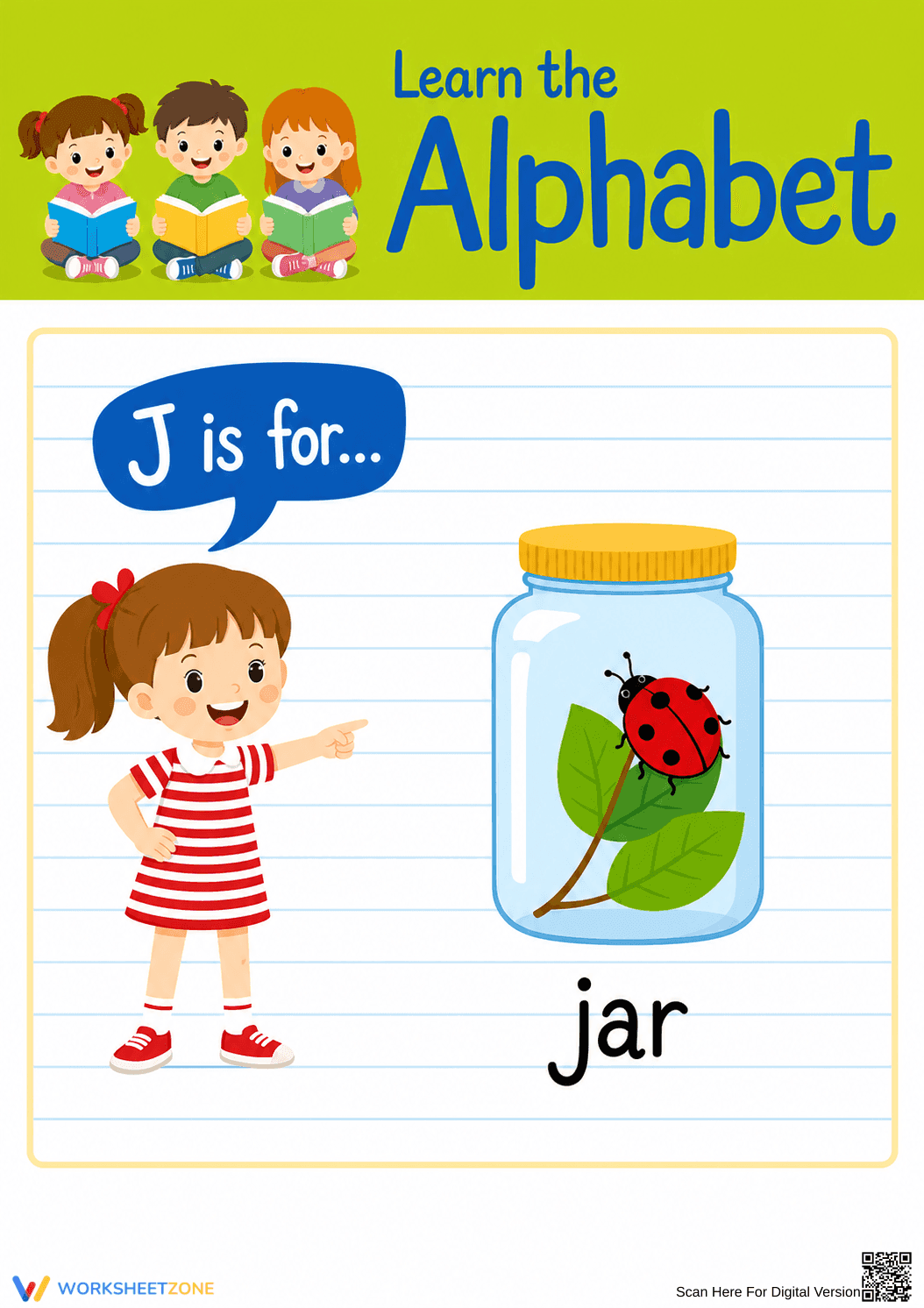

Letter J Beginning Sound — Printable No-Prep Worksheet
Paste this activity's link or code into your existing LMS (Google Classroom, Canvas, Teams, Schoology, Moodle, etc.).
Students can open and work on the activity right away, with no student login required.
You'll still be able to track student progress and results from your teacher account.
This Grade K beginning sound worksheet helps students master the letter J through clear visual identification and phonemic awareness. By connecting the letter J to the word "jar," learners build the foundational skills necessary for early reading success. This resource provides a direct, engaging way to introduce initial consonant sounds in any primary classroom.
At a Glance
- Grade: Kindergarten · Subject: ELA
- Standard:
CCSS.ELA-LITERACY.RF.K.3.A— Demonstrate basic knowledge of one-to-one letter-sound correspondences for each consonant- Skill Focus: Letter J Beginning Sound
- Format: 1 page · 1 task · Answer key included · PDF
- Best For: Initial phonics introduction and visual anchoring
- Time: 5–10 minutes
This single-page PDF features a high-quality illustration of a jar to reinforce the "j" sound. The layout includes the uppercase "J" in a speech bubble and the lowercase word "jar" at the bottom. The clean design serves as both a student handout and a classroom anchor chart, ensuring the phonemic connection is visible and memorable for young learners.
The zero-prep workflow is designed for maximum efficiency. First, print the single-page PDF (30 seconds). Second, distribute the sheet to students during your morning meeting or phonics block (1 minute). Third, review the sound and image together as a whole group (2 minutes). Total teacher preparation time is under 2 minutes, making it an ideal sub-plan addition or quick warm-up activity.
This resource is aligned to `CCSS.ELA-LITERACY.RF.K.3.A`, which focuses on the one-to-one correspondence between letters and their primary consonant sounds. By isolating the letter J, students practice the specific phoneme /j/ in a controlled context. Both standard codes can be copied directly into lesson plans, IEP goals, or district curriculum mapping tools.
Use this worksheet during the introduction phase of a direct instruction lesson on the alphabet. It serves as a perfect visual prompt for a "Think-Pair-Share" activity where students brainstorm other words starting with J. As a formative assessment, observe if students can independently produce the /j/ sound when pointing to the jar image. It can also be used as a coloring page for fine motor practice.
This worksheet is designed for Kindergarten students, though it provides excellent remedial support for Grade 1 learners. It is particularly effective for English Language Learners who benefit from the clear picture-to-word association. Pair this resource with a physical jar or a letter J alphabet song to create a multi-sensory learning experience that caters to diverse learning styles.
Research from Fisher & Frey (2014) emphasizes the importance of visual anchors in the gradual release of responsibility model, particularly for early literacy. By providing a clear, singular focus on the letter J and its corresponding phoneme /j/, this worksheet reduces cognitive load for novice readers. The use of high-frequency vocabulary like "jar" ensures that students are building on familiar concepts while acquiring new phonemic knowledge. According to the RAND AIRS 2024 report, consistent exposure to letter-sound relationships in the early grades is a primary predictor of later reading fluency. This resource provides the necessary repetition and clarity required for students to achieve mastery of CCSS.ELA-LITERACY.RF.K.3.A. By integrating this printable into a daily phonics routine, educators can ensure that every student develops a robust understanding of the alphabet's foundational components.


